Label
The kraken is a legendary sea monster of enormous size said to appear off the coasts of Norway.
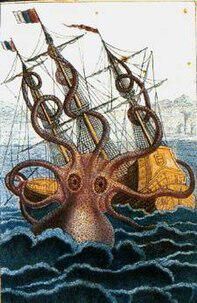
Kraken, the subject of sailors' superstitions and mythos, was first described in the modern age at the turn of the 18th century, first in a travelogue by Francesco Negri in 1700, followed in 1734 by an account from Dano-Norwegian missionary and explorer Hans Egede, who described the kraken in detail and equated it with the hafgufa of medieval lore. However, the first description of the creature is usually credited to the Norwegian bishop Pontoppidan (1753). Pontoppidan was the first to describe the kraken as an octopus (polypus) of tremendous size,[b] and wrote that it had a reputation of pulling down ships, but the French malacologist Denys-Montfort of the 19th century is better known for these.
The great man-killing octopus entered French fiction when novelist Victor Hugo (1866) introduced the pieuvre octopus of Guernsey lore, which he identified with the kraken of legend, and this led to Jules Verne's depiction of the kraken, which he did not really distinguish between squid or octopus.
The legend may have indeed originated from sightings of giant squid, which may grow to 13–15 meters (40–50 feet) in length.
If Linnaeus wrote on the kraken, he only did so indirectly. Linnaeus had published on the Microcosmus genus (an animal with various other organisms or growths attached to it, comprising a colony). And these, including Bartholin's cetus called hafgufa, and Paullini's monstrous marinum. These have been referred to as "krakens" by subsequent authors. The claim that Linnaeus printed the vernacular name "kraken" in the margin of a later edition of Systema Naturae fails to be confirmed, and another claim that he published on the cephalopod species Sepia microcosmus - Wikipedia