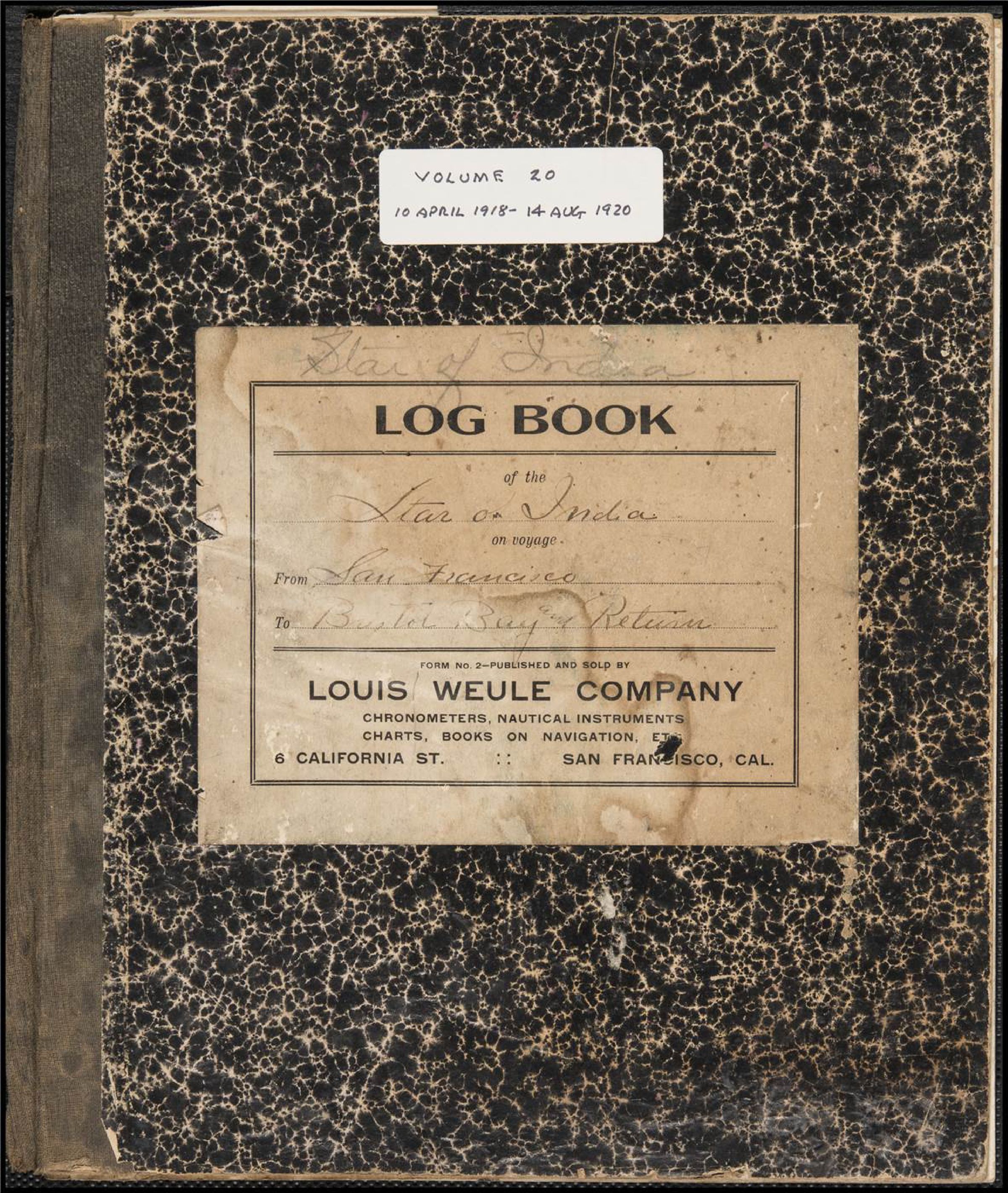
Name/Title
Title on Binding: Log Book Star of India, Volume 20, 10 Apr. 1918 -- 14 Aug. 1920 Title on Official Log: Log of the Star of India, dated 1918, April 10 through 1920, August 14Entry/Object ID
A0245.1.18Scope and Content
One volume of the Star of India vessel log prepared by Captain Marzan, 1st Mate C. J. Carlson, 1st Mate John Troudsen, Captain Weidemann and 1st Mate Thomas Koskinen (190 pages), includes handwritten entries on a daily basis. Entries begin on April 10, 1918 and end on August 14, 1920.
Log Entry Summary: On April 10, 1918, Star of India is taken in tow by the tugboat Sea Prince and leaves San Francisco, California bound for Bristol Bay, Alaska. On April 18, 1918, approximately 800 miles west of San Francisco cannery worker Ricardo Ramirez attempts to commit suicide by cutting his throat with a razor. An unknown crew member (probably the 1st Mate Carlson) stitches and dresses the wound and Ramirez receives the best possible ship board care. On April 20, 1918 Ramirez becomes violent and tears the bandage off his throat and opens the wound causing extreme bleeding. Ramirez receives treatment for the second time, a crew member ties him down and watches him to prevent further injury.
On May 8, 1918 the crew sights Tilgarda Island as the Star of India approaches Unimak Pass. On May 9 and 10, 1918 the crew sights Ugamak Island, Scotch Cap and Cape Sarichef as Star of India moves through the Unimak Pass and into the Bering Sea. On May 13, 1918, Star of India encounters numerous ice flows just north of Port Moller on the Alaska Peninsula. By late evening the crew sights Port Heiden and the ship continues to dodge ice flows as it sails north. May 17 through 27, 1918 ice flows surround the Star of India and trap the ship near Cape Greig. The Star of India drifts with the ice flow between Cape Greig and Cape Menshikof as the crew takes depth soundings and collects fresh water from the ice.
On May 28, 1918, in the early morning hours Star of India breaks free of the drift ice and sails into open water. By late evening, Star of India arrives in Bristol Bay, Alaska and anchors near Johnston Hill about 5 miles offshore and south of the Naknek River.
On May 30, 1918 the crew signals the steamer Kvichak to come alongside and bring a doctor to treat a mentally unstable individual of Japanese descent. On May 31, 1918, Star of India is taken in tow by the steamer Nushagak to clear the ice flows and anchors at Naknek, a small town near the mouth of the Naknek River. On June 5, 1918, Star of India is taken in tow by the steamer Nushagak and moves to an anchorage at Clark's Point on the Nushagak River. On June 6, 1918, Star of India is taken in tow by the steamer Nushagak and moves up river and anchors at the P.H.J. Cannery. The fishermen and cannery workers go ashore. June 7 through 13, 1918 the crew unloads the livestock and cannery supplies onto lighters for transport ashore and securely moors the ship at the P.H.J. Cannery. On June 14, 1918 all hands go ashore. The log ends with no further entries for this voyage.
The log entries begin again on August 7, 1918. The Star of India is at the P.H.J. Cannery and a ship gang comes abroad and prepares the holds for cargo. August 8 through 26, 1918 the crew cleans the ship, loads 15 tons of coal, all the ship stores, fresh water, thousands of cases of salmon, cannery machines and various freight and prepares the sails and rigging for the upcoming voyage. On August 27, 1918 the fishermen return to the ship. The Star of India is taken in tow by the steamer Nushagak and moves to an anchorage at Clark's Point. On August 28, 1918, Star of India is taken in tow by the steamer Nushagak and leaves Nushagak, Alaska bound for San Francisco, California.
On August 30, 1918 the crew sights Cape Seniavin, south of Port Heiden as the Star of India sails south down the Alaska Peninsula. On September 3, 1918 the crew sights Scotch Cap lighthouse as the Star of India moves through Unimak Pass and into the North Pacific Ocean. On September 17, 1918 the crew sights Point Reyes off the California coast. On September 19, 1918, Star of India is taken in tow by the tugboat Intrepid and arrives in San Francisco, California and anchors off Black Point, near Fort Mason. The Naval Guard and Customs Officer arrive onboard and the crew goes ashore. On September 20, 1918, Star of India is taken in tow by the tugboat Sea Prince and moves to an anchorage at Mission Flats. The log ends with no further entries for this voyage.
The log entries begin again on April 8, 1919. The Star of India is in tow of the tugboat Reliance and moves to Pier 28 in San Francisco Bay. April 9 through 14, 1919 stevedores load cargo and prepare the vessel for the upcoming voyage. The Chinese gang and fishermen come aboard. On April 15, 1919, Star of India is taken in tow by the tugboat Intrepid and leaves San Francisco, California bound for Bristol Bay, Nushagak, Alaska.
The crew sights Point Reyes, Point Bonita and the Farallon Bar in the early afternoon as Star of India sails west into the Pacific Ocean. On April 16, 1919 the crew sights Point Montara approximately 25 miles south of San Francisco. On May 10, 1919 the crew sights Ugamak and Kaligagan Islands as the Star of India approaches the entrance to Unimak Pass. On May 11, 1919 the crew sights Scotch Cap and Cape Sarichef as the Star of India moves through the Pass and into the Bering Sea. In late afternoon the crew sights Cape Mordvinof on the northwest side of Unimak Island. On May 12, 1919 the crew sights Amak Island about 10 miles off the coast as the Star of India sails north along the Alaska Peninsula.
On May 14, 1919, Star of India arrives in Nushagak Bay and anchors off Cape Constantine. On May 17 and 18, 1919, Star of India sails toward the entrance to the Nushagak River. The ship encounters a strong gale and anchors at Protection Point on the eastern side of Cape Constantine. On May 19 and 20, 1919 the crew sights the steamer Nushagak and the Star of Finland as the vessels move up the river. On May 22, 1919, Star of India is taken in tow by the steamer Nushagak and travels up the Nushagak River and anchors at Clark's Point. The crew stows the sails and prepares the cargo gear. By late evening, Star of India is taken in tow by the steamer Nushagak and continues up river towards P.H.J. Cannery. The Star of India runs aground on a flat and the force of striking bottom breaks two stanchions. Within the hour the vessel is free and anchors at the P.H.J. Cannery.
On May 23, 1919 several fishermen go ashore, the crew cleans the vessel and prepares the cargo for discharge. May 24 through June 2, 1919 the Chinese leave the ship for the cannery. The crew unloads all cargo, cleans the ship and goes ashore. The log ends with no further entries.
The log entries begin again on August 1, 1919. The Star of India is at the P.H.J. Cannery and a ship gang comes aboard. August 2 through 14, 1919 the men rig the cargo gear and load 10 tons of coal, 22 gas drums, sheets of tin, thousands of cases of salmon and all the ship stores. The rest of the crew comes onboard.
On August 15, 1919 the fishermen come onboard, the crew fills the fresh water tanks and the Star of India is taken in tow by the steamer Nushagak and leaves Nushagak, Alaska bound for San Francisco, California. By evening the crew sights Nichols Hill and Etolin Point as the Star of India leaves Nushagak Bay.
On August 19, 1919 the crew sights Cape Mordvinof and the schooner Prosper as the Star of India approaches the entrance to Unimak Pass. On August 20, 1919 the crew sights Pogromni and Shishaldin volcanic peaks on Unimak Island. August 21 through 25, 1919 the crew sights Cape Sarichef, Scotch Cape, Scotch Cape lighthouse and Ugamak and Tigalda Islands as the Star of India moves through Unimak Pass and enters the North Pacific Ocean.
On September 8, 1919 the crew sights Farallon lighthouse and Point Reyes off the coast of California. The Star of India is taken in tow by tugboat Sea Lark and arrives in San Francisco, California and moors at Pier 54. September 9 through 12, 1919 the stevedores come aboard, rig the cargo gear and unload the cargo. By midday the Star of India is taken in tow by the tugboat Sea Lark and moves to the Alaska Packers Association yard. The log ends with no further entries.
The log entries begin again on February 11 and 12, 1920. The Star of India is in the Alaska Packers Association Alameda yard undergoing a vessel survey. Mr. Larson, survey inspector examines the vessel decks, holds and bilges and finds the ship to be in good condition.
February 27 through March 1, 1920, Star of India is in tow by the tugboat Restless and leaves the Alaska Packers Association yard and moves to dry-dock. The dry-dock gang cleans, scrapes and paints the vessel bottom using 38 gallons of N1 International paint. On March 2, 1920, Star of India is taken in tow by the tugboats Sea Lark and Sea Fox and transfers to the shipyard to complete work on the vessel. On April 15, 1920, Star of India is taken in tow by the tugboat Sea Prince and moves to Pier 54 and moors at the wharf. The stevedores come aboard and rig the cargo gear. April 15 through 19, 1920 the stevedores load cargo, 1st Mate Thomas Koskinen and the cooks and helpers arrive and the stevedores leave the ship.
On April 20, 1920, Star of India is taken in tow by an unknown tugboat and moves into the stream. The crew prepares the vessel for the upcoming voyage. April 21 through May 4, 1920 the 2nd and 3rd Mates come aboard, cannery hands arrive, Chinese and Mexicans come aboard, the water boat comes alongside and fills the fresh water tanks and longshoremen load the fresh meat and vegetables.
On May 5, 1920, Star of India is taken in tow by the steamer Nushagak and leaves San Francisco, California bound for Nushagak, Alaska. The crew sights Point Bonita and Point Reyes as the Star of India sails west into the Pacific Ocean. On May 8, 1920 the crew sights the schooner Henrietta about 200 miles off the California coast. On May 10, 1920 seaman and fisherman Burger Thorstensen hoists the forward gallant sail just as a line and block tear away striking him across the knee and shin. The blow to his leg causes a severe laceration and bruise, an unknown crewman cleans and dresses the wound.
On May 21 and 22, 1920 the crew sights Scotch Cap lighthouse and Cape Sarichef as the Star of India moves through Unimak Pass and into the Bering Sea. The steamer Nushagak releases the tow cable just north of Unimak Island and Star of India continues under sail (Star of India is in tow by the steamer Nushagak for 18 days). On May 25, 1920 the crew sights Cape Greig and Star of India anchors near Kvichak Bay about 20 miles west of Egegik, Alaska.
On May 28 and 29, 1920, Star of India is taken in tow by the steamer Nushagak and arrives in Nushagak Bay, Alaska and anchors in the bay. By late evening, Star of India moves up the Nushagak River and anchors at the P.H.J. Cannery. On May 30, 1920 the fishermen, trap men, beach men and Chinese go ashore to the cannery. May 31 through June 7, 1920 the crew unloads cargo onto lighter, cleans the vessel and several fishermen transfer to Clark's Cannery. The log ends with no further entries.
The log entries begin again on August 3, 1920. The Star of India is in Nushagak, Alaska at the P.H.J. Cannery. August 3 through 15, 1920 the crew unloads 100 tons of salt onto lighters, cleans the vessel holds, loads thousands of cases of salmon and the rest of crew comes onboard. On August 16, 1920, Star of India is taken in tow by the steamer Nushagak and leaves Nushagak, Alaska bound for San Francisco, California. The log ends with no further entries for this voyage.
The volume has no unused pages at the end of the document.Collection
Euterpe - Star of India Logbook CollectionLexicon
Nomenclature 4.0
Nomenclature Secondary Object Term
Log, Ship'sNomenclature Primary Object Term
LogNomenclature Sub-Class
Other DocumentsNomenclature Class
Documentary ObjectsNomenclature Category
Category 08: Communication ObjectsArchive Details
Date(s) of Creation
1918 - 1920