Name/Title
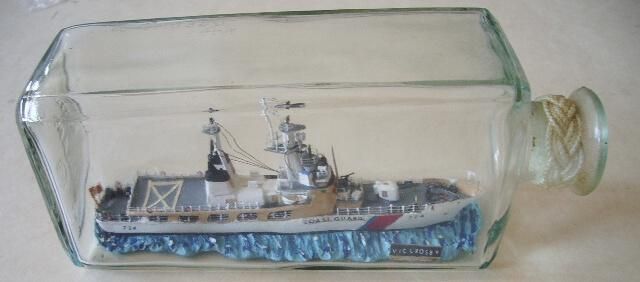
U.S.C.G.C. MUNRO (WHEC 724) C.G.Cutter SHIP-IN-A-BOTTLEEntry/Object ID
1990.164.001Description
U.S.C.G.C. Munro (Whec 724) C.G.Cutter Ship-In-Bottle
Cr: Incomplete (Cork Missing)/Good, 1978
See Stipulation with 90.107
Coast Guard Ship, White, #724. Braid Trim Around Bottle Neck.
on September 27, 1942, Coast Guard Signalman First Class Douglas A. Munro Was in Charge of a Landing Craft While Evacuating 500 Besieged Marines From the Beaches of Guadalcanal. Near the Completion of the Mission, the Few Marines Remaining on the Beach Were Pinned Down By Japanese Gunfire. Munro Used His Boat To Cover the Marine Withdrawal. Realizing That the Men Were in Great Danger, Munro Placed His Vessel Between the Beachhead and the Enemy, Drawing Japanese Fire and Protecting the Men Until They Could Be Taken Aboard. Minutes After the Last Marine Was Safe Munro Was Fatally Wounded, But His Wounded Crew Carried on Until the Last Boat Had Landed and Cleared the Beach.
in Recognition For Extraordinary Bravery in the Line of Duty, Douglas A. Munro Became the First, and Only, Coast Guardsman To Receive the Medal of Honor. the Coast Guard Cutter Munro Is Named in His Honor. Douglas Munro Was Born in Cle Elum, Washington and Graduated From Cle Elum High School in 1937. He Attended Central Washington University Before Enlisting in the Coast Guard in 1939. Munro Was Buried in the City of South Cle Elum, Washington and Now Rests Between His Parents in the Veterans' Section of the Cemetery of His Home Town.
douglas Munro’s Citation For the Medal of Honor
munro, Douglas Albert
rank and Organization: Signalman First Class, U.S. Coast Guard
born: 11 October 1919, Vancouver, British Columbia. Accredited To Washington.
citation: For Extraordinary Heroism and Conspicuous Gallantry Action Above and Beyond the Call of Duty As Petty Officer in Charge of a Group of 24 Higgins Boats, Engaged in the Evacuation of a Battalion of Marines Trapped By Enemy Japanese Forces At Point Cruz Guadalcanal, on 27 September 1942. After Making Preliminary Plans For the Evacuation of Nearly 500 Beleaguered Marines, Munro, Under Constant Strafing By Enemy Machineguns on the Island, and At Great Risk of His Life, Daringly Led 5 of His Small Craft Toward the Shore. As He Closed the Beach, He Signaled the Others To Land, and Then in Order To Draw the Enemy's Fire and Protect the Heavily Loaded Boats, He Valiantly Placed His Craft with Its 2 Small Guns As a Shield Between the Beachhead and the Japanese. When the Perilous Task of Evacuation Was Nearly Completed, Munro Was Instantly Killed By Enemy Fire, But His Crew, 2 of Whom Were Wounded, Carried on Until the Last Boat Had Loaded and Cleared the Beach. By His Outstanding Leadership, Expert Planning, and Dauntless Devotion To Duty, He and His Courageous Comrades Undoubtedly Saved the Lives of Many Who Otherwise Would Have Perished. He Gallantly Gave His Life For His Country.
munro History
the United States Coast Guard Cutter Munro Was Commissioned on September 27, 1971, At Avondale Shipyard in New Orleans, Louisiana. the Tenth of Twelve 378 Foot Cutters, Munro Was the First To Be Named After a Coast Guard Hero - Signalman First Class Douglas Munro. the Previously Commissioned 378's Had Been Named For Former Secretaries of the Treasury, a Tradition That Began in 1830 When a Cutter Was Named For Alexander Hamilton.
secretary of Transportation John A. Volpe and Douglas Munro's Mother, Edith, Were on Hand To Commission the Munro. the Ship's Original Compliment Included 17 Officers and 143 Enlisted Men, Under the Command of the Ship's First Commanding Officer, Captain John T. Rouse (a Full List of Commanding Officers Throughout the Years Is Included Below).
the Dedication of the Ship Took Place on April 15, 1972, At Munro's First Homeport of Boston, Massachusetts. Secretary Volpe Was Once Again on Hand, Retelling the Story of Douglas Munro and Reminding the Crew of the Honor They Had To Bear the Name of That Hero. While Operating Out of Boston, the Ship's Original Missions Included Ocean Station Patrol and Search and Rescue.
the Stay in Boston Was Not To Last Long, However, As the Munro Shifted To a New Homeport of Seattle, Washington, on August 29, 1973. the Seattle Post Intelligencer Hailed the Arrival of "Two (Munro and Boutwell) of the Newest, Finest Ships in the Coast Guard Fleet." Seattle Was Also Especially Receptive To the Munro Because Douglas Munro Himself Had Been a Resident of Cle Elum, a Small Town in Washington State. While Operating Out of Seattle, the Munro Became More Active in the Fisheries Enforcement Mission and Less Active in the Ocean Station Mission, Which Was Quickly Being Made Obsolete By Technological Advances. Alaskan Fisheries Were Especially Busy and Controversial At This Time. in 1971, For Instance, the Combined Japanese, Russian, Canadian, and South Korean Fishing Fleets Had Caught About Ten Times As Many Fish As the U.S. Fleet Did. Coast Guard Action Was Badly Needed To Regulate the Practices of These Foreign Fleets. Munro Performed This Mission Admirably and with Many Successes, Including the Seizure of the Korean Longliner Dong Won No. 51 in June of 1979.
in 1981, the Ship Moved To Yet Another New Homeport: Honolulu, Hawaii. in 1986, Munro Interdicted the Motor Vessel Line Island Trader, Which Had Been Attempting To Enter the U.S. with 4.5 Tons of Marijuana. Later That Same Year, the Ship Underwent an Extensive Three-Year Fleet Renovation and Modernization (Fram) Program. Weapons Systems Were Upgraded and Many Portions of the Cutter Were Remodeled. Upon Being Re-Commissioned in November 1989, Munro Moved To Her Current Homeport At Coast Guard Island in Alameda, California
in the Twelve Years Since Renovation, Munro Has Maintained the Highest Level of Mission Performance. in 1997 the Cutter Seized the Russian Fishing Trawler Chernyayevo in the Bering Sea For Violation of the Magnuson/Stevens Fisheries Conservation and Management Act, Setting an Important Precedent For Law Enforcement Along the U.S./Russia Maritime Boundary. in 1998, Munro Intercepted the Chinese Vessel Chih Yung, Carrying 172 Undocumented Migrants Attempting To Illegally Enter the U.S. in 1999 the Cutter Interdicted the Fishing Vessel Eduardo I, Carrying 83 Undocumented Ecuadorian Migrants. Also in 1998, Munro Interdicted the Mexican Vessel Xolesuientle, Seizing 11.5 Tons of Cocaine, One of the Largest Drug Seizures in Coast Guard History. in 1999 the Cutter Seized the Motor Vessel Wing Fung Lung, Carrying 259 Illegal Chinese Migrants.
today, Over Thirty Years After Their Ship Was Commissioned, Munro's Crew Continues To Accomplish Its Missions and Maintain an Aging Ship, Proud To Carry the Name of a Hero As They Serve Their Country.
list of Uscgc Munro's Commanding Officers
• capt John T. Rouse Sep 71 - Sep 73
• capt Howard Istock Sep 73 - Aug 75
• capt Robert Hackney Aug 75 - May 77
• capt Alan C. Dempsey May 77 - Jun 79
• capt Richard E. Sardeson Jun 79 - Aug 80
• capt Michael J. O'Brien Aug 80 - Jun 81
• capt Michael B. Dunn Jun 81 - Jul 83
• capt John L. Linnon Jul 83 - Jul 85
• capt Galen R. Siddell Jul 85 - Dec 86
• decommissioned For Fram Dec 86 - Nov 89
• capt Fred L. Ames Nov 89 - Jul 90
• capt Robert E. Gronberg Jul 90 - Aug 92
• capt Paul J. Bibeau Aug 92 - Sep 94
• capt J. J. Hathaway Sep 94 - Jun 96
• capt Dale G. Gabel Jun 96 - Jul 98
• capt Wayne E. Justice Jul 98 - Jun 00
• capt Brian J. O'Keefe Jun 00 - Jul 02
• capt Robert L. Hurst - PresentCollection
Models CollectionMade/Created
Manufacturer
Crosby, VictorLexicon
Nomenclature 4.0
Nomenclature Tertiary Object Term
Bottle, ImpossibleNomenclature Secondary Object Term
ConstructionNomenclature Primary Object Term
SculptureNomenclature Class
ArtNomenclature Category
Category 08: Communication ObjectsSearch Terms
U.S.C.G. Munro (Whec 724)Material
Glass, Wood, Plaster