Name/Title
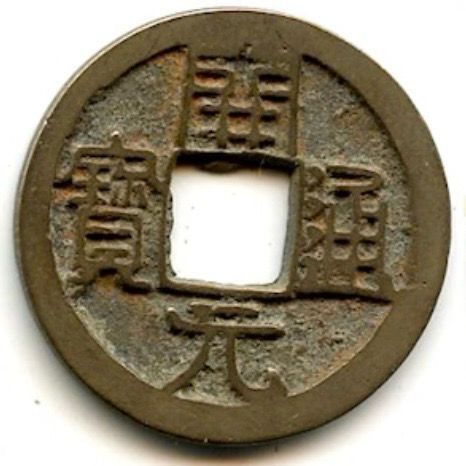
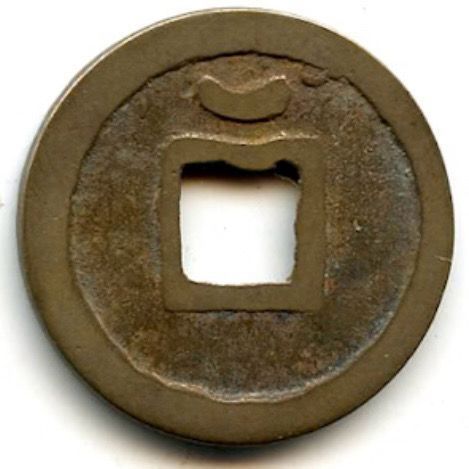
CE 0732 - 0907 Kai Yuan cash w/crescent over hole, late type c.732-907 AD, Tang, China (H#14.8u)Description
Tang Dynasty Kaiyuan Tongbao Cash Coin with Crescent, c. 732–907 CE
China, Tang Dynasty (618–907)
Late Kaiyuan type, c. 732–907 CE
Cast bronze 1-cash coin
Hartill 14.8u
Description
Cast bronze Kaiyuan Tongbao (開元通寶) cash coin of the Tang dynasty, belonging to the late series conventionally dated approximately 732–907 CE. The obverse bears the four-character inscription 開元通寶 (Kaiyuan Tongbao), arranged around a square central hole and read top to bottom and then right to left. The reverse is uninscribed except for a prominent raised crescent positioned above the central hole.
This specimen corresponds to Hartill 14.8u, a late Kaiyuan Tongbao variety distinguished by the characteristic form of 元 (yuan), with a “left shoulder,” and by the crescent above the square hole on the reverse.
Kaiyuan Tongbao coinage was first introduced by the Tang government in 621 CE, shortly after the dynasty’s establishment. Its monetary significance extended far beyond the Tang period. Earlier Chinese coins such as the Ban Liang (“half liang”) and Wu Zhu (“five zhu”) were named according to units of weight. The Kaiyuan Tongbao instead employed tongbao (通寶), conventionally translated as “circulating treasure” or “circulating currency.” Variations on this terminology subsequently became characteristic of Chinese cash inscriptions for centuries.
The round bronze body with a square central hole continued an established Chinese monetary form. Cash coins were cast rather than struck, generally produced in molds in groups and subsequently separated and finished. The central hole also facilitated the stringing of multiple coins together for storage and transactions.
Late Tang Kaiyuan Tongbao occur with numerous reverse marks, including dots and crescents in different positions. The crescent on this specimen has traditionally been described as a “fingernail mark,” and later stories sometimes associated such marks with an empress or other woman of the imperial court pressing a fingernail into a coin model. The historical basis of these stories is uncertain; the crescent is therefore more securely understood as a deliberate variety mark whose precise original significance is unknown.
The Tang dynasty was one of the most influential periods of imperial Chinese history, characterized by extensive long-distance trade, major urban centers, cultural and religious exchange across Central and East Asia, and substantial developments in literature and the arts. The long production history and geographical circulation of Kaiyuan Tongbao coinage made it one of the most recognizable monetary forms associated with the Tang economy.
Obverse: 開元通寶 (Kaiyuan Tongbao), read top to bottom and right to left around a square central hole. Late-style 元 (yuan) with left shoulder.
Reverse: Blank except for a prominent raised crescent above the square central hole; raised inner and outer rims.
Condition: Substantially complete and clearly legible inscription with strong outer and square-hole rims. Prominent and well-preserved reverse crescent. Brown to olive-brown raised surfaces contrast with gray-brown material in portions of the recessed fields. Some previous surface cleaning or conservation is possible but cannot be established from photographs alone.
Reference: Hartill 14.8u.Create Date
August 13, 2026Update Date
August 13, 2026