Name/Title
CE 1557 — Conrad Gessner, Nebelkrähe and Wilde Holtzkrähe (Crows), Hand-Colored Woodcuts from Vogelbuch, First German EditionDescription
Conrad Gessner (1516–1565)
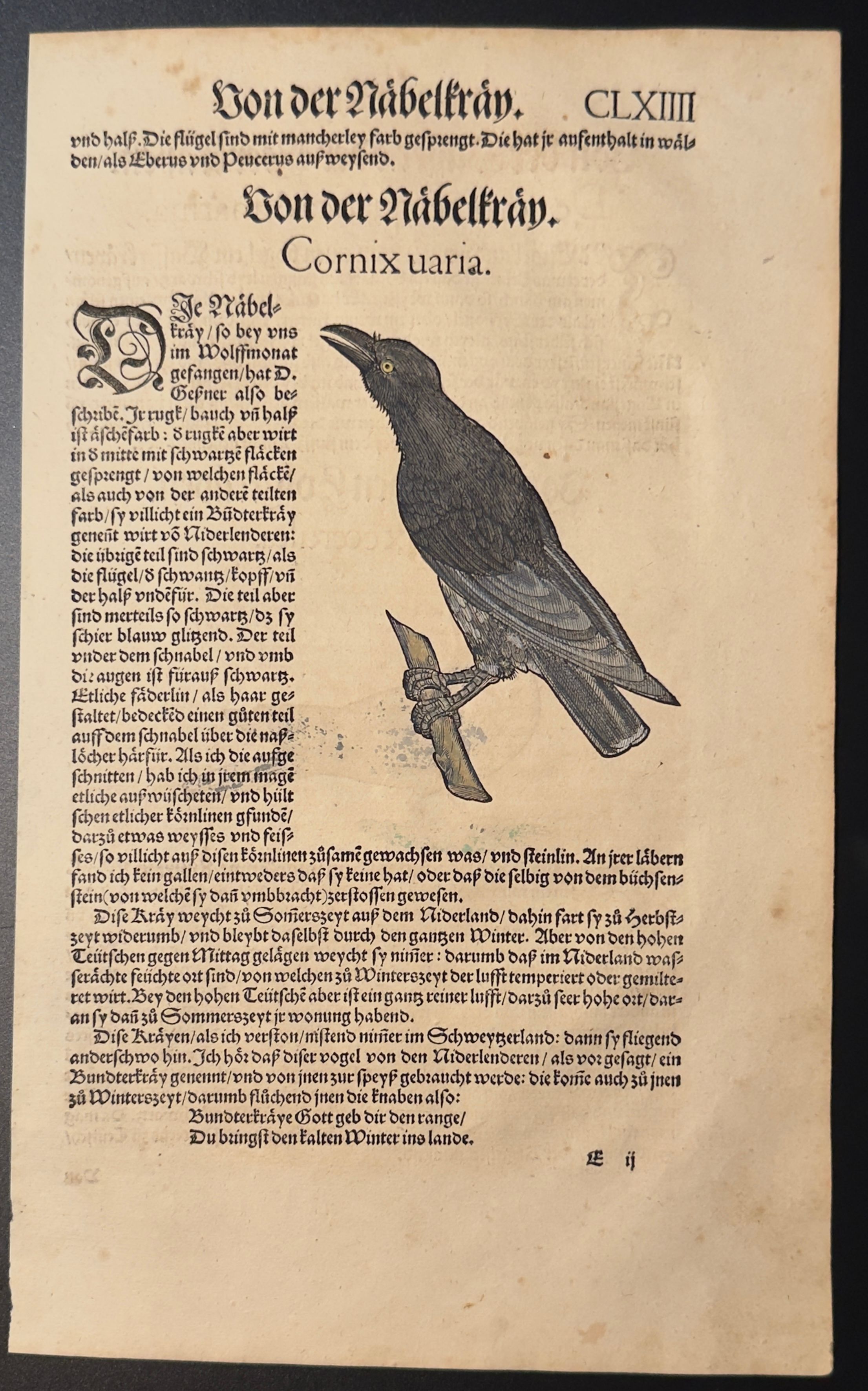
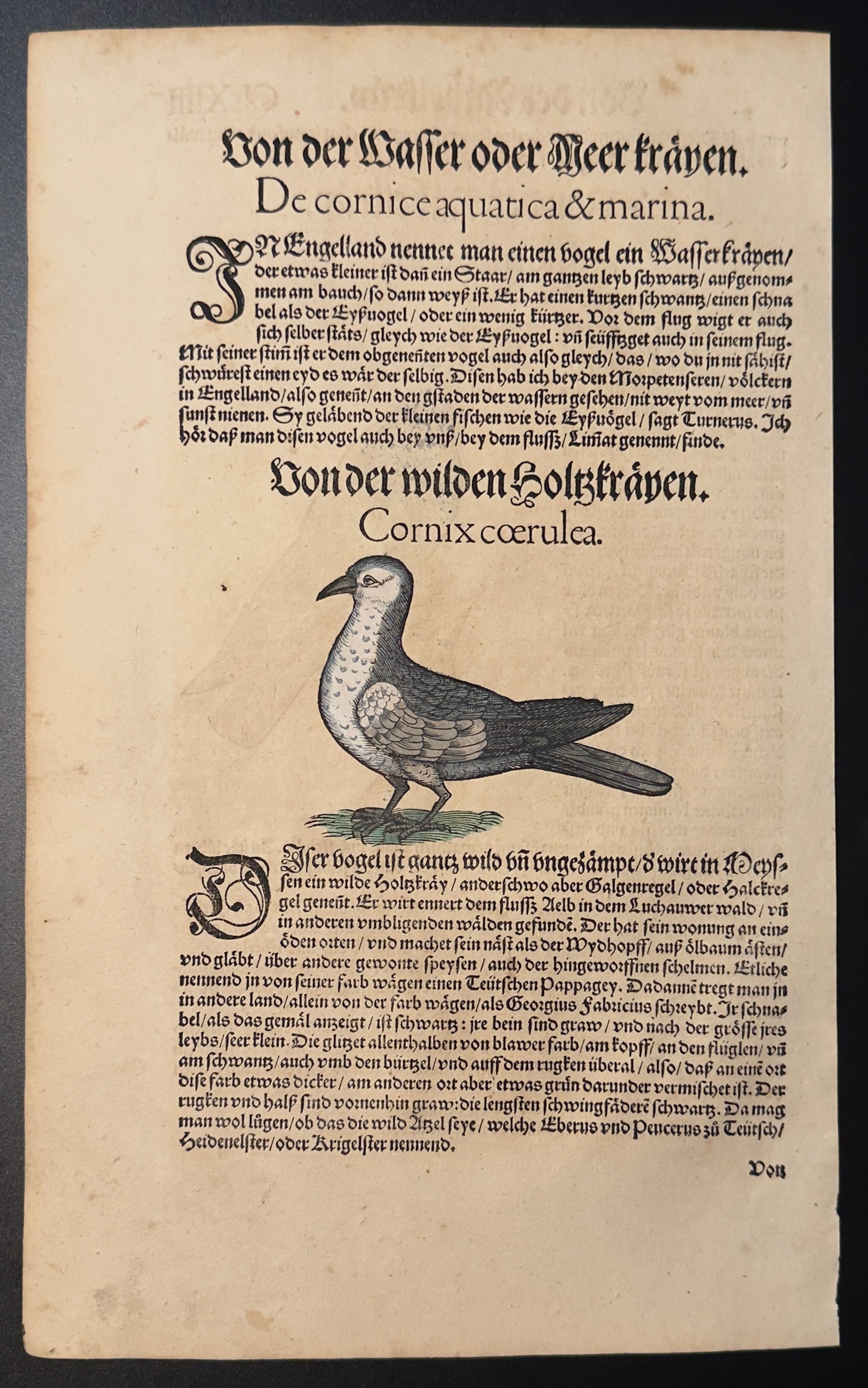
Nebelkrähe (Cornix varia) and Wilde Holtzkrähe (Cornix caerulea)
From Vogelbuch
German translation and adaptation by Rudolf Heusslin
Zürich: Christoph Froschauer, 1557
First German edition
Woodcuts and letterpress on paper with hand coloring
One folio leaf, recto and verso
37.3 × 23.3 cm
This folio leaf comes from the first German edition of Conrad Gessner’s Vogelbuch, published in Zürich in 1557. The work was adapted by Rudolf Heusslin from Book III of Gessner’s Latin Historia animalium, De avium natura (1555), and presented Gessner’s ornithological material to a German-reading audience. The edition contains more than 200 woodcuts illustrating the birds discussed in the text.
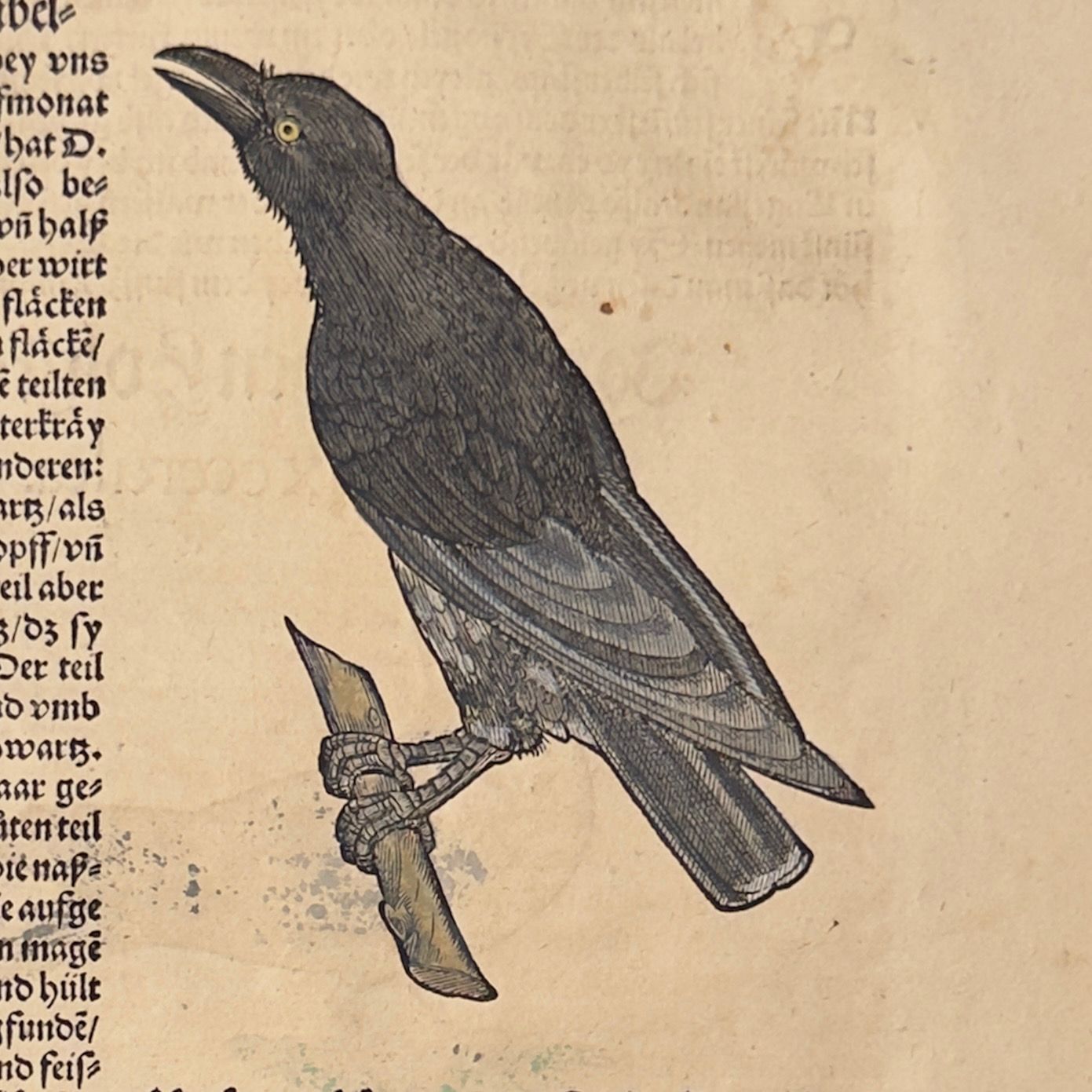
One side is headed “Von der Näbelkräh” and identifies the bird in Latin as Cornix varia. The large woodcut depicts a dark crow perched on a cut branch. Gessner’s accompanying German text discusses its coloration, behavior, seasonal occurrence, and relationships to other crows. The historical name Nebelkrähe is associated with the bird now known as the hooded crow (Corvus cornix), although the identification of an early modern illustration with a modern species should be treated as an interpretation rather than simply substituting modern taxonomy for Gessner’s terminology.
The other side begins with “Von der Wasser oder Meerkrähen” (De cornice aquatica & marina), discussing birds called “water” or “sea crows.” Below this appears a separate entry headed “Von der wilden Holtzkrähen”, identified as Cornix caerulea. Its woodcut depicts a lighter-bodied bird with darker wings and tail. Gessner’s categories were constructed from physical observation together with classical texts, vernacular names, reports from correspondents, and earlier natural histories. Consequently, his names do not always map cleanly onto modern species or genera.
The leaf illustrates an important feature of Gessner’s method: he did not organize birds according to the standardized biological taxonomy developed much later. Instead, he compared Latin, Greek, German, and other vernacular names; descriptions inherited from earlier authors; geographic reports; physical characteristics; and observations of living or preserved animals. The Vogelbuch therefore records both sixteenth-century knowledge of birds and the process by which naturalists attempted to reconcile different systems of naming and description.
Gessner’s original Latin Historia animalium was one of the major zoological compilations of the Renaissance. The German Vogelbuch was not simply a translation of the Latin volume: Heusslin reorganized and condensed the material for a different readership. Its title explicitly presented the book as useful not only to physicians and scholars but also to artists, goldsmiths, woodcarvers, embroiderers, hunters, and cooks.
The illustrations were an important component of that project. Gessner sought images that could function as recognizable representations of animals rather than merely decorative motifs. Surviving bibliographic descriptions of the 1557 edition record 217 woodcuts, including both smaller text illustrations and large representations such as the crow on this leaf.Create Date
September 5, 2026Update Date
September 13, 2026