Name/Title
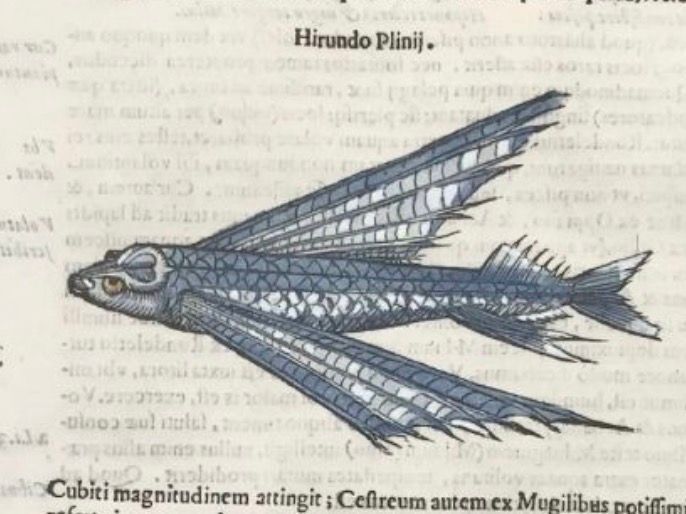
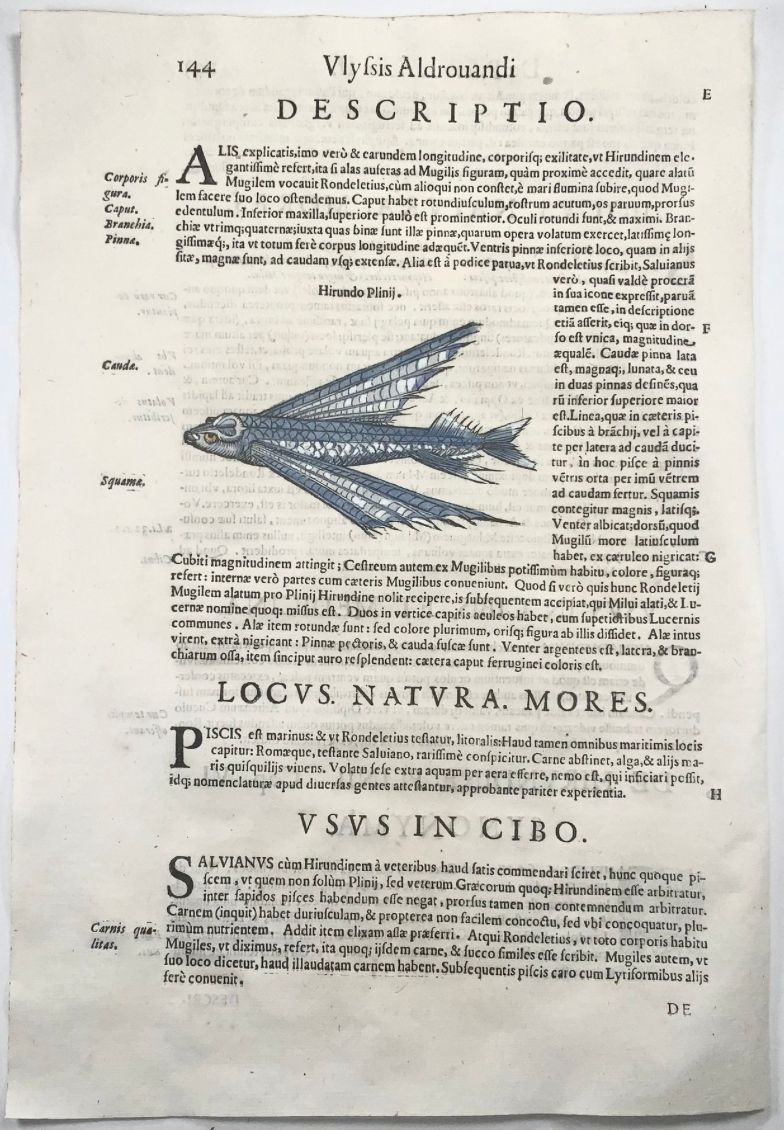
CE 1638 Ulisse Aldrovandi, Hirundo (Flying Fish)Description
Ulisse Aldrovandi (1522–1605)
From De Piscibus Libri V
Edited by Bartolomeo Ambrosini
Bologna: Nicolò Tebaldini, 1638
Woodcut and letterpress on laid paper with hand coloring
p. 144
This leaf from Aldrovandi’s De Piscibus depicts a flying fish identified in the text as Hirundo, a name derived from the Latin word for swallow. The enlarged pectoral fins are represented as wing-like structures extending from either side of the body.
Flying fishes were particularly striking subjects for early naturalists because their ability to leave the water appeared to blur familiar distinctions between aquatic and aerial animals. Aldrovandi discusses the fish through comparison with earlier authorities and descriptions of its appearance, habitat, and behavior. The page itself preserves this encyclopedic organization: the illustration is embedded within sections headed Descriptio, Locus, Natura, Mores, and Usus in Cibo, addressing description, habitat and behavior, and use as food.
The image is also a useful contrast with the more fantastic marine creatures represented elsewhere in early modern natural history. Flying fishes could appear extraordinary to European readers unfamiliar with them, but they represented observable animals rather than creatures known primarily through inherited monster traditions. Their inclusion alongside less securely documented animals illustrates the heterogeneous evidence upon which Renaissance zoological compilations were constructed.
Aldrovandi’s De Piscibus was published posthumously in 1638 under the supervision of Bartolomeo Ambrosini. Its extensive woodcut illustrations formed part of Aldrovandi’s broader effort to document animals visually as well as textually.Create Date
August 8, 2026Update Date
September 6, 2026