Name/Title
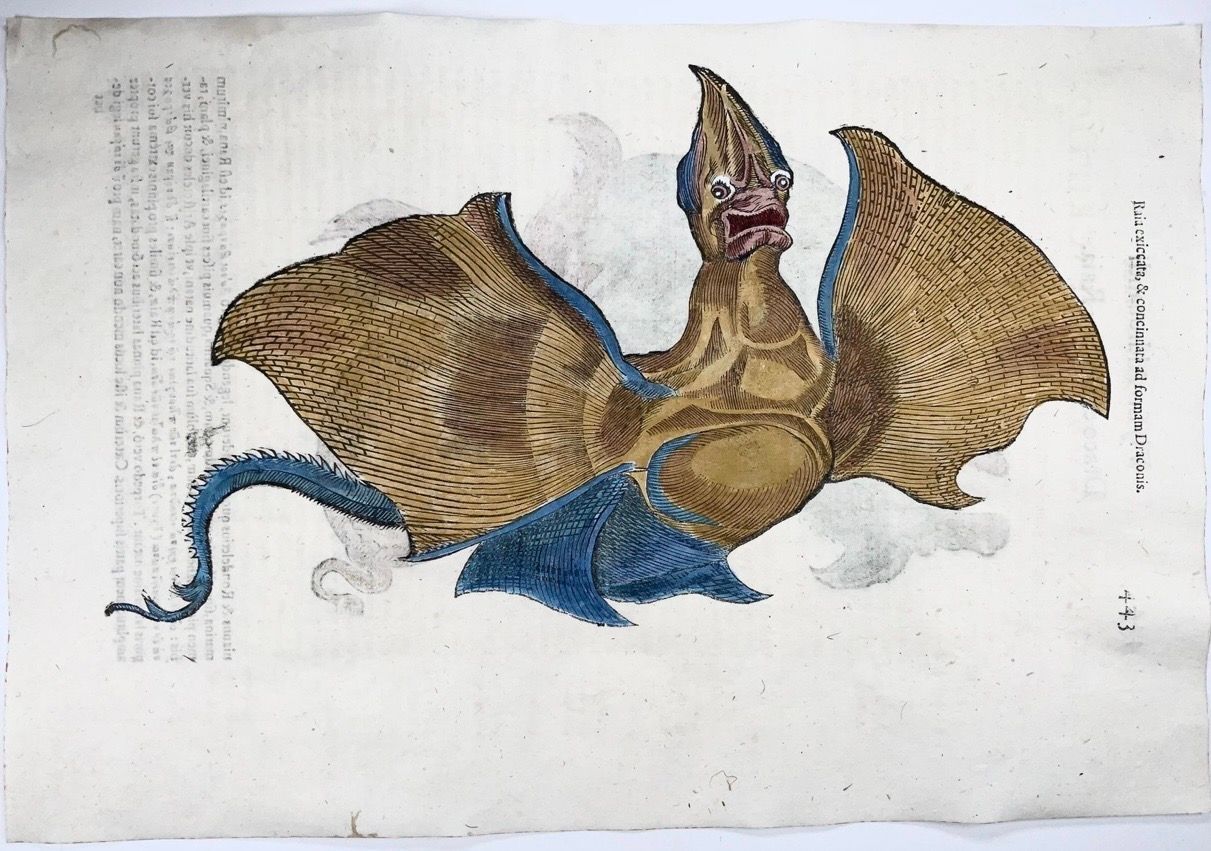
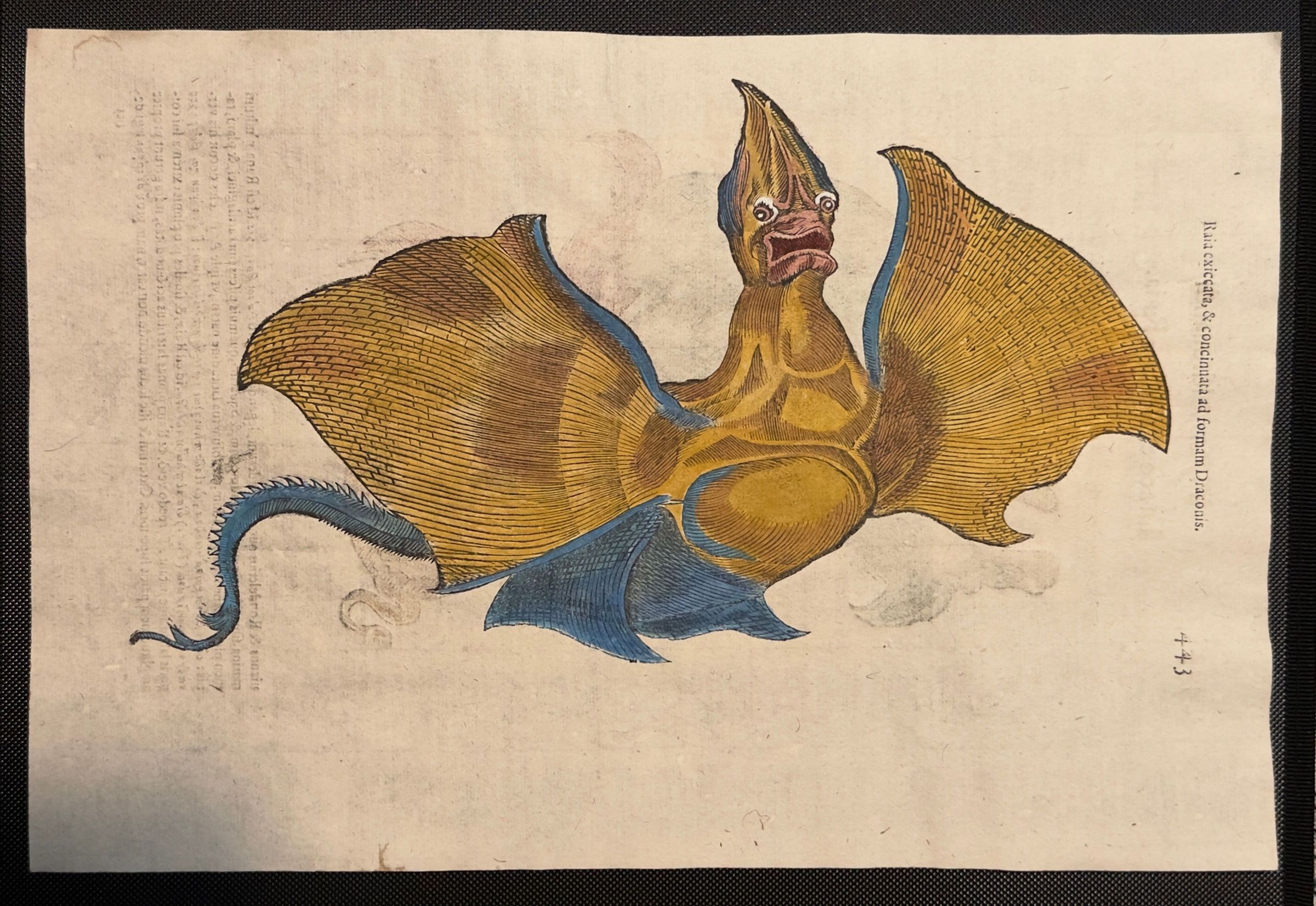
CE 1638 — Ulisse Aldrovandi, Draco effictus ex Raia and Raia cornuta (Sea Dragon and Horned Ray), Hand-Colored Woodcuts from De PiscibusDescription
Ulisse Aldrovandi (1522–1605)
Draco effictus ex Raia and horned ray
From De Piscibus Libri V et De Cetis Lib. Unus
Bologna: Nicolò Tebaldini, for Marco Antonio Bernia, 1638
Woodcuts and letterpress on laid paper with hand coloring
One folio leaf, printed recto and verso
pp. 443–444
34.9 × 23.5 cm
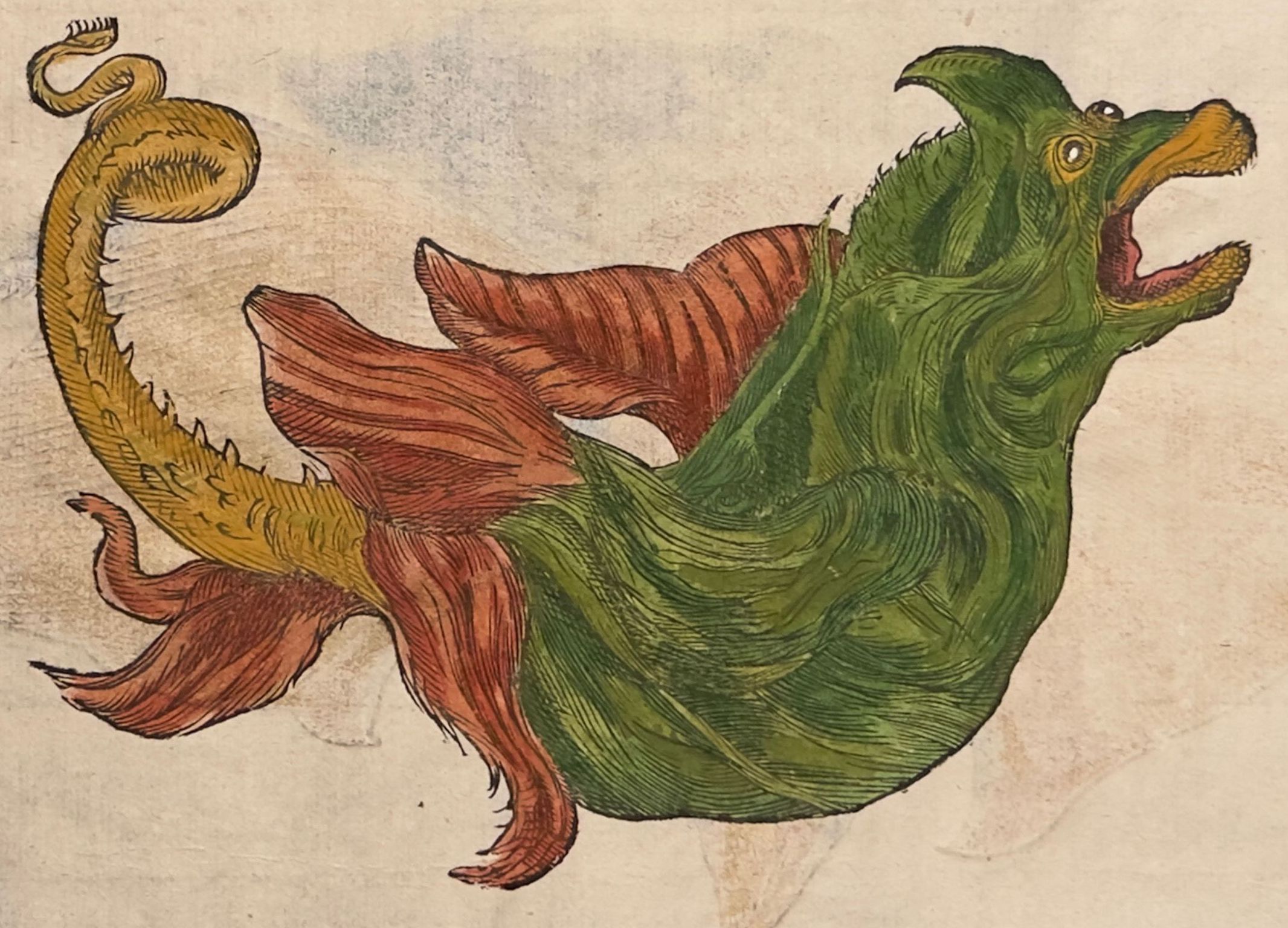
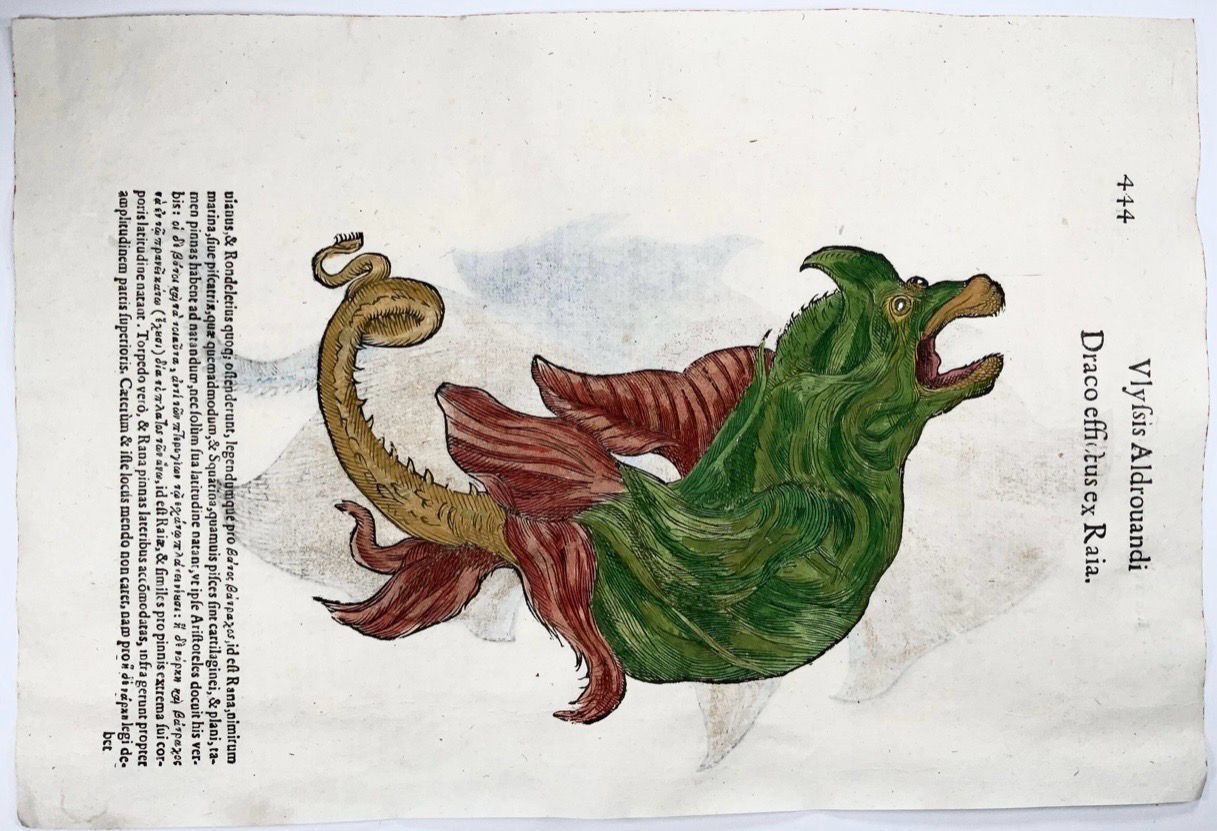
This folio leaf from Ulisse Aldrovandi’s De Piscibus presents two unusual ray-like creatures. On page 444, the large woodcut is explicitly headed “Draco effictus ex Raia”—a “dragon fashioned from a ray.” The animal combines the flattened body and fin structure of a ray with a projecting head, open mouth, curled tail, and other features arranged to produce the appearance of a dragon.
The wording effictus ex Raia is important. Aldrovandi is not straightforwardly presenting this creature as a naturally occurring species of sea dragon. The image belongs to a documented early modern practice in which rays and skates were dried, cut, reshaped, or otherwise prepared to resemble dragons and other fantastic creatures. Such fabricated specimens circulated as curiosities and were sometimes called Jenny Hanivers. Because the underside of a ray naturally possesses nostrils and a mouth that can appear facial when dried, the animal was particularly suitable for this kind of transformation.
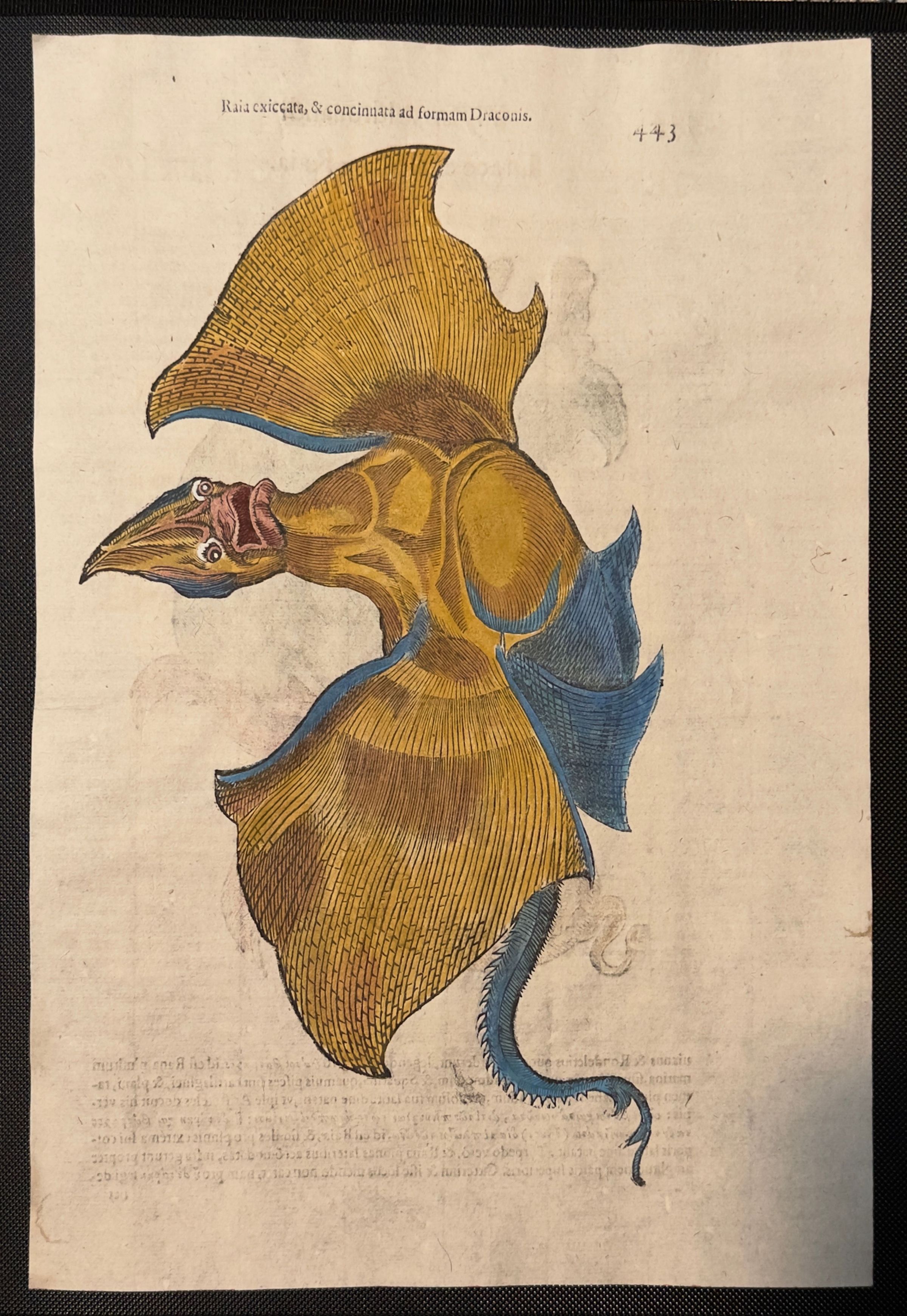
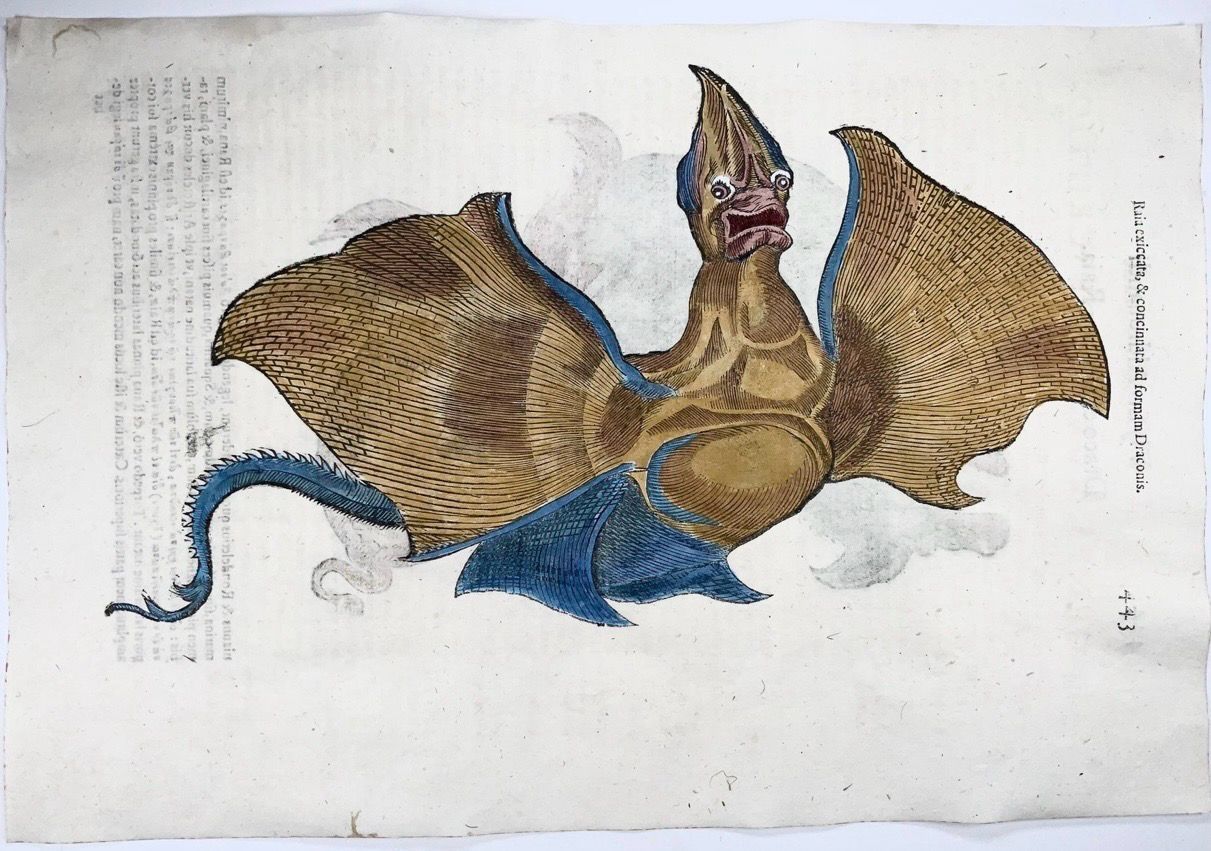
The opposite side depicts a large horned ray, identified within Aldrovandi’s discussion of raiae or rays. Its broad, wing-like pectoral fins, pointed projections, and long tail give the animal a form that could itself appear extraordinary to European viewers. Placing these images within the same section is therefore significant: the leaf juxtaposes the natural history of rays with an explicitly fashioned dragon made from a ray.
Aldrovandi’s natural-historical project incorporated direct observation and specimens alongside information gathered from classical authors, correspondence, travelers, earlier naturalists, and collections of curiosities. His treatment of unusual animals consequently preserves evidence not only about zoological knowledge but also about the ways specimens were collected, manipulated, displayed, interpreted, and sometimes transformed. The Draco effictus ex Raia is a particularly clear example because its caption acknowledges that the “dragon” has been made from another animal rather than presenting it without qualification as an independently existing species.
De Piscibus was assembled from Aldrovandi’s manuscripts after his death. The 1638 Bologna edition was printed by Nicolò Tebaldini at the expense of Marco Antonio Bernia and contains hundreds of woodcut illustrations. Bibliographic records identify the work as a folio of more than 700 pages devoted to fishes and cetaceans. The Edward Worth Library notes that Aldrovandi drew extensively upon the rapidly expanding illustrated ichthyological literature of the sixteenth century, including the work of Guillaume Rondelet, Pierre Belon, Ippolito Salviani, and Conrad Gessner.Create Date
September 5, 2026Update Date
October 4, 2026