Name/Title
CE 1669 Conrad Gessner, Von Dem Einhorn (The Unicorn)Description
Conrad Gessner (1516–1565)
Revised and expanded by Georg Horst (1626–1685)
German translation associated with Conrad Forer
From Gesnerus Redivivus, auctus & emendatus, oder: Allgemeines Thier-Buch
Frankfurt am Main: Wilhelm Serlin, 1669
Woodcut and letterpress on laid paper with hand coloring
pp. 79–80
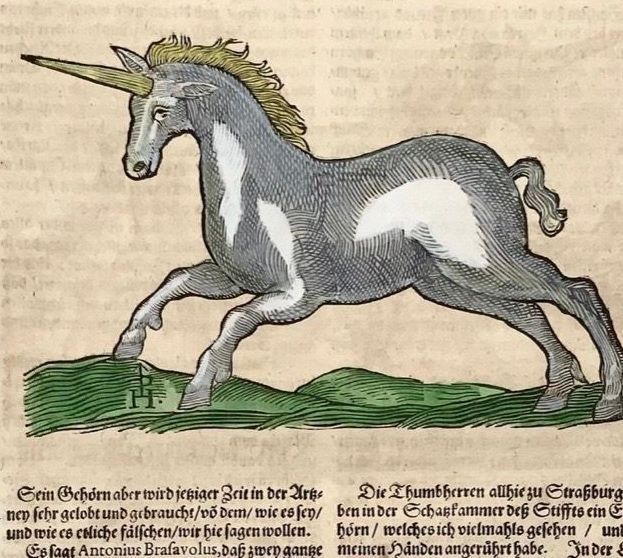
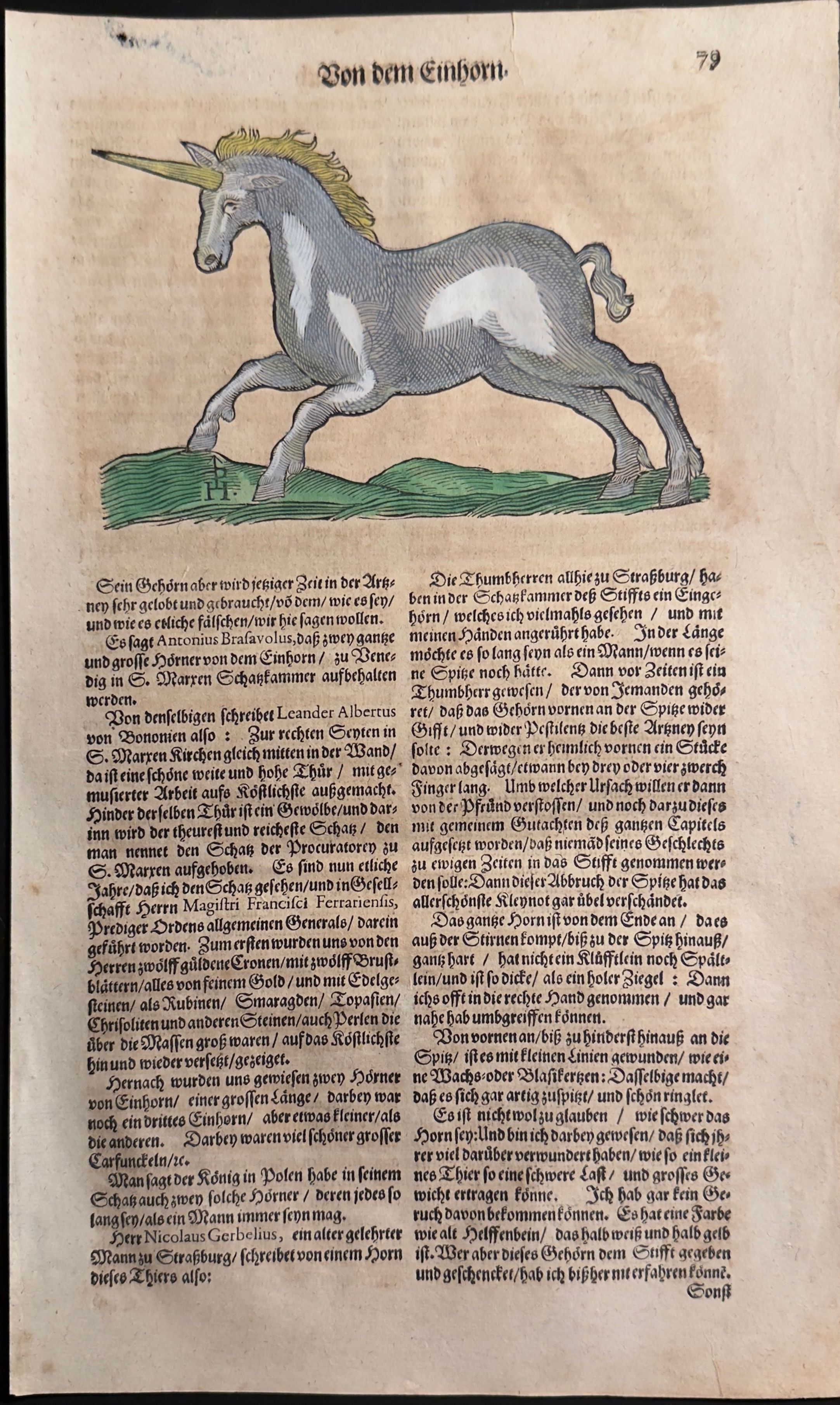
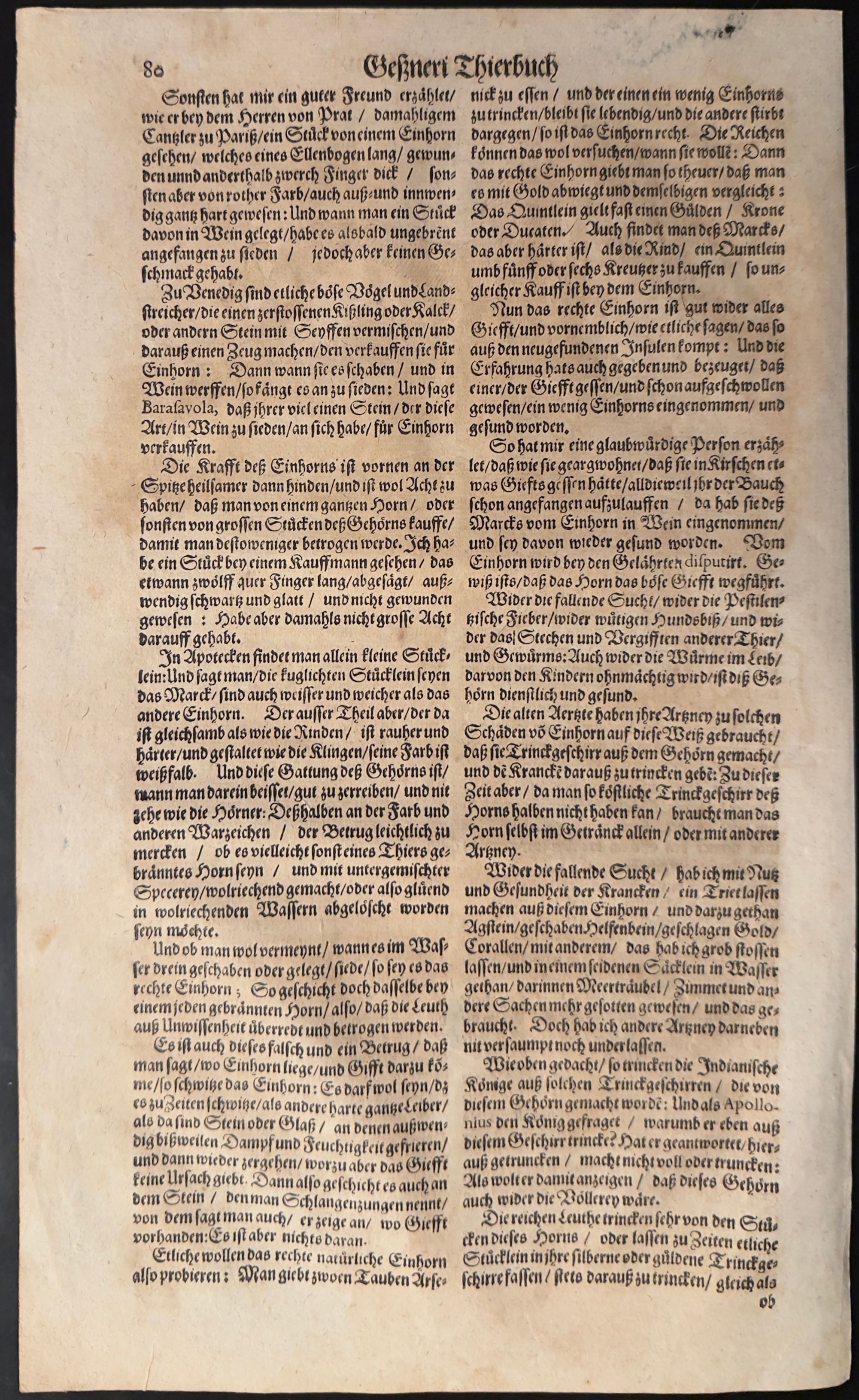
This leaf from the 1669 German edition of Conrad Gessner’s zoological encyclopedia is headed Von dem Einhorn (“On the Unicorn”). A large woodcut depicts a horse-like animal with a single long horn above a German discussion of the unicorn; the text continues on the verso.
Gessner’s original Historia animalium, published between 1551 and 1558, attempted to assemble available European knowledge about animals from ancient literature, medieval traditions, contemporary naturalists, travelers’ reports, images, specimens, and direct observation. The inclusion of the unicorn should therefore not be read simply as evidence that Gessner uncritically accepted it as a zoological fact. His method frequently preserved competing reports and traditions while evaluating the quality of the information available to him.
The unicorn provides a particularly useful example of the evidentiary problems confronting early modern natural historians. Gessner discussed conventional representations of the animal while acknowledging uncertainty about whether the familiar horse-like image accurately represented an actual creature. The 1669 edition continued to devote several pages to unicorns.
European belief in the unicorn was also connected materially to the narwhal. Narwhal tusks circulated in Europe as supposed “unicorn horns” and were valued as curiosities and for purported medicinal and antidotal properties. Consequently, discussions of the unicorn brought textual tradition and legendary animals into contact with actual biological specimens whose origins were imperfectly understood.
The leaf thus records a stage in natural history in which the boundaries among received authority, reported observation, physical specimens, and zoological identification remained subjects of active investigation rather than settled categories.Create Date
July 4, 2026Update Date
September 5, 2026