Name/Title
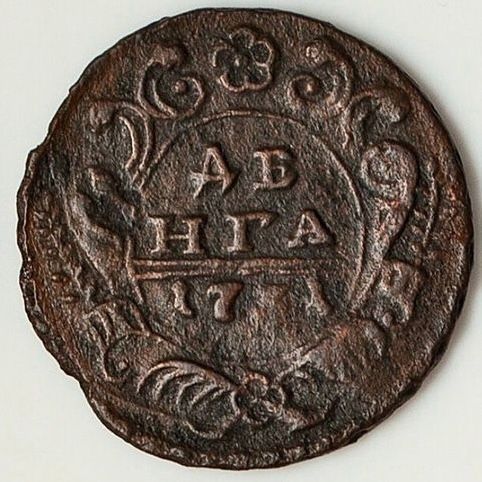
CE 1730s Elizabeth DengaDescription
1730s CE Elizabeth Denga (1/2 Kopeck) VF
Elizabeth of Russia (1709–1762), known as Empress Elizabeth Petrovna, ruled as Empress of Russia from 1741 to 1762. She was the daughter of Peter the Great and Catherine I, and her reign is often remembered as a period of cultural flourishing and relative internal stability, even as Russia engaged in significant European conflicts.
Elizabeth seized the throne in 1741 through a coup d’état that overthrew the infant Emperor Ivan VI, consolidating power with the support of the imperial guards. Unlike her father, she avoided the execution of political opponents, preferring exile or imprisonment, which earned her a reputation for personal mercy, though she could also be autocratic and impulsive.
Her reign coincided with the War of the Austrian Succession (1740–1748) and the Seven Years’ War (1756–1763). Russia emerged as a major European military power, defeating Prussia in several battles. However, Elizabeth’s death in 1762 brought her nephew Peter III to the throne, and he quickly reversed many of her policies.
Domestically, Elizabeth’s government pursued administrative reforms and invested heavily in culture, education, and the arts. She founded the University of Moscow (1755) and the Academy of Fine Arts in St. Petersburg (1757). Her patronage attracted architects, artists, and musicians, helping usher in a golden age of Russian baroque architecture and court culture.
During her reign, copper coins such as the denga (½ kopeck) were widely struck and circulated, reflecting both the growing needs of the expanding Russian Empire and Elizabeth’s efforts to stabilize the currency system established by her father.
Elizabeth died in January 1762, leaving no children. She was succeeded by her nephew, Peter III, though within months he was overthrown by his wife, who became Catherine the Great. Elizabeth remains remembered as a monarch who combined political will with cultural vision, helping to strengthen Russia’s place in European politics while cultivating a brilliant court culture.Create Date
May 23, 2026Update Date
May 23, 2026