Name/Title
CE 1920 — Republic of China — 10 Cash (10 Wen), Crossed Five-Color & Beiyang Flags — Y#306Description
Republic of China (1912–1949)
10 Cash (10 Wen)
Undated, issued 1920
Copper
Approx. 29 mm; standard weight c. 6.8 g
Milled, plain edge
Y#306
This copper 10-cash coin was issued by the Republic of China around 1920, during the politically fragmented early Republican period. Although the coin itself bears no Western or Chinese cyclical date, numismatic references assign this issue to 1920.
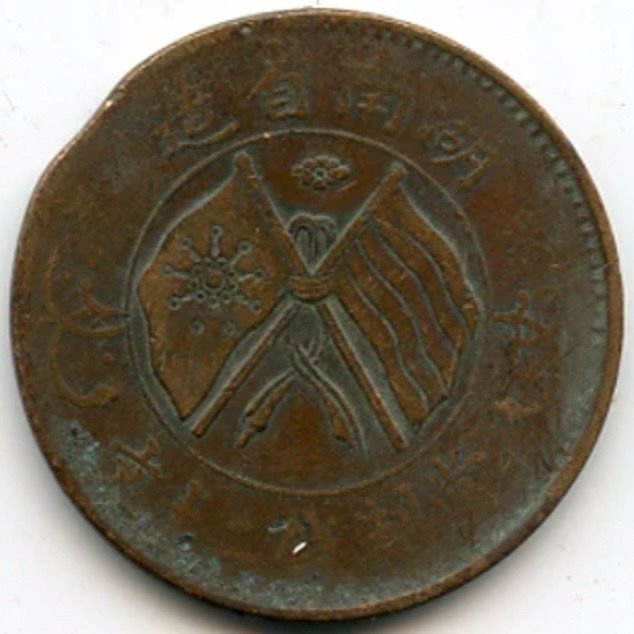
The obverse depicts two crossed flags. At left is the Five-Colored Flag of the early Republic, whose horizontal bands represented the five major ethnic groups recognized in the political symbolism of the period. At right is the striped Beiyang or Army flag, with a central star-like emblem. The two standards are tied together beneath a small flower.
Above appears:
中華民國
Zhōnghuá Mínguó
“Republic of China”
The inscription beneath the flags on this type is:
當十銅元
dāng shí tóngyuán
indicating a copper coin valued at ten cash. This inscription is important because several closely related 1920 varieties use different characters and arrangements. Y#306 encompasses the type with 當十銅元, while other varieties within the broader series carry alternative denomination formulas.
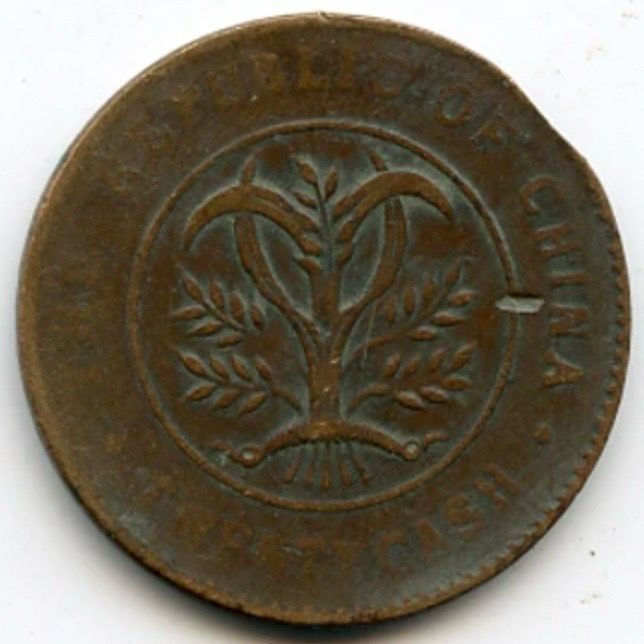
The reverse depicts a tied group of wheat ears and long leaves, surrounded by the English inscription:
THE REPUBLIC OF CHINA / TEN CASH
The use of English alongside Chinese reflects the international conventions increasingly found on Chinese machine-struck coinage during the late Qing and Republican periods. The agricultural motif belongs to a broader Republican visual vocabulary in which crops and other productive symbols replaced much of the explicitly dynastic imagery of imperial coinage.
This coin also illustrates a major technological transition in Chinese monetary history. Unlike the Qing Guangxu Tongbao cash coin we just catalogued—which was cast with a square central hole—this Republican issue was machine struck as a solid round coin. By the early twentieth century, Western-style minting machinery had largely displaced the traditional cast-cash system that had characterized Chinese copper-alloy currency for centuries.
The crossed flags are specifically Republican political symbols. The Five-Colored Flag became the national flag following the 1911 Revolution and establishment of the Republic in 1912, while the second flag was associated with the military establishment of the Beiyang government. Their juxtaposition therefore identifies the coin visually with the early Republican state during a period when effective political authority was divided among competing military and regional governments.Create Date
September 16, 2026Update Date
September 18, 2026