Name/Title
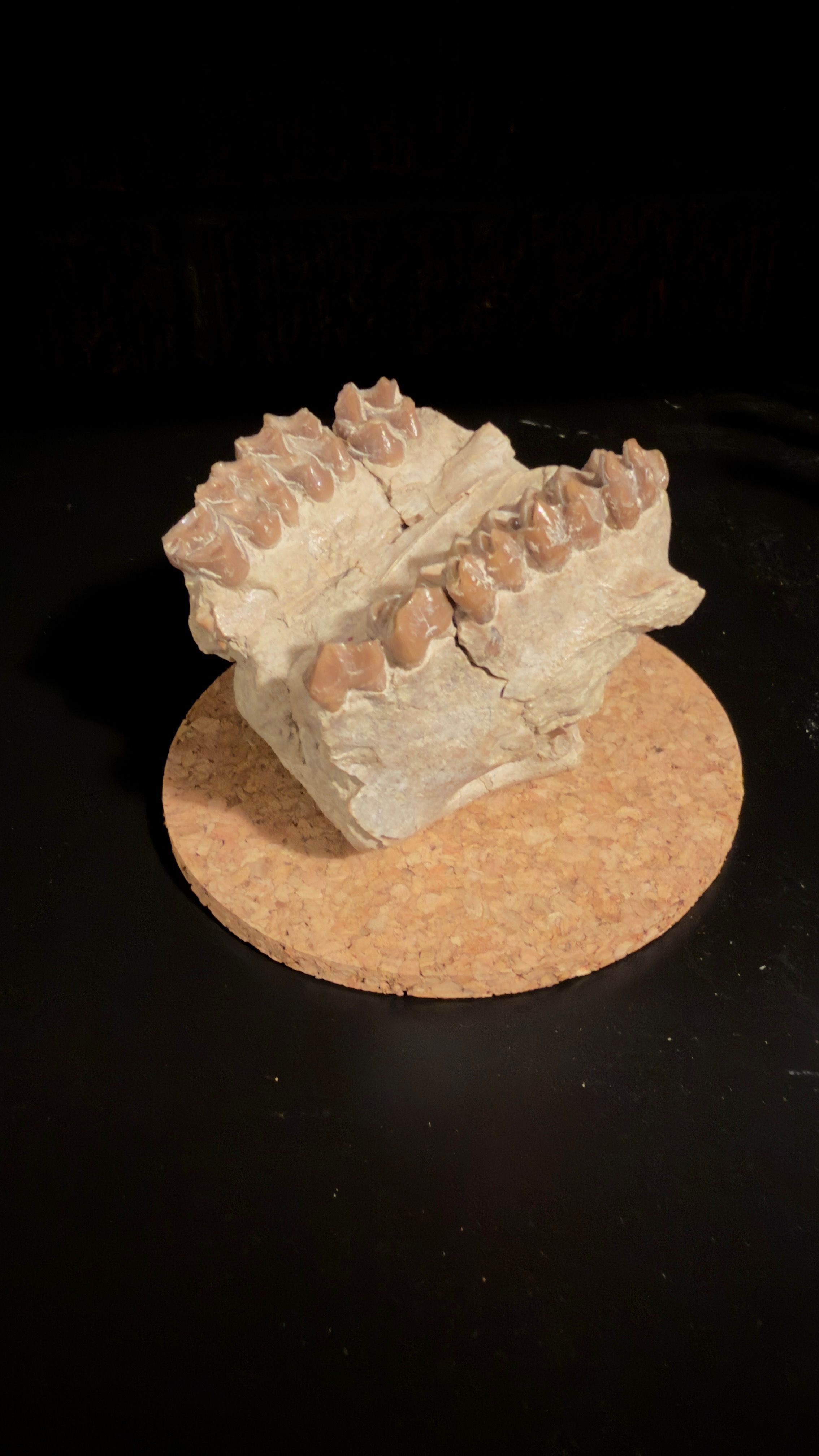
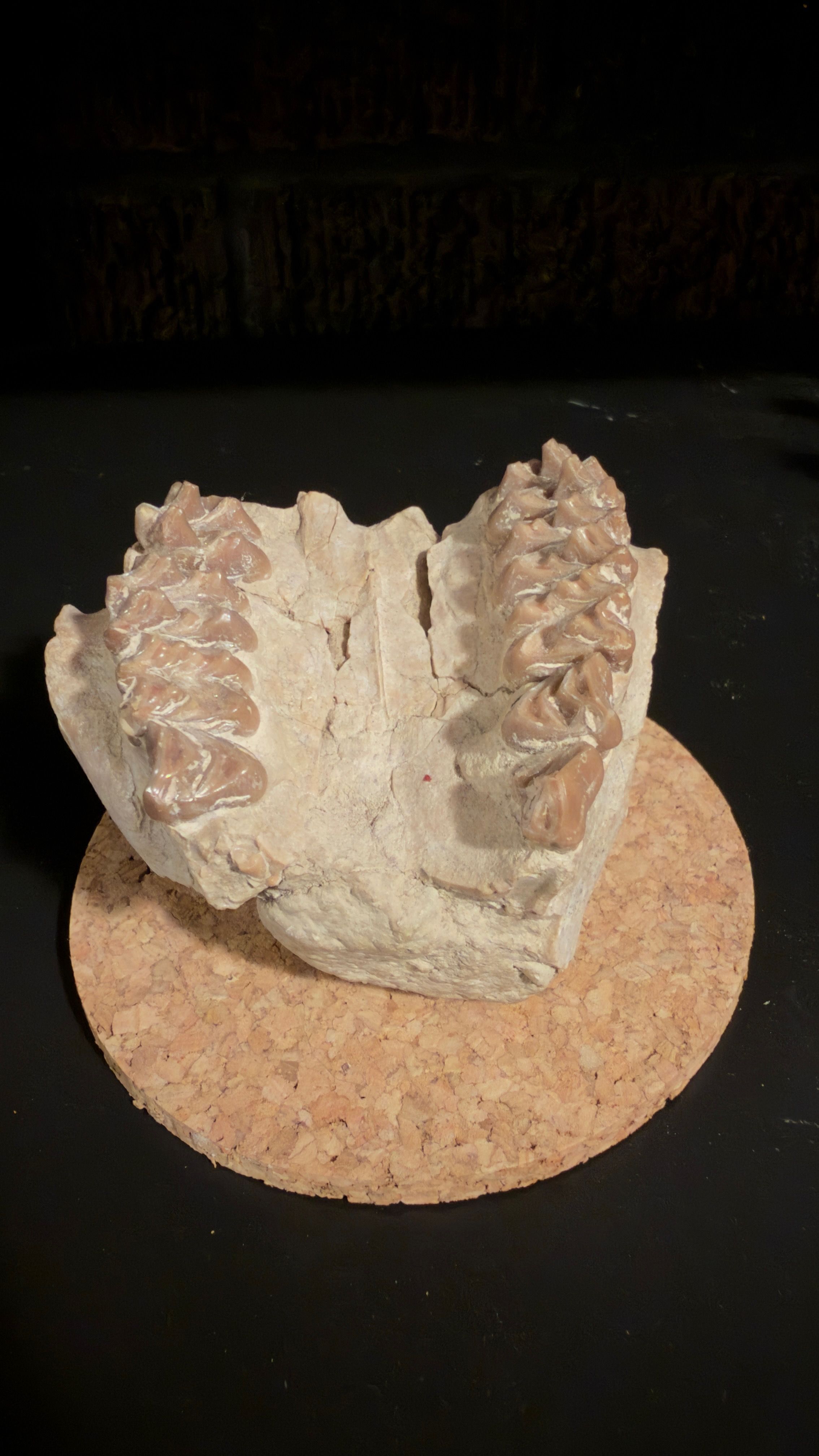
Partial Oreodont Skull (Merycoidodon gracilis)Description
Partial Oreodont Skull
Merycoidodon gracilis
Late Oligocene (ca. 28–23 million years ago)
Brule Formation
White River Badlands, United States
This specimen preserves a partial skull of Merycoidodon gracilis, an oreodont—an extinct group of artiodactyl mammals endemic to North America. Oreodonts were medium-sized, herbivorous to omnivorous ungulates that flourished during the Oligocene and Miocene, occupying ecological niches broadly comparable to those of modern deer or peccaries.
The skull fragment retains a well-defined series of cheek teeth, whose rounded cusps and thick enamel reflect an adaptation to abrasive vegetation typical of increasingly open, seasonal environments. Dental remains such as these are especially informative in oreodonts, as tooth morphology provides key evidence for diet, taxonomy, and evolutionary relationships within this diverse clade.
The Brule Formation, part of the larger White River Group, is among the most important terrestrial fossil-bearing units in North America for the Paleogene. Deposited in river floodplains and overbank settings, it documents a period of climatic cooling and faunal turnover following the Eocene–Oligocene transition. Oreodonts are among the most abundant and characteristic mammals recovered from these deposits, making them index fossils for the region.
Compact in size yet rich in anatomical detail, this partial skull exemplifies how fragmentary remains can nevertheless anchor broader reconstructions of ancient ecosystems. It offers a glimpse into mammalian life on the Great Plains long before grasslands came to dominate the landscape.
Dimensions: 3.00 × 2.54 × 2.18 inches (7.63 × 6.45 × 5.53 cm)Create Date
September 11, 2025Update Date
January 12, 2026