Name/Title
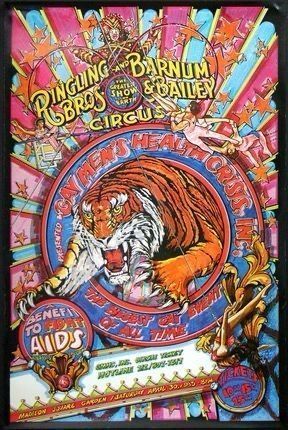
(1983) Gay Men’s Health Crisis, Inc., Ringling Bros. and Barnum & Bailey Circus Benefit for Gay Men’s Health Crisis Poster, designed by Enno Poersch, United StatesDescription
Ringling Bros. and Barnum & Bailey Circus Benefit for Gay Men’s Health Crisis, 1983
Public benefit performance poster
Design: Enno Poersch
Country: United States
Offset print, approx. 35 × 23 in. (88 × 58 cm)
This poster advertises a special performance of the Ringling Bros. and Barnum & Bailey Circus held on Saturday, April 30, 1983 at Madison Square Garden to benefit Gay Men’s Health Crisis (GMHC). The design appropriates the visual language of traditional circus advertising: bold typography, saturated color, starbursts, and a central tiger image framed within a circular emblem reading “Gay Men’s Health Crisis Inc.” The text announces the event as “The Greatest Show on Earth” presented in support of “The Best Circus Event of All Time,” reframing spectacle as fundraising for AIDS-related services. Beneath the word “AIDS,” the design references Kaposi’s sarcoma, a cancer frequently associated in the early years of the epidemic with people living with HIV.
Produced in 1983, the poster dates to the first full year of GMHC’s formal incorporation (founded in 1982) and reflects one of the organization’s early large-scale fundraising efforts. At a time when federal funding for AIDS-related services was limited and public understanding of the disease remained uneven, community-based organizations relied heavily on benefit events to sustain programming and direct services.
The poster demonstrates how early AIDS activism often drew upon mainstream entertainment and commercial aesthetics to mobilize broad public participation. By pairing a widely recognized American cultural institution with a newly formed AIDS service organization, the event signaled both urgency and legitimacy. The work is preserved here as part of the historical record of early AIDS-era fundraising and visual culture.Create Date
July 29, 2025Update Date
October 15, 2026