Name/Title
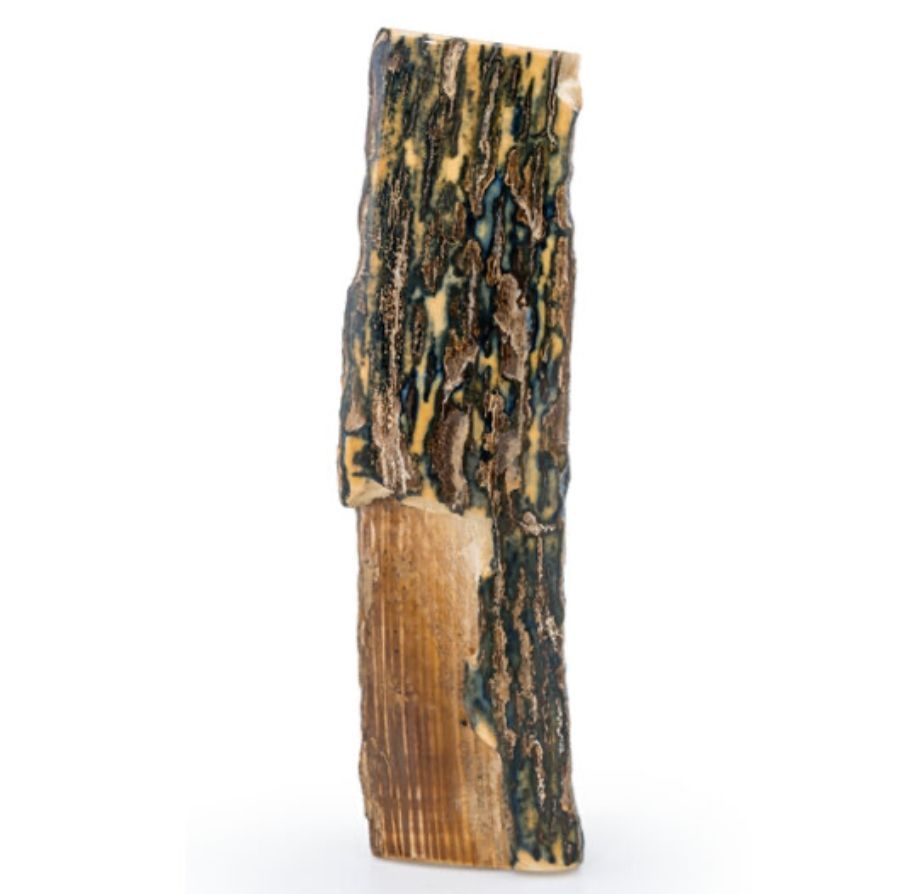
Woolly Mammoth Tusk Section (Mammuthus primigenius)Description
Woolly Mammoth Tusk Section
Mammuthus primigenius
Pleistocene (ca. 400,000–4,000 years ago)
Alaska, United States
This specimen is a longitudinal section of a woolly mammoth tusk, preserving both exterior dentin and internal growth structure. Woolly mammoths were large, cold-adapted proboscideans closely related to modern elephants, inhabiting the northern regions of Eurasia and North America during the Pleistocene Epoch. In Alaska, they were a dominant component of the Ice Age steppe–tundra ecosystem.
The tusk displays characteristic Schreger lines—intersecting, chevron-like patterns formed by the microscopic arrangement of dentinal tubules. These lines are diagnostic of proboscidean ivory and are particularly acute in mammoths, allowing their tusks to be distinguished from those of modern elephants. Variations in color and texture reflect mineral infiltration during burial as well as differences between outer cementum and inner dentin.
Mammoth tusks grew continuously throughout the animal’s life, recording seasonal and annual growth in much the same way as tree rings. As a result, tusk sections such as this are valuable not only as fossil material but also as paleoclimatic archives, capable of preserving information about diet, migration, and environmental conditions through isotopic analysis.
Recovered from Alaskan deposits, where permafrost has aided preservation, this tusk section represents both the biology of a single animal and the broader ecological world of the Late Ice Age. It offers a tangible connection to one of the most iconic megafauna species to have lived alongside early humans in North America.
Dimensions: 11.02 × 4.02 × 1.09 inches (28.00 × 10.20 × 2.76 cm)Create Date
August 3, 2025Update Date
July 28, 2026