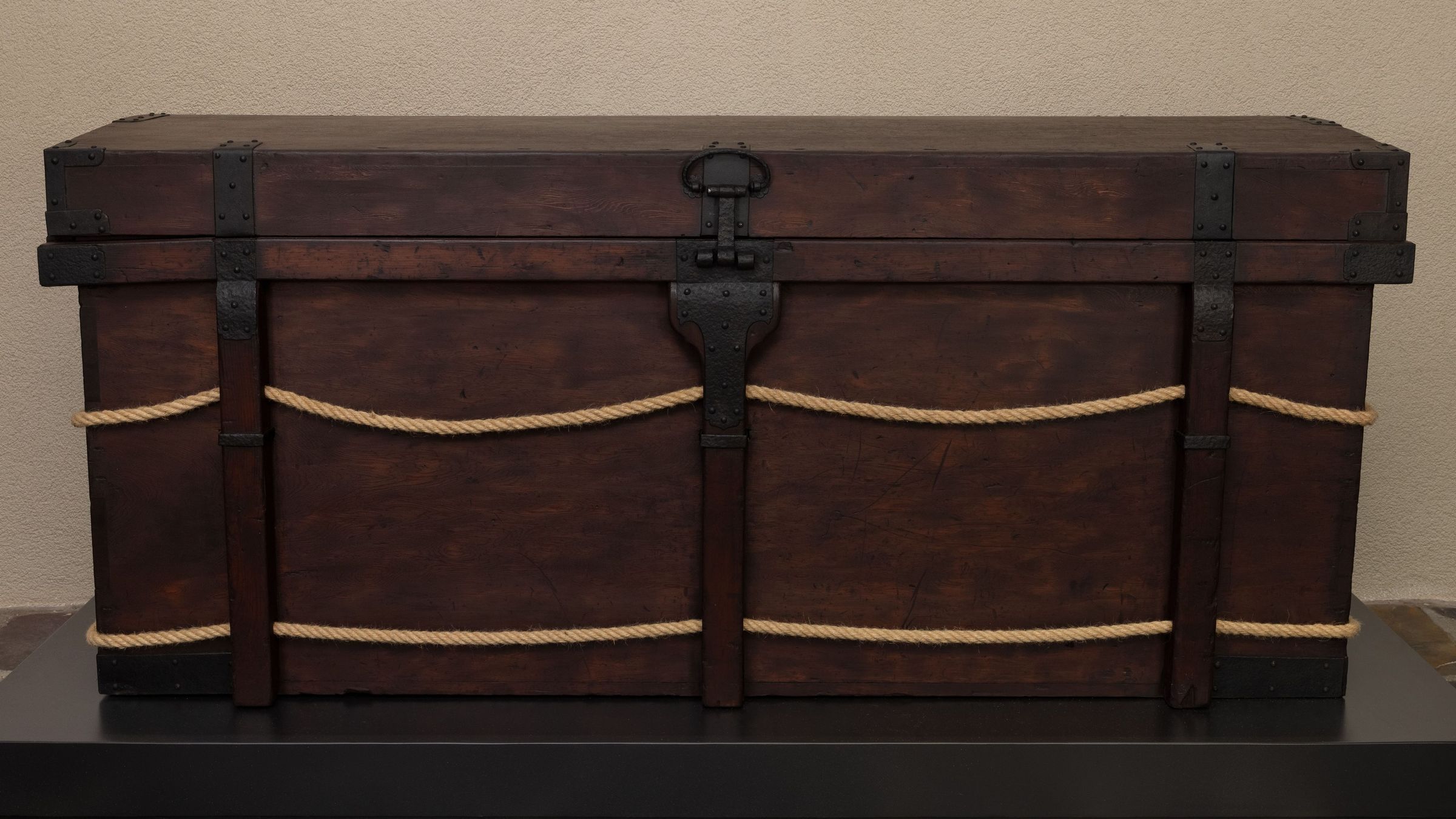
Name/Title
Japanese Edo Jidai Kuruma NagamochiEntry/Object ID
MK_0189Description
Discover the Japanese Edo period through this grand Nagamochi (chest). This Nagamochi was a predecessor to Tansu. Tansu are typically known as chests of drawers. The Nagamochi is a more simplified storage device common in most homes and where almost anything in the home was stored. It was often placed on the Doma “earthen floor” in the entry. Many homes or businesses typically had one.
Most Nagamochi were produced in the Tohoku and Hokuriku areas between 1775 and 1850 when their popularity faded and the Tansu became the more prevalent storage device for those who could afford drawers.
This Nagamochi is very large and it originally would have had a carriage that it sat upon allowing it to be moved as it can easily store several hundred pounds of weight.
During the Meireki Fire of 1657 in Edo (present day Tokyo) there were massive traffic jams of Kuruma tansu in the streets trapping thousands of people trying to evacuate. In response to the tragedy, kuruma tansu were no longer allowed in the three major cities, Kyoto, Osaka, and Edo.
This Nagamochi's strong carcass is crafted from only six massive, wide, flatsawn Hinoki cypress boards. These boards required a tree with a diameter exceeding 1.5M (5 feet), cut using Oga log saws. The rough boards were then flattened with a Chyona adze and polished with a Kanna plane before the laborious construction could begin.
The Nagamochi's original "Shibu" finish is a traditional Japanese wood treatment using fermented astringent persimmon juice (Kakishibu). It acts as a binder, sealer, and waterproofing agent, and is antibacterial and an insect deterrent. Kakishibu has a very high Tannin content and is also a strong rust inhibitor.
The original finish was applied after the hardware was installed and Kakishibu was most likely used to blacken the hardware during the finishing process of the trunk.
The Iron work on the chest is quite impressive for its era. One of the unique characteristics is that the “hinges” for the lid are actually three Awajyou (early Japanese type padlocks). Removing the locks would be the same as removing the hinge pins enabling the user to remove the entire lid to access its contents. Most likely it was used in a mercantile setting.
The large side handles, Saotoshi, were used by inserting a long rod thru both handles and men on either end could then lift the pole on their shoulder and carry the trunk. This size trunk probably would have required four men to carry it when loaded.
The hardware was hand-forged from iron ingot, raw material harvested from riverbanks and smelted for four days. The best iron was for swords; the hardware craftsman, or kannamonoshi, forge-welded ingots into stock. This immense labor of hammering and scraping made the ironwork, often more expensive than the woodwork.
Now, part of the Mauna Kea’s large collection of Edo and Meiji-period Japanese storage vessels, this piece has forgotten its functionality, instead decoratively adorning our corridors. Its presence here both speaks to the historical evolution of Japanese craftsmanship, and invites viewers to consider where purpose and artistry meet.
This treasured piece has been in the Mauna Kea's collection since 1965, when Laurance Rockefeller developed the hotel, and has recently undergone an extensive restoration.Made/Created
Date made
1615 - 1868Place
Country
JapanContinent
AsiaDimensions
Height
31 inWidth
31 inLength
71 inLocation
Area
Promenade CorridorFloor
Promenade LevelBuilding
Main TowerRoom
Kamani RoomBuilding
HBR Main TowerRoom
Kamani RoomBuilding
HBR Main TowerFloor
5th FloorBuilding
Main Tower