Name/Title
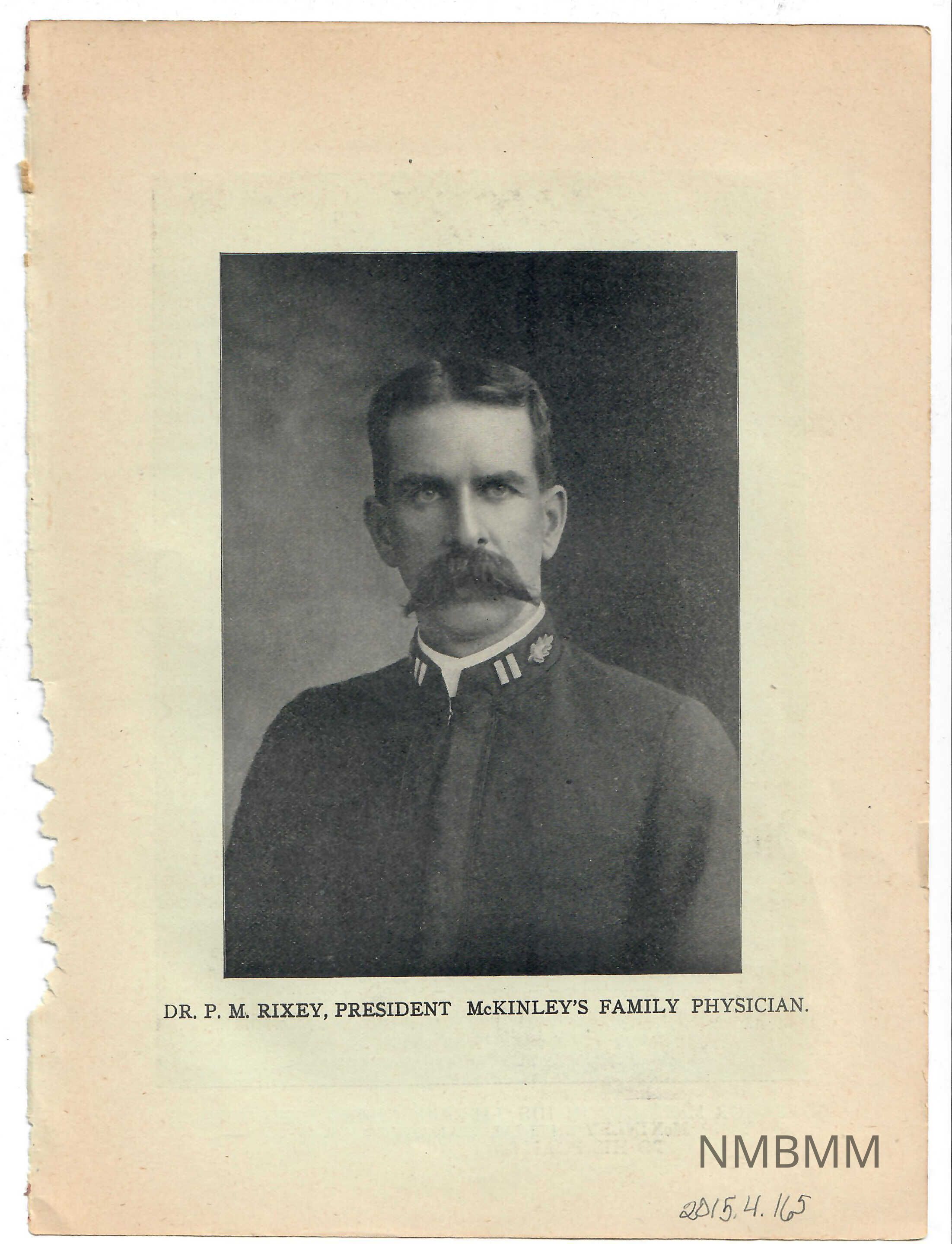
Governor McKinley in his Library Giving Instructions to His Political Managers/Dr. P.M. Rixey, President McKinley's Family PhysicianEntry/Object ID
2015.4.165Description
GOVERNOR MCKINLEY IN HIS LIBRARY GIVING INSTRUCTIONS TO HIS POLITICAL MANAGERS, 1896 , ORIGINAL VINTAGE FRAMED PRINT FROM 1901. THIS PRINT MEASURES 7" X 9 1/2" AND IS HOUSED IN A 8" X 10" WOOD AND GLASS FRAME. MAY HAVE SOME DISCOLORATION OR EDGE WEAR. (PLEASE SEE PICS.) WILLIAM MCKINLEY WAS THE 25TH PRESIDENT OF THE UNITED STATES, SERVING FROM MARCH 4 1897, UNTIL HIS ASSASSINATION IN SEPTEMBER OF 1901, SIX MONTHS INTO HIS SECOND TERM.
The back of the page features a sepia-toned photo of Dr. P. M. Rixey. Dr. Rixey served as the McKinley family physician. Presley Marion Rixey, Rear Admiral, United States Navy. Born in Culpepper County, Virginia, 14 July 1852, the son of Presley Morehead and Mary F. (Jones) Rixey.
He received his primary education in Culpepper and Warrenton Counties, Virginia, before attending the University of Virginia from which he received a Medical Doctor (MD) degree in 1873. Attended Jefferson Medical College in Philadelphia from 1873 to 1874.
On 25 April 1877 married Earlena J. English, daughter of Rear Admiral Earl English, United States Navy. Resided in Rosslyn, Virginia, where he died 17 June 1928. He was buried with full military honors in Arlington National Cemetery.
Received appointment from Virginia, 28 January 1874, as Assistant Surgeon; Passed Assistant Surgeon, 18 April 1877; Surgeon, 27 November 1888; Medical Inspector, 24 August 1900; Surgeon General with the rank of Rear Admiral, 5 February 1902; Medical Director, 7 May 1907; retired as Medical Director with the rank of Rear Admiral, 4 February 1910. Served as White House physician for Presidents William McKinley and Theodore Roosevelt. In addition, was official physician at White House from 1898 to May 1909.
Received the Order of Naval Merit from King Alphonso XIII of Spain for assistance he gave to crew of Santa Maria after that vessel suffered an explosion in New York Harbor in 1893.
In June 1925, Dr. Presley M. Rixey, White House physician to both McKinley and Theodore Roosevelt, wrote an article called "Guarding the Health of Our Presidents" for a popular magazine called Better Health. Once accustomed to the author's ego, the article is an interesting narrative of a serious illness Mrs. McKinley suffered while traveling. It is also a reminder of the way antibiotics have changed the way humans live... and die. Doctors for Taft, Wilson, Harding and Coolidge
President Taft succeeded President Roosevelt and elected to have an Army Medical Officer to relieve me of duty at the White House, Col. M. A. Delaney. President Wilson succeeded President Taft and appointed P. A. Surgeon Gary T. Grayson of the Navy as his official White House physician. Surgeon Grayson came into the Navy during my administration of the Bureau of Medicine and Surgery and was with me occasionally at the White House and notably on the one-hundred mile ride made by President Roosevelt, Major Archibald Butt, and myself, to Warrenton, Va., and return the same day. His service was so much appreciated by Mr. Wilson that he was promoted over the heads of two grades of older medical men from the rank of Surgeon, Lieutenant Commander to Medical Director, Rear Admiral, an unprecedented action, but not more so than the unprecedented service he was called upon to render President Wilson in foreign countries as well as at home.
President Harding elected to have Dr. Sawyer as his official phvsician, and gave him the rank of Brigadier General in the Army, and he had Past Assistant Surgeon Boone of the Navy as his assistant.
A short time after President Harding's death I wrote to General Sawyer and suggested that he write an official report of President Harding's illness and death as he was his official physician and it would become a matter of record and of great interest to the people and profession. He replied as follows:
CHARLES E. SAWYER
Brigadier General, M. O. R. C.
Washington, D. C.
August 13, 1923
My dear Admiral Rixey:
Accept my thanks for your very opportune suggestion and for the copy of the medical report you made in the case of President McKinley.
As soon as I have time, will be very happy, indeed, to talk to you about the details which occurred and which, I am sure, will be of much interest to you.
I trust that you are feeling well, and that everything is going well with you and your good wife. I shall take advantage of the first opportunity presenting and call upon you.
With kindest regards, I am,
Sincerely yours
(Signed) C. E. SAWYER
Rear Admiral P. M. Rixey,
Rosslyn, Virginia
President Coolidge has an army surgeon, Major Coupal, as his official physician.
In conclusion I wish to emphasize the importance of the President's health while in office, and in caring for his physical well-being among many other things I suggested these simple rules: Ten minutes setting-up exercise before breakfast, one hour's walk before going to his office, from one to three hours' exercise in the open air before dinner at 8 o'clock. These simple suggestions as to exercise, accompanied by proper advice of the White House physician as to observing ordinary rules of diet and personal hygiene, will help greatly if illness or injury should come to the President.
How would you like to shake hands with thousands of persons who desire to express their admiration and affection by squeezing your hand until it swells? In my opinion the President should not shake hands on the occasion of large receptions of the people. Instead, as each one's name is called and he passes in close review the President can greet him or her as cordially without shaking hands. A good rule might be that as each person in the line approaches the President he should place his right hand over his heart instead of reaching for the President's hand. It would
seem that the few thousand who would forego the handshaking would be glad to do so in order that the tax on the President's energy might be reduced to a minimum and the prevention of such a terrible tragedy as came to President McKinley.
As to the White House physician, he must always sink his own interests in that of the health of the President and of his personal and official families. In other words, his desires, pleasures, and all other duties must be subordinated and devoted to this special service.
NOTES: His nephew, per the U.S. Census 1900 (2 June) District of Columbia, Washington County, Roll 164 Book 2, Page 70, line 3: Presley M. Rixey, Jr. (Second Lieutenant, United States Marine Corps), Born November 1879. He is also believed to be buried in Arlington National Cemetery.
Also buried in Arlington National Cemetery is Presley M. Rixey, Brigadier General, United States Marine Corps, August 1904-January 1989.
Posted: 27 July 2002 Updated: 3 June 2003 Updated: 29 October 2005Collection
ScarmuzziAcquisition
Accession
2015.4.0Source or Donor
Patricia A. ScarmuzziAcquisition Method
Gift