Name/Title
William McKinleyEntry/Object ID
2016.2.99bbDescription
Front:
William McKinley
page 1:
Eileen B. Blaney
1368 Mahoning Ave. P.O. Box 1309
Warren, Ohio 44483
#GD34875
Assignment 10B
Ruth Castelli
May 12, 1994
About 2000 words
William McKinley
The Forgotten President
Eileen B. Blaney
page 2:
Early Life
The winter wind howled outside the two story wood frame house. People shopped in the general store on the first floor as the cry of a new baby sounded from overhead. It's Januray 29, 1843. Mother McKinley has given birth to the seventh of her nine children. But this little person will be special. He will be the 25th President of the United States. He will bring his country into world leadership.
page 3:
Little William was cheerful and kind. He had pale skin, a stocky build, brown hair and grays.
William brought in the cows from the pasture and helped his mother and sisters around the house.
page 4:
In summer ha and his friends went barefoot, played soldier and swam in Mosquito Creek.
In winter they enjoyed ice skating.
page 5:
William was a good shot with a bow and arrows, but do you know what William liked the most? He loved making and flying kites and secretly dreamed of being President.
page 6:
Father McKinley ran an iron foundry. Mother McKinley took care of the Methodist Curch.
page 7:
They lived in Niles, Ohio located in the Northeastern part of the state. The only was in and out of town was a wagon trail to Pittsburgh, Pennsylvania and a canal. Niles was a rural town with only 300 people but it had several stores and businesses plus three churches and a school but it only offered basic subjects.
page 8:
Education was very important to the McKinley's. They had family reading time. Each member took a turn reading out loud while the others listened, Their life was very plain but secure and loving.
page 9:
Poland Seminary
William received his basic schooling in Niles but when he was nine years old, the family moved to Poland, Ohio. Poland Seminary was a new three story building that offered many subjects.
page 10:
William was a hard working student. He did his homework first before he felt free to play.
He enjoyed reciting his lessons and loved public speaking. He entered many debating contests. He was good in languages too. His teachers agreed he was a very bright student.
page 11:
William was 15 when he joined the Methodist Episcopal Church in Poland. He studied Old Testament Hebrew under Rev. W. F. Day and remained a strong Methodist all his life.
page12:
Allegheny College
At age 17, he entered Allegheny College in Meadville, Pennsylvania. He became ill and had to return home.
page 13:
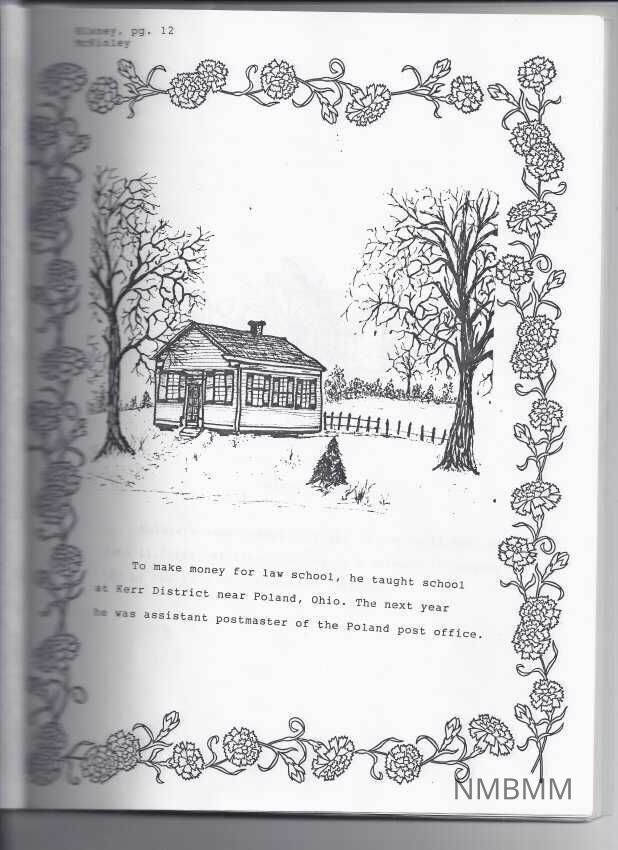
To make money for law school, he taught school at Kerr District near Poland, Ohio. The next year he was assistant postmaster of the Poland post office.
page 14:
Civil War Hero
Soldiers were needed to fight in the Civil War. On June 11, 1861, William enlisted as a private in Company "E" of the 23rd Ohio Volunteer Infantry.
page 15:
He was in charge of feeding the troops on the battlefield at Antietam. The men called him "Sergeant Billy." He loaded wagons with food and coffee and delivered it to his men on the front lines as the battle raged around him. Can you imagine how surprised the men were? No one had ever thought of doing that before. He was commissioned Second Lieutenant for that deed.
William served under a future president, Colonel Rutherford B. Hayes. Hayes described him as handsome, bright, gallant, brave and a fine officer.
page 16:
While on march to Martinsburg, West Virginia, William turned 21. He voted for the first time. His choice was Lincoln. Do you know what was used for a voting booth? An ambulance. the ballot box was an empty candle can.
page 17:
In a battle near Winchester, West Virginia, William again showed his bravery. He rode across an open field under heavy fighting to reach an isolated regiment. Smoke from gun fire engulfed him. His commander thought William was killed but when the smoke cleared, he was still in the saddle riding like the wind. The men's lives were saved. The next day William was made Captain of Company "G."
Near the end of the war, William was commissioned a Brevet Major by President Lincoln. He arrived home without a scratch. All his friends called him Major.
page 18:
McKinley and the Law
McKinley entered Albany School of Law in 1866. He was 24 years old. While at a party he was served ice cream. It was the first time he had tasted it. He thought the "custard" had been frozen by mistake. Later in life he would laugh about it and say, "I was just a country biy you know." He graduated in 1867.
page 19:
picture of Court House in Warren, Ohio.
He passed his bar examination in Warren, Ohio.
page 20:
McKinley moved to Canton, Ohio and joined the law firm of George W. Belden. Mother McKinley wanted William to become a minister but he had other ideas. He choose politics.
While he practiced lawin Canton, he also: campaigned for Ulysses S. Grant for President, was elected prosecuting attorney of Stark County, became speaker and leader for the Woman's Temperance movement, campaigned for Rutherford B. Hayes for Govenor of Ohio, was attorney for the "scrappy" Coal Miners and did not charge them, joined many groups like the YMCA, Masons and the local Methodist Church.
page 21:
He was great at remembering faces and names. He used common sense and gave speeches with "fire." All these things made him very popular, especially with a young lady named, Ida Saxton.
page22:
They were married on January 25, 1871.
page 23:
They had two little girls but Katie only lived 3 1/2 years and died of a heart problem. Little Ida died at 6 months of cholera. The stress was too much for young Mrs. McKinley. She became very ill with epileptic seizures. But the marriage remained strong.
page 24:
The Scarlet Carnation
In 1876 McKinley ran for Congress, Dr. Levi Lamborn of Alliance, Ohio ran against him. Dr. Lamborn had developed the scarlet carnation; a red orange color, and gave one to McKinley during the campaign. McKinley won and decided the flower was good luck. He wore one the rest of his life. It was also made the state flower of Ohio.
page 23:
Congress 1877-1891
In the 45th Congress, McKinley fought for a tariff to protect new industries. His speaking skill was impressive as he delivered his first speech on April 15, 1878. With Garfield being elected President, McKinley was appointed to the empty seat of the important Ways and Means Committee. He was elected to the job for 14 years. By 1884 McKinley was a powerful Congressman.
page 24:
Governor of Ohio 1892-1895
While Governor, he made many improvements. He got a law passed to build the State Mental Hospital in Massillon. Mine Workers riots were controlled without bloodshed and a small excise tax on corporations put the state on its feet money wise.McKinley was the most popular Republican speaker in the country. He made 371 speeches in 300 towns in 16 states. His dignity increased but his grass root simplicity remain in tact. People from all walks of life felt at ease with him. Turning down a third term as Governor, the McKinley's moved back to Canton... to plan a dream.
page 25:
A New Style Campaign
It was a very exciting time. The telephone was used for the first time to hear the progress from the Republican National Convention while mountains of telegraph ticker tape spilled on to the floor. McKinley was elected on the first ballot. Since Ida was too frail to travel and William would not leave her behind, the "Front Porch Campaign" was born. Canton was a very exciting place to live as thousands of people arrived by train daily. People wore campaign buttons for the first time and McKinley made up to sixteen speeches a day. He promised "a full lunch pail" and the people believed him. On November 3, 1896, his childhood dream came true.
page 26:
25th President of the United States 1897-1901
"I have never been in doubt since I was old enough to think intelligently that I would sometime be made President." McKinley took office March 4, 1897 with Garret A. Hobart as his Vice President. McKinley would be the last Civil War President.
page 27:
He had his own version of the Presidnetial Seal. It was adopted from the "Great Seal of the United States." Can you find the difference between the three seals shown?
page 28:
Like all of us, he had pets. A horse named Midnight and a parrot that could whistle a few lines of "Yankee Doodle."
page 29:
The years he spent in Congress and as Governor of Ohio, made McKinley the most polished and qualified President to take office, and brought many new ideas to the office. He was first President to make provisions for the press. When he traveled by train, there was a press car. He was first President to be filmed in 1896 and to ride in an automobile in 1899.(a Stanely Steamer). He was most traveled President of his time. He wrote most of his own speeches. We lead congress by "coming to terms" with them and gently guiding them instead of fighting with them. McKinley started the "commissions" policy; the use of non-government experts to take care of pieces of Government business. One of them was the Isthmian Canal Commission, who worked out most of the details to build the Panama Canal. The most important financial reform for the U.S. came on March 14, 1900 when the Gold Standard of money was adopted.
page 30:
In 1901, there were 45 states in the Union. Do you know which five states were still territories? Arizona, New Mexico, Okalhoma, Alaska and Hawaii. Alaska was bought from Russia in 1867. Hawaii was annexed in 1898.
page 31:
Under McKinley's leadership the United States became a world power. It all started with the Spanish-American War. The U.S. acquired Cuba, Guam, the Phillippine Island and Puerto Rico. The Boxer Rebellion brought the Somoan Group and Tutuila under U.S. rule.
By the "open door policy" was adopted and the U.S. was a thriving country.
page 32:
1900 McKinley was re-elected President with Theodore Roosevelt as Vice President.
page 33:
On September 6, 1901 at the Pan-American Expostion in Buffalo, New York, President McKinley finished his greatest speech. "Let us ever remember that our real preeminence rests in the victories of peace, not those of war." People gathered to shake his hand. One man stood back. As most of the people moved away, President McKinley gave his carnation to a small girl. The man moved toward McKinley; his hand wrapped in a handkerchief. Two shots were fired and the President slumps to the floor. The man, Leon Czolgosz's only reply was, he wanted to kill a "Great Ruler." President McKinley died September 14, 1901 in Buffalo, New York and was buried in Canton, Ohio.
page 34:
"At the time of McKinley's death, it was publicly acknowledged that no executive since Lincoln had so mastered the Congress." He gave the office of President a new direction. He remained humble and was remembered for his kindness, honesty and good judgement.
page 35:
map of Ohio
page 36:
ReferencesCollection
BlaneyAcquisition
Accession
2016.2.0Source or Donor
Eileen B. BlaneyAcquisition Method
Gift