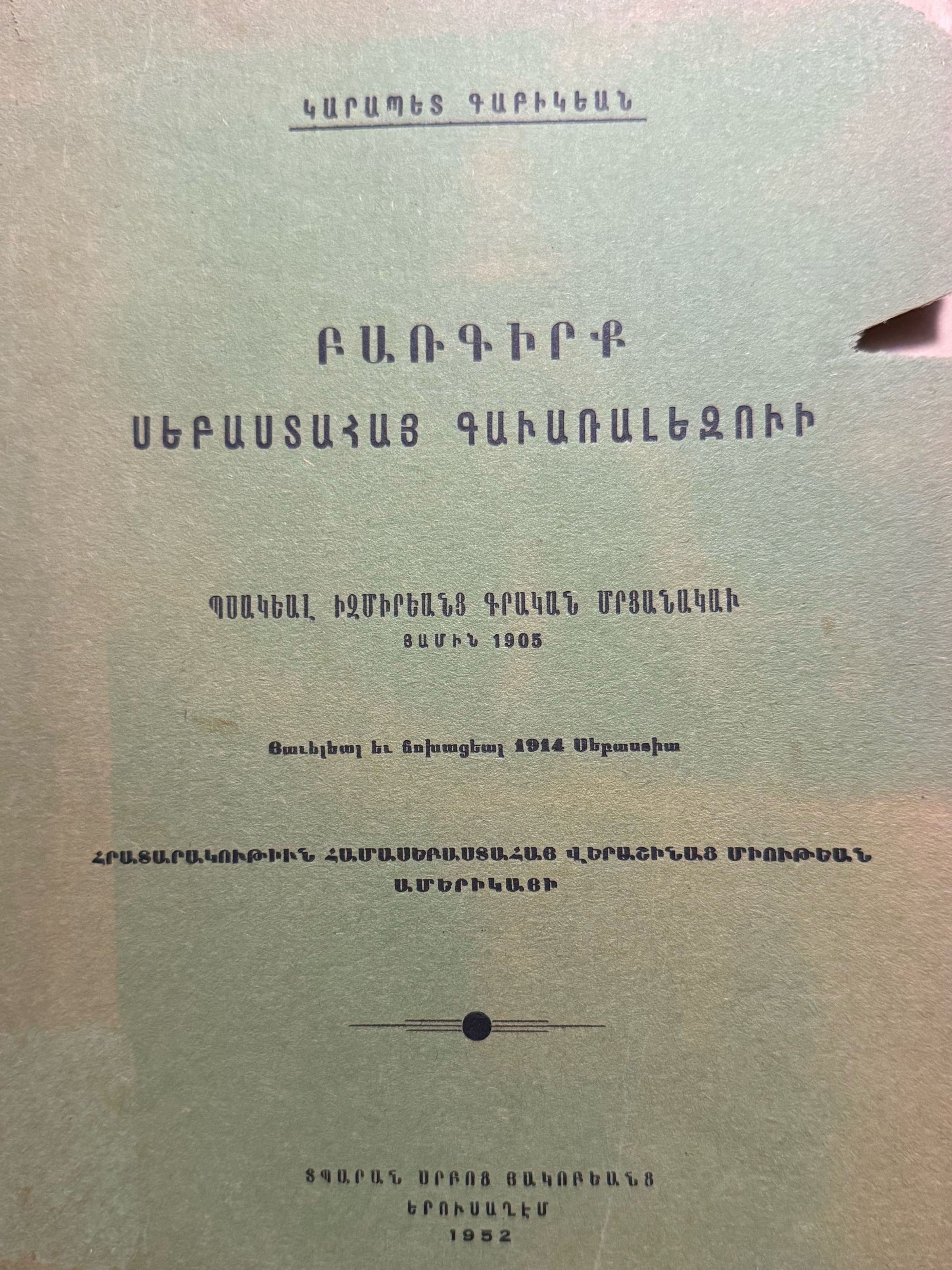
Parkirk Sepasdahay Kavaralezu (Garabed Kapigian, 1952)
Name/Title
Parkirk Sepasdahay Kavaralezu (Garabed Kapigian, 1952)Description
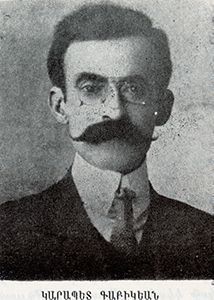
Karapet Gabikyan (Armenian: Կարապետ Գաբիկեան, also transliterated Gabikian or Gabikyan) was a lexicographer, ethnographer, educator, and community figure born in 1861 in Sebastia (modern Sivas, in historic Western Armenia). He received his early education in Sebastia’s local school and began a teaching career that would define his lifelong dedication to Armenian language and culture. Over time he wrote several scholarly and ethnographic works, though most were tragically lost during the Armenian Genocide. In the spring of 1915, when Ottoman authorities began arresting Armenian intellectuals and community leaders in Sebastia, Gabikyan foresaw what was coming. Before his deportation, he burned his manuscripts, notes, and literary compositions to prevent them from falling into hostile hands. He was deported along with his family, who perished during the march into the Syrian desert. Gabikyan survived and arrived as a refugee in Aleppo in 1919, where he began reconstructing the memory of his destroyed community. With fellow survivors such as Grigor Pahlevanyan, he founded the “Sebastatsi Compatriotic Union,” which collected detailed demographic and statistical records of survivors and undertook relief work for orphans and displaced Armenians from Sebastia. Gabikyan’s most significant contribution is his monumental work Yeghernapatum Pokun Hayots yev norin metzi mayrakaghak’in Sebastioy (“The History of the Catastrophe of Little Armenia and Its Great Capital Sebastia”), completed in 1920 and published in Boston in 1924 under the pseudonym Guzhkan Sebastio. Written from personal experience and based on eyewitness testimonies, the book provides one of the earliest comprehensive narratives of the Armenian Genocide in the Sebastia region. It opens with the political climate of the late Ottoman Empire and the Balkan Wars, tracing how the extermination of Armenians was systematically planned and executed. Gabikyan describes with painful precision the destruction of hundreds of Armenian villages, the burning of churches and schools, and the mass deportations that followed. He records that the Armenian population of Sebastia numbered about 5,800 households, roughly 34,000 to 36,000 individuals, and estimated that around 350,000 Armenians were deported from the provinces of Western Armenia and Lesser Armenia. His work includes meticulous documentation of place names, destroyed villages, and deportation routes leading through places such as Ferendjlar, Suruç, and Raqqa. Beyond chronicling violence, Gabikyan also highlighted the resilience of Armenian survivors, the plight of orphans, and the recovery of women and children who had been forcibly Islamized. In 1920 Gabikyan accepted an invitation from the Armenian Patriarchate of Jerusalem and moved there, bringing with him eleven Armenian orphans. In Jerusalem he continued teaching Armenian language, history, and geography in local Armenian schools, while finalizing and preparing his manuscript for publication abroad. He married Azniv Norarevyan of Sebastia in Aleppo in 1919, and they had two children. He died in Jerusalem in 1925. Karapet Gabikyan’s legacy lies in his dual identity as both witness and scholar. Having lost his family, his community, and nearly all his previous work, he turned his suffering into a disciplined act of preservation, documenting the life and destruction of Sebastia’s Armenians with rare clarity and moral force. His History of the Catastrophe of Little Armenia remains a crucial source for understanding the local dimensions of the Armenian Genocide and the cultural life of Western Armenia before its annihilation. His records of place names, survivor statistics, and ethnographic detail make his book not only a personal testament but also a vital document of historical memory.Category
Books