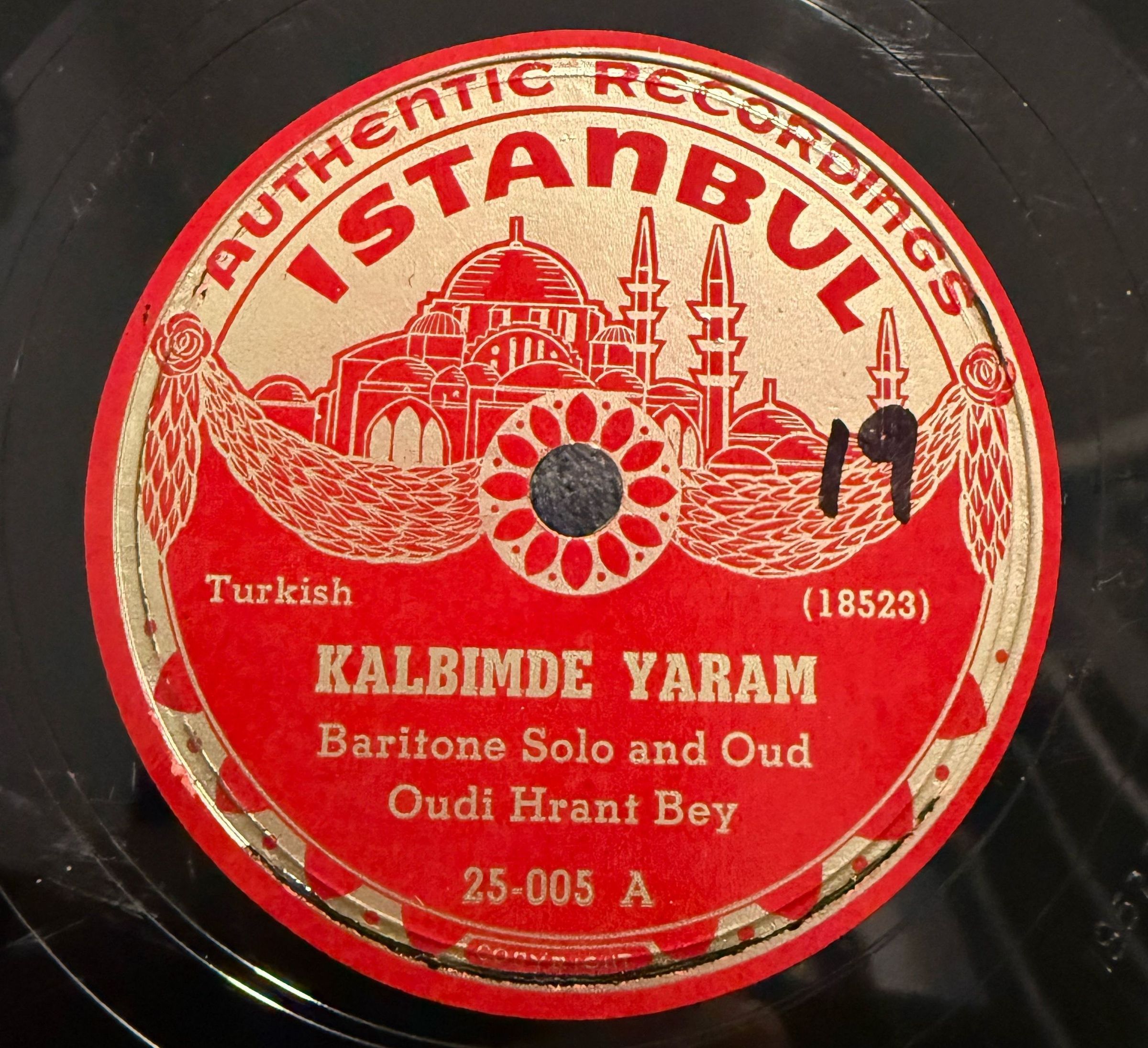
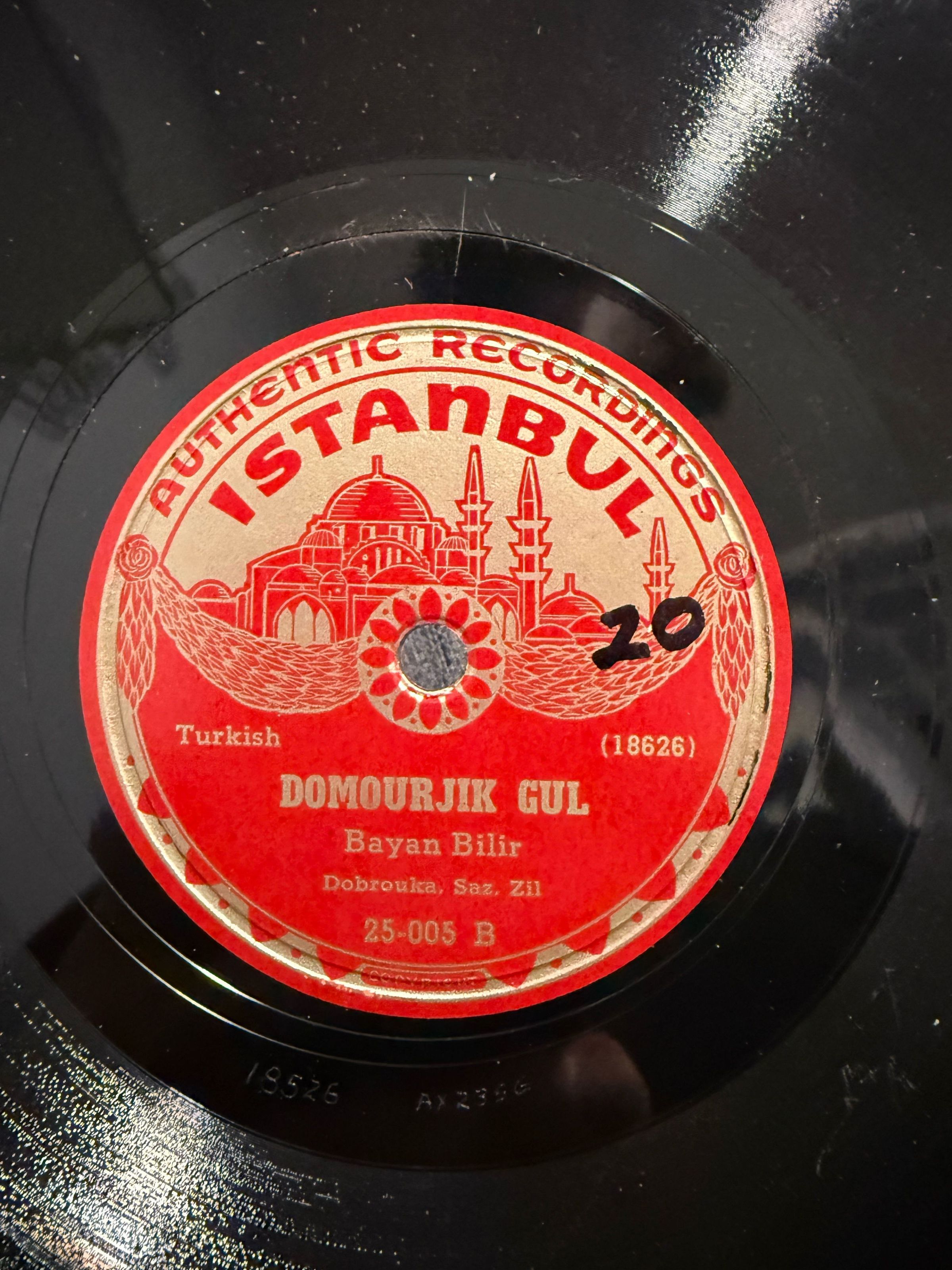
Udi Hrant, Kalbimde Yaram/Bayan (Zehra) Bilir, Doumourjuk Gul
Name/Title
Udi Hrant, Kalbimde Yaram/Bayan (Zehra) Bilir, Doumourjuk GulDescription
Udi Hrant Kenkulian, born in 1901 in the vicinity of Adapazarı emerged as one of the most influential oud masters of the twentieth century. Declared blind just days after his birth, he faced the challenge of persistent blindness throughout his life despite undergoing multiple treatment attempts, including in Vienna. His early years were marked by hardship: during the period of the Armenian Genocide his family was displaced, and it was while living in Konya under dire circumstances that he first plucked at the oud, acquiring a battered instrument and teaching himself to perform local dance melodies despite his poverty and disability. After relocating with his family to Istanbul (then Constantinople) following World War I, Kenkulian began working in coffee‑houses and nightclubs in the Beyoğlu district, studying formally with Armenian musicians including violinist‑vocalist Agopos Alyanakian, Dikran Katsakhian, and oudist‑vocalist Krikor Berberian. By the early 1930s he was composing his own songs and recording taksims (instrumental improvisations) in Turkish classical and popular modes—his 1935 recordings of taksims in the Hijaz and Huzzam modes were quickly praised as masterpieces and circulated internationally, including in the United States. While of Armenian descent and working in Turkey as an ethnic Armenian citizen, he wrote the bulk of his lyrics in Turkish and developed a large audience across linguistic and ethnic communities—including Armenian, Turkish and Greek speakers. Musically, he was a pioneering figure: he introduced techniques to the oud such as double‑stops (playing two strings simultaneously), bidirectional plectrum strokes (using up‑stroke as well as down‑stroke), novel open tunings and octave‑paired strings, expanding the expressive potential of the instrument and influencing subsequent generations of oud players. In 1950, a travel opportunity to the United States—initially conceived as a medical trip for his blindness—evolved into a concert tour through New York, Boston, Detroit, Los Angeles and Fresno. He performed both his Turkish‑language repertoire and Armenian‑language songs while abroad, and these visits raised his profile significantly back in Istanbul where he began to perform on radio as a soloist and eventually formed his own chorus. In 1969 he formally bestowed the title “Udi” (master of the oud) on five younger Armenian‑American oud players—John Berberian, Chick Ganimian, Richard Hagopian, George Mgrdichian and Harry Minassian—thus cementing his mentorship and legacy among diaspora musicians. His artistry was praised for its soulful spirit, deft improvisation (taksim), and seamless blending of Armenian melodic sensibility with Turkish‑classical forms. In later years he toured to Paris, Beirut, Greece and in 1966 visited Soviet Armenia, broadening his global reach. Behind the virtuosity, his life bore traces of resilience: blind from early infancy, uprooted by genocide and displacement, making his survival through café work and night‑club gigs to international tours. He died on 29 August 1978 in Istanbul, after a final performance in April of that year while already suffering from cancer, and was laid to rest in the Şişli Armenian Cemetery. On the flipside, "Bayan Bilir", who was Zehra Bilir, was born on 26 March 1913 in Arapgir. While for much of her public life she was known simply as a pioneering Turkish folk‐song artist, her origins trace to an Armenian family: many sources record her birth name as Eliza (or Eliza Olçuyan / Surhantakyan) and note that her father was an Armenian named Harutyun. Her early childhood was shadowed by upheaval: her father went to serve in World War I and never returned. Her mother later married a Turkish man and relocated the family, which contributed to Zehra’s upbringing within a mixed cultural environment. Although she often identified publicly as Turkish and Muslim—saying in a later interview: “I am originally from Elazığ. I don’t remember my father. He was an Armenian… I am Turkish and a Muslim.”—her Armenian ancestry remained part of her personal history, though rarely accentuated in her public persona. Zehra’s artistic journey began in Istanbul when she moved there via Elazığ and Kayseri for her schooling and early career. At first she worked outside music—for example as a milliner’s assistant—but soon transitioned into performance, including ballet and operetta work, before turning to folk song. Her music education included solfège and notation lessons from the Armenian musician Artaki Candan‑Terziyan, which attests to her Armenian‑connected network within Istanbul’s musical life. By the 1940s she had established herself as one of the first major female soloists of Turkish folk music (Türk Halk Müziği). Her stage persona—often wearing traditional regional costume, singing with a handkerchief, and conveying rural Anatolian emotional landscapes—made her a distinctive figure. While mainstream memory credits her as purely a Turkish folk artist, the Armenian‑heritage angle adds a layer of complexity: her identity operated at an intersection of Armenian origin, Turkish public culture, and the societal pressures of her time. Despite her Armenian roots, Zehra rarely publicly embraced or emphasized her Armenian ethnicity during her career; some observers describe her as a “hidden Armenian” within Turkish cultural life. On the other hand, within the Armenian community and among scholars of minority culture in Turkey, her background has become increasingly recognized and discussed. Her musical repertoire drew deeply on Anatolian folk traditions, and she recorded numerous songs, among them “Tiridine Bandım” and “Cemo Gül Açanda Gel.” She also served as a figure of inspiration for women performers in folk music and as a repository of regional song traditions. She passed away on 28 June 2007 in Istanbul and was buried in the Zincirlikuyu Cemetery.Audio Format
78 RPM RecordRecording Type
MusicCategory
Vinyl Record
Album Detail
Contributors
Udi Hrant
Zehra Bilir