Postcard #54
Name/Title
Postcard #54Description
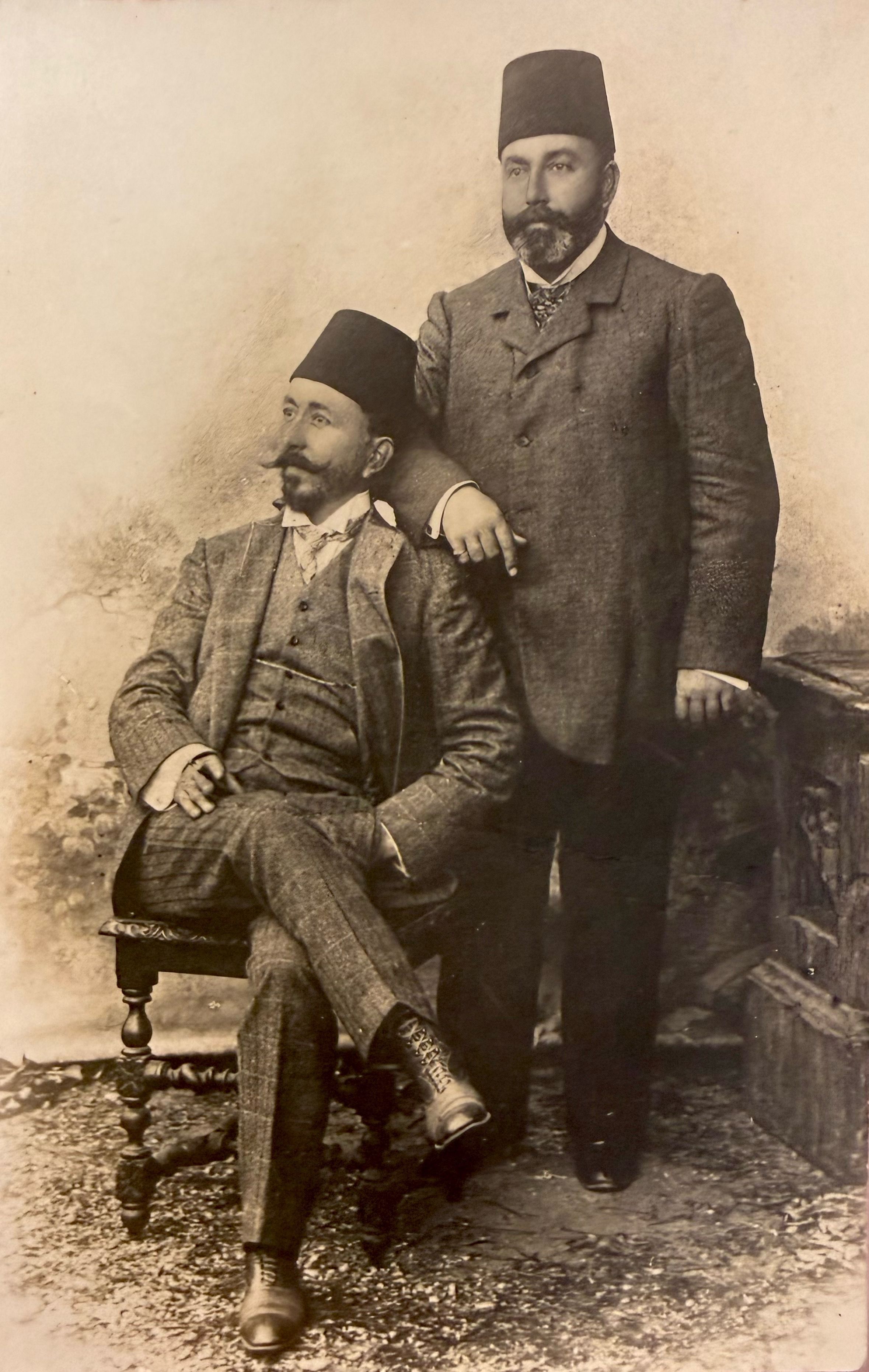
Melkon (Gürciyan) Guirdjian, known by his pen name Hrant, was an Armenian writer, educator, and civic activist born in 1859 in the village of Havav, located in Palu, now part of Elazığ. He received his early education in his hometown before moving to Constantinople at the age of 11. There, he attended the prestigious Jemaran Armenian School in Üsküdar and later the Surp Haç Tbrevank, where he completed his studies. From 1878 to 1896, Guirdjian taught Armenian history, language, and culture at various Armenian schools, including the renowned Getronagan Armenian High School.  In 1893, Guirdjian was imprisoned for alleged political activities. Following his release, he fled to Varna, Bulgaria, due to political instability. In Varna, he founded the Armenian school Artzrunian, which served as a refuge for Armenian refugees. During his absence from Constantinople, his home was raided by local authorities, and many of his manuscripts and writings were destroyed. He returned to Constantinople in 1898 but was immediately arrested upon his arrival. After spending six months in prison, Guirdjian escaped to Kastamonu, where he remained for ten years. During his time in Kastamonu, he continued to teach Armenian literature and history covertly. In 1906, his literary works were once again destroyed based on reports from secret agents.  Following the success of the Young Turk Revolution in 1908, Guirdjian returned to Constantinople and resumed his civic and literary activities. On April 24, 1915, during the early stages of the Armenian Genocide, Guirdjian, along with other prominent Armenian intellectuals and community leaders, was arrested and deported to unknown destinations within the interior provinces of the Ottoman Empire. He was ultimately killed by Turkish gendarmes on the outskirts of Ankara.  Guirdjian’s literary works include “Letters from Wayfarer’s Life,” “Stories,” “Countryman’s Letters,” “Mesrop and Sahak,” and various translations. His writings, particularly under the pen name Hrant, offer poignant depictions of the challenges faced by provincial Armenians in the Ottoman Empire. On the right is Ömer Naci (1878–1916) who was a Turkish military officer, politician, and intellectual active during the late Ottoman Empire. Born in Bursa to a Circassian family, he lost his parents at a young age and was adopted by Cemal Bey, the head of the Baghdad finance office. Under Cemal Bey’s guidance, Naci received a rigorous education, studying Arabic, Persian, and French, and developed a strong interest in literature and poetry. Naci attended the Manisa Military High School and the Imperial Military Academy (Mekteb-i Harbiye), where he became close friends with Mustafa Kemal Atatürk. Their friendship was marked by shared intellectual pursuits, particularly in literature and poetry. Naci’s eloquence and oratorical skills made him a prominent figure in the Committee of Union and Progress (İttihat ve Terakki Cemiyeti), the political organization that played a significant role in the Young Turk Revolution of 1908. During the Balkan Wars and World War I, Ömer Naci participated in several military campaigns. In 1913, he played a role in the Ottoman coup d’état, collaborating with fellow CUP member Ömer Seyfettin to stir public sentiment against the government by spreading rumors of territorial concessions to Bulgaria. With the outbreak of World War I, he was sent to the Caucasus Front in August 1914 to help establish the Teşkilât-ı Mahsusa, an Ottoman intelligence and paramilitary organization, alongside Bahaeddin Şakir. On behalf of the CUP Central Committee, a delegation consisting of Şakir, Ömer Naci, and Hilmi Bey—accompanied by Georgian and Azerbaijani representatives—attended the VIII World Congress of the Dashnaktsutyun, held in Erzurum from 28 July to 14 August 1914. According to some reports, the Ottoman government sought the Armenians’ assistance to remove the Caucasus from Russian influence and potentially grant independence afterward. At the time, the Armenian side, seeing the international situation in their favor, rejected this proposal. Naci contracted typhus during a military mission in Iran and died on July 29, 1916, in Kirkuk. His body was interred in the Turkish Martyrs’ Cemetery in Kirkuk, Iraq. Naci’s legacy is remembered for his contributions to Turkish literature, his pivotal role in the political and military events of his time, and his enduring friendship with Mustafa Kemal Atatürk.Photograph Details
Subject Place
* Untyped Subject Place
ConstantinopleCategory
Postcards