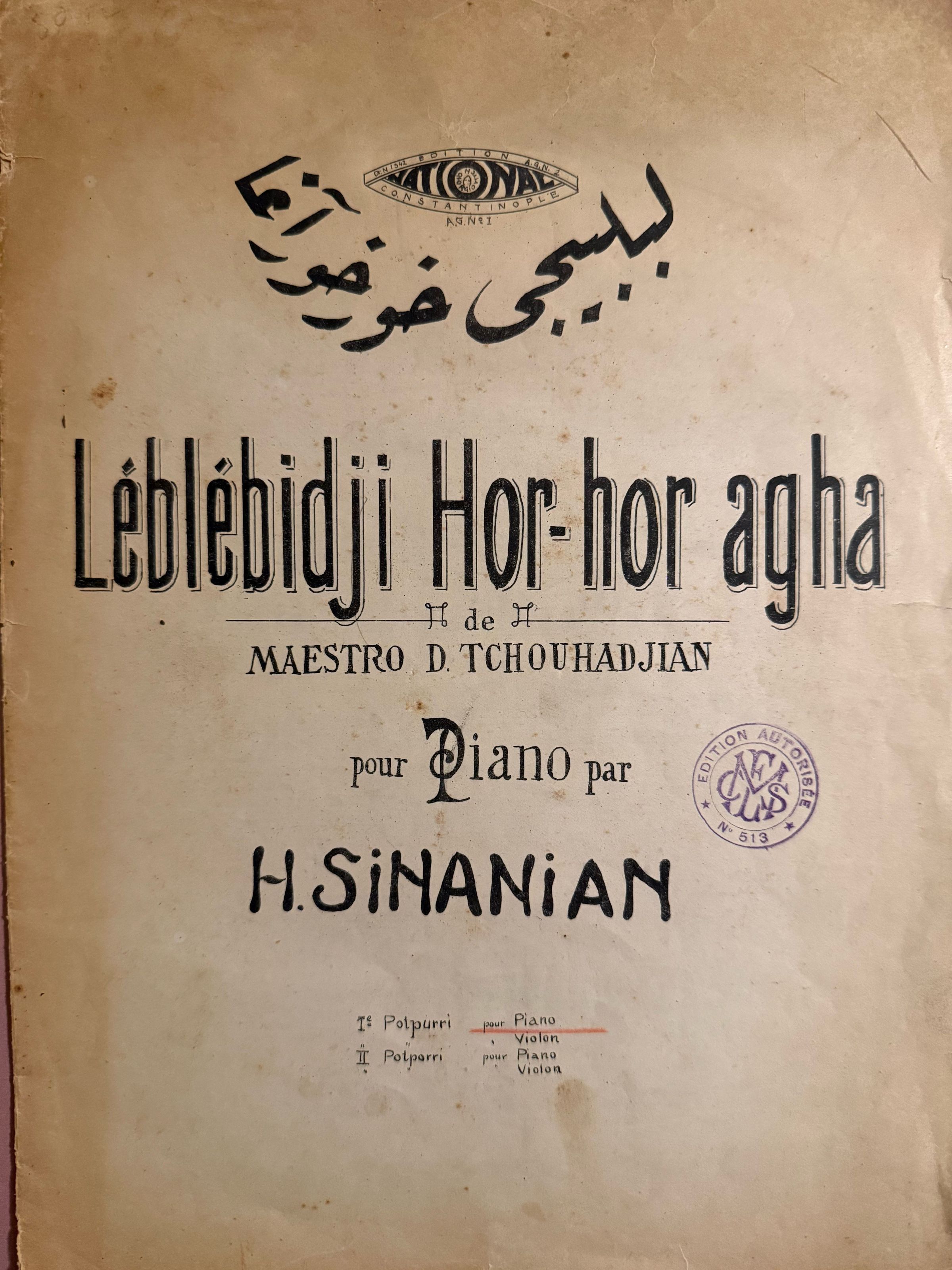
Musical Score (Leblebidji Hor-hor Agha)
Name/Title
Musical Score (Leblebidji Hor-hor Agha)Scope and Content
Tigran Chukhajian (1837–1898) was a pioneering Ottoman-Armenian composer and conductor, widely regarded as the founder of Armenian opera. Born in Constantinople (modern-day Istanbul), he was the son of a court watchmaker to Sultan Abdulmejid I. His early exposure to music and theater ignited a lifelong passion for the arts. Chukhajian received formal musical training in Milan, where he developed a deep admiration for Giuseppe Verdi. He later returned to Constantinople, where he became a central figure in the cultural life of the Armenian community. He founded the first opera institution in the Ottoman Empire and composed several operas, including Arshak II (1868), which is considered the first Armenian national opera. The opera was based on the life of King Arshak II and was partially staged in 1873, with a full performance occurring in 1945. Another significant work by Chukhajian is Leblebici Horhor Agha (1875), also known as The Chickpea Seller. This operetta is notable for being one of the earliest examples of Turkish-language musical theater. It premiered in Constantinople and was performed over a hundred times during its initial run, even during Ramadan. The operetta's success led to its adaptation into a silent film in 1923 and a sound film in 1934, which won an honorary award at the Venice International Film Festival. Tigran Chukhajian passed away in Smyrna (now Izmir) on March 11, 1898, and is buried in the Armenian cemetery there. Harutyun Sinanyan (1872-1939) was born in Istanbul and was the grandson of Krikor Sinanyan, who founded Istanbul’s first Western music orchestra. He studied under prominent musicians such as Dikran Çuhacıyan, Brasen, and Radelli. As he began to gain recognition, he was invited to the Ottoman Palace by Sultan Abdulhamid II, who admired his talent. Following his grandfather’s example, Sinanyan established Istanbul’s second orchestra and collaborated extensively with the Minakyan Theater Company, directing famous musical classics such as La Belle Hélène, La Ascote, and Carmen. Remarkably, at the age of 17, he founded Istanbul’s first major symphonic orchestra. The orchestra’s repertoire included works by Beethoven, Mozart, Kuno, Verdi, Rossini, Bellini, Dikran Çuhacıyan, and his own compositions—a significant achievement at such a young age. During the declaration of the Second Constitutional Era (II. Meşrutiyet), when Turks and Armenians were politically approaching each other, Sinanyan composed a march for the Committee of Union and Progress (İttihat ve Terakki). This march was performed throughout the country with great enthusiasm. Newspapers such as Tanin, Sabah, Servet-i Fünun, La Turquie, Levant Herald, and Le Moniteur published highly favorable reviews of the piece. Following this, Sinanyan composed the Şehitler Marşı (Martyrs’ March), which was also well received by the Unionists, and later wrote a song dedicated to Prince Sabahaddin. He performed at venues including the Büyükada Yacht Club, Pera Palas, and Sümer Palas. In 1917, he was appointed as a teacher at Heybeliada Naval Academy (Deniz Harp Okulu), where he taught flute, clarinet, piano, violin, and solfège to young cadets. Sinanyan composed nearly 70 works during his lifetime. He passed away on January 7, 1939, and is buried in the Şişli Armenian Catholic Cemetery.Category
Musical Publications