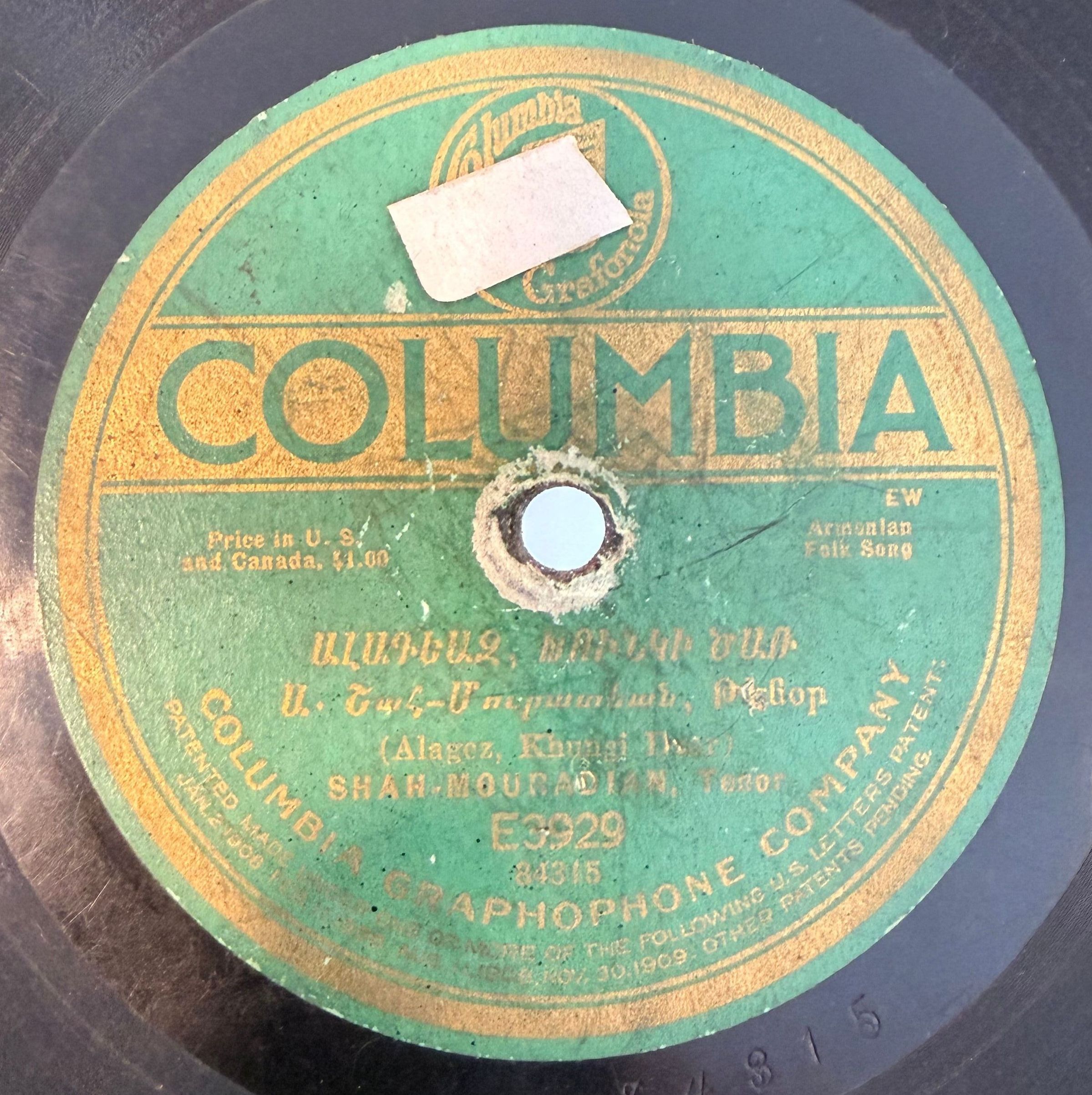
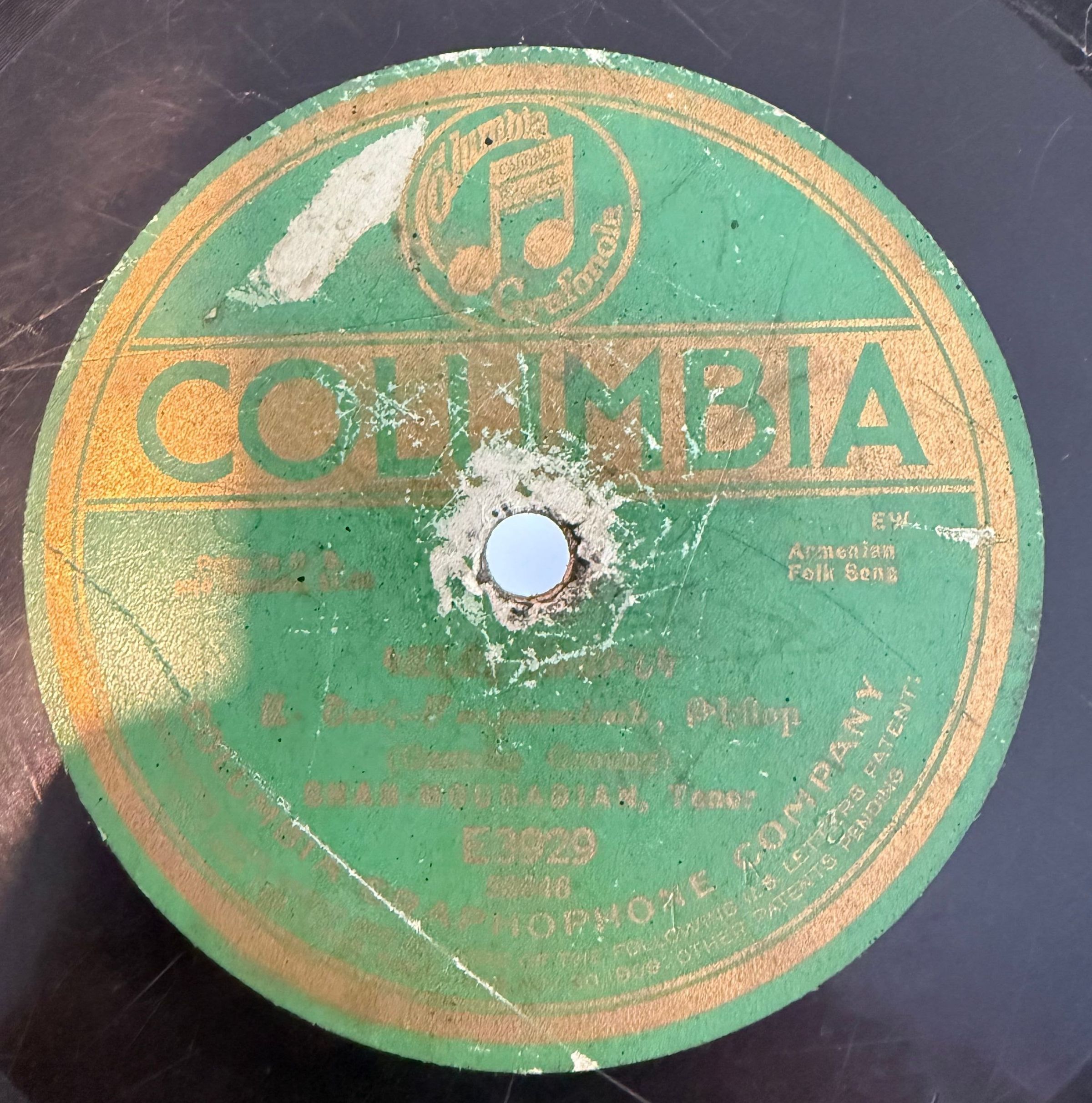
Armenag Shah-Muradian, Gantche Groong/Alagez Khungi Dzar
Name/Title
Armenag Shah-Muradian, Gantche Groong/Alagez Khungi DzarDescription
In 1917-1918 Shah-Mouradian made sixteen recordings with Columbia Records in New York. Many of them were from the same repertoire as his earlier discs. These recordings became incredibly popular in the United States; practically every Armenian family who owned a phonograph in the 1920s had at least one of them, if not several. Writers like William Saroyan and David Kherdian remembered their parents’ generation playing these records as a hallmark of their childhood. “Kanche Krunk” (also rendered as Gantche Groung or Call, Crane) is an Armenian folk song belonging to the tradition of exile and longing songs centered on themes of separation, homesickness, and life away from one’s homeland. The song’s central symbol is the crane, a bird that occupies an important place in Armenian folklore and medieval literature as a messenger associated with homeland, travel, and communication across distant lands. In the song, the speaker—often portrayed as an exile or migrant—addresses the crane, asking it to call out or carry news back home, expressing longing for native soil, loved ones, and familiar places. Across different versions of the song, emphasis may shift between romantic separation and the broader experience of displacement, exile, and the sorrow of living far from one’s homeland. The crane functions as an intermediary between the world in which the speaker now lives and the homeland left behind. The song survives in several textual and musical variants that circulated among both Western and Eastern Armenian communities. Although rooted in oral tradition, it became especially well known through the work of Komitas Vardapet, who collected, arranged, and helped preserve Armenian folk repertoire in the late nineteenth and early twentieth centuries. Through Komitas’s arrangement, “Kanche Krunk” entered the canon of Armenian concert and traditional music and continued to be performed in both solo and ensemble settings. “Ալագեազ, Խունկի ծառ” (more commonly rendered as Alagyaz, Khnki Tsar) is an Armenian folk song preserved and popularized through the work of Komitas Vardapet. It belongs to the broad tradition of Armenian lyrical folk songs that intertwine landscape imagery with themes of love, longing, and emotional separation. The song takes its title from two powerful images: Alagyaz (the historic Armenian name for Mount Aragats and its surrounding highland landscape) and the “incense tree” or “fragrant tree” (khunki tsar), a poetic symbol that appears in Armenian folk language to evoke beauty, delicacy, and idealized affection. In Armenian folk poetry, natural features are rarely decorative; mountains, springs, trees, and orchards often act as emotional stand-ins for memory, homeland, and human relationships. The text follows a familiar Armenian folk motif in which the speaker laments a beloved who has been taken away or become unreachable. The opening imagery presents Alagyaz as an elevated and healing place, whose waters are described as medicine, while the emotional center of the song turns toward grief over lost love and yearning for reunion. The beloved is praised through traditional Armenian poetic metaphors comparing beauty to fruit, precious stones, and natural abundance. Through Komitas’s arrangement and preservation work, “Alagyaz, Khnki Tsar” entered the concert repertoire and became one of the recognizable examples of how Armenian folk melodies could retain their village origins while being adapted into art music. Today the song continues to be performed by folk singers, choirs, and classical vocalists as part of the Armenian musical canon.Audio Format
78 RPM RecordRecording Type
MusicCategory
Vinyl Record