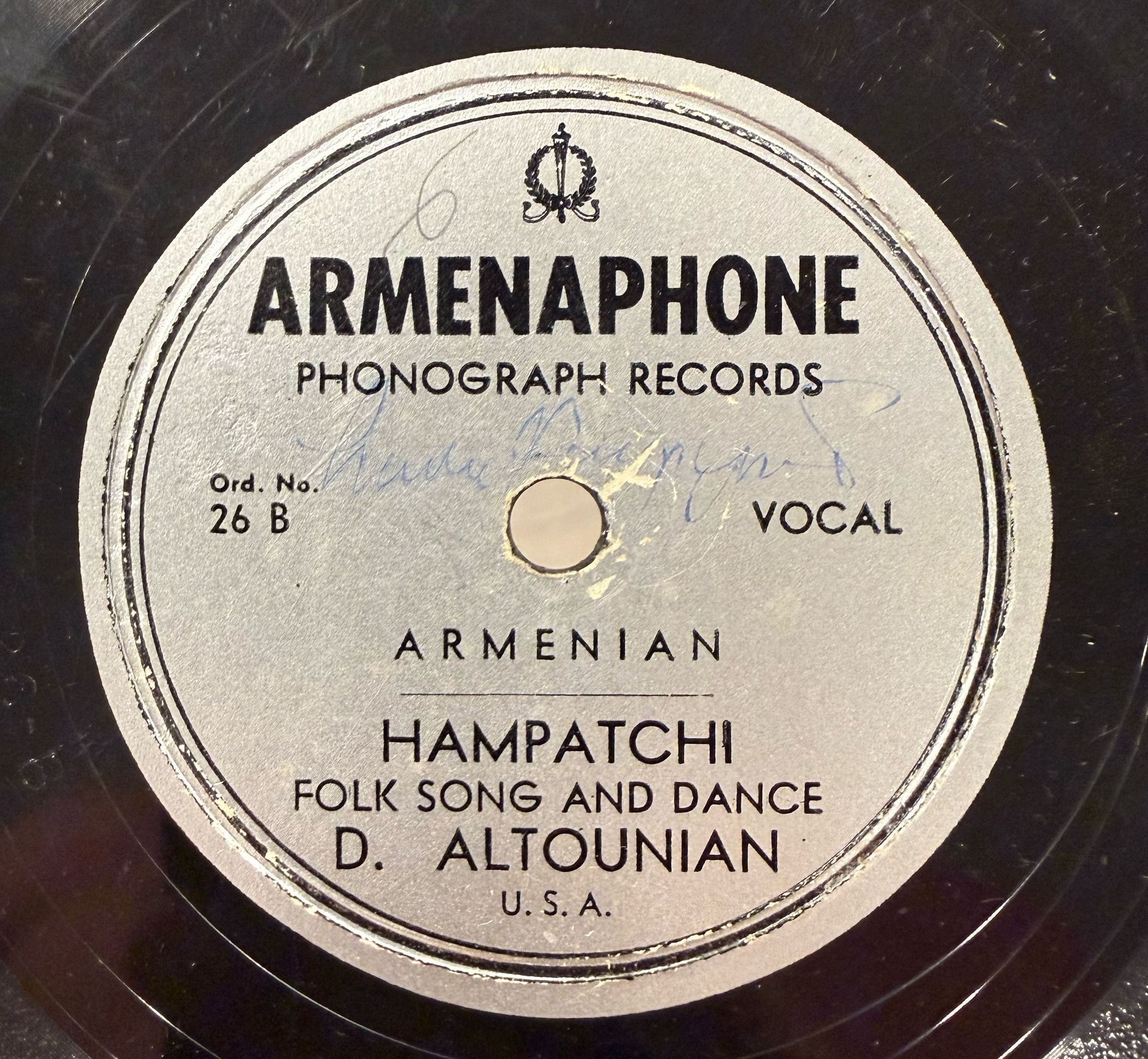
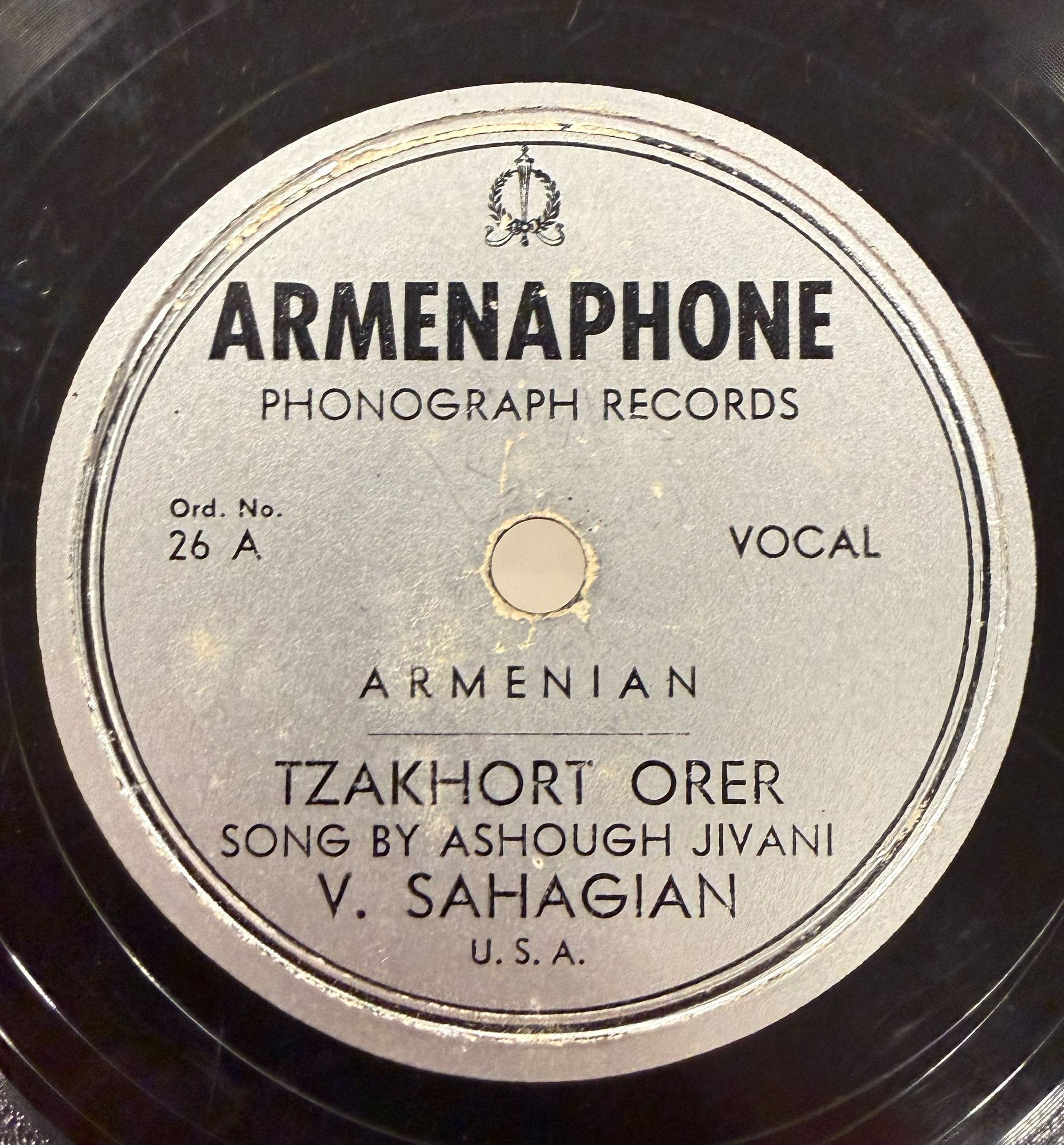
D. Altounian/V. Sahagian, Hampatchi/Tzakhort Orer #1
Name/Title
D. Altounian/V. Sahagian, Hampatchi/Tzakhort Orer #1Description
Armenaphone was an Armenian diaspora reissue imprint active mainly in New York during the late 1940s and throughout the 1950s, operated by Hrand Markar Tashjian through his record store and distribution business HM Tashjians on Third Avenue. It did not function as a conventional recording label with dedicated studio sessions; instead it belonged to a broader ecosystem of ethnic reissue labels that repackaged early commercial recordings for immigrant communities whose original releases had gone out of print. The label emerged in a period when major American companies such as Columbia and Victor had largely abandoned their ethnic catalogs after the interwar era, leaving a significant gap in access to Armenian-language recordings in the United States. Tashjian filled this gap by reissuing older masters—often originally recorded in the Ottoman Empire, Europe, or early American sessions—under his own imprints. Armenaphone was one of the principal labels in this system, alongside others such as Perfectaphone, Popular, and Kurdiphone, each aimed at overlapping but distinct Near Eastern diaspora audiences. Armenaphone records were typically 78 rpm shellac discs sold through HM Tashjian’s Manhattan shop and through Armenian community networks in cities such as New York, Boston, Detroit, Fresno, and later Los Angeles. The repertoire consisted largely of Armenian folk songs, urban Ottoman-era popular music from Constantinople, patriotic and revolutionary songs associated with early 20th-century Armenian political culture, and instrumental dance pieces performed on instruments such as oud, violin, and clarinet. Much of the material originated from pre-1915 or interwar recordings, especially from labels like Columbia, Odeon, Favorite, and other early multinational recording companies whose Armenian catalogs had been discontinued or dispersed. The labeling practices on Armenaphone releases were often inconsistent. Artist names were sometimes abbreviated, altered, or left partially uncredited, and matrix information is frequently incomplete on surviving copies. This reflects both the informal archival conditions under which the material was republished and the legal ambiguity surrounding reissues of older recordings at the time. As a result, Armenaphone discs today are often studied not only as musical artifacts but also as historical documents requiring cross-referencing with earlier 78 rpm catalogues to reconstruct original recording identities. Within the broader history of recorded sound, Armenaphone represents an early form of independent archival reissuing. It predates the more formally organized folk and ethnographic reissue movements of the 1950s and 1960s, such as Folkways, and demonstrates how immigrant entrepreneurs effectively functioned as cultural preservationists long before institutional archives systematically addressed diasporic audio heritage. Its significance lies less in technical innovation than in continuity: it kept otherwise unavailable Armenian recordings in circulation during a period when commercial demand was too small for major labels to maintain them. Today, Armenaphone records are primarily encountered in private collections and archives specializing in 78 rpm material. They are valued for both their sonic content and their role in preserving fragments of early Armenian recording history, particularly as many of the original pressings they derive from are rare or lost.Audio Format
78 RPM RecordRecording Type
MusicCategory
Vinyl Record