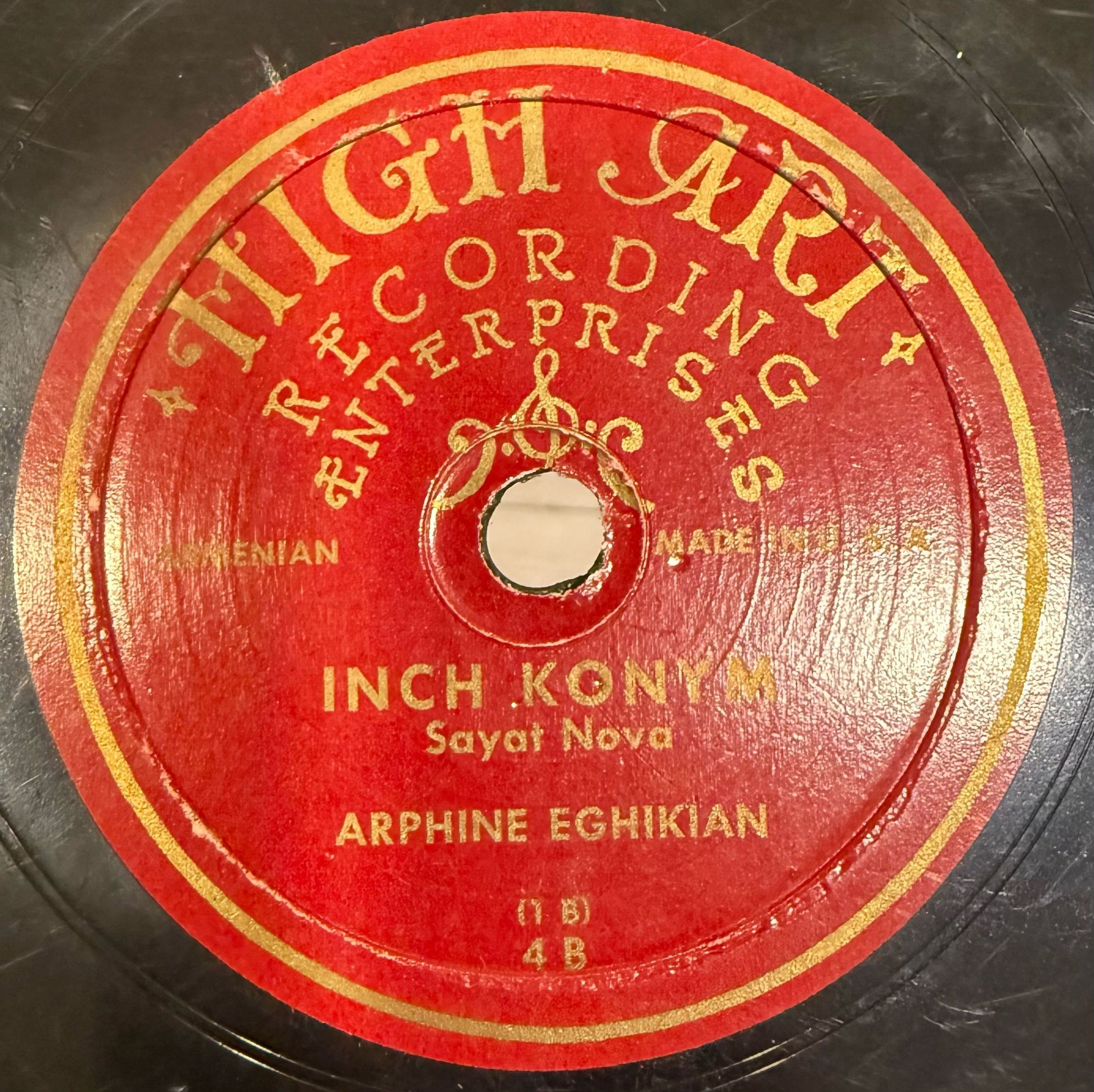
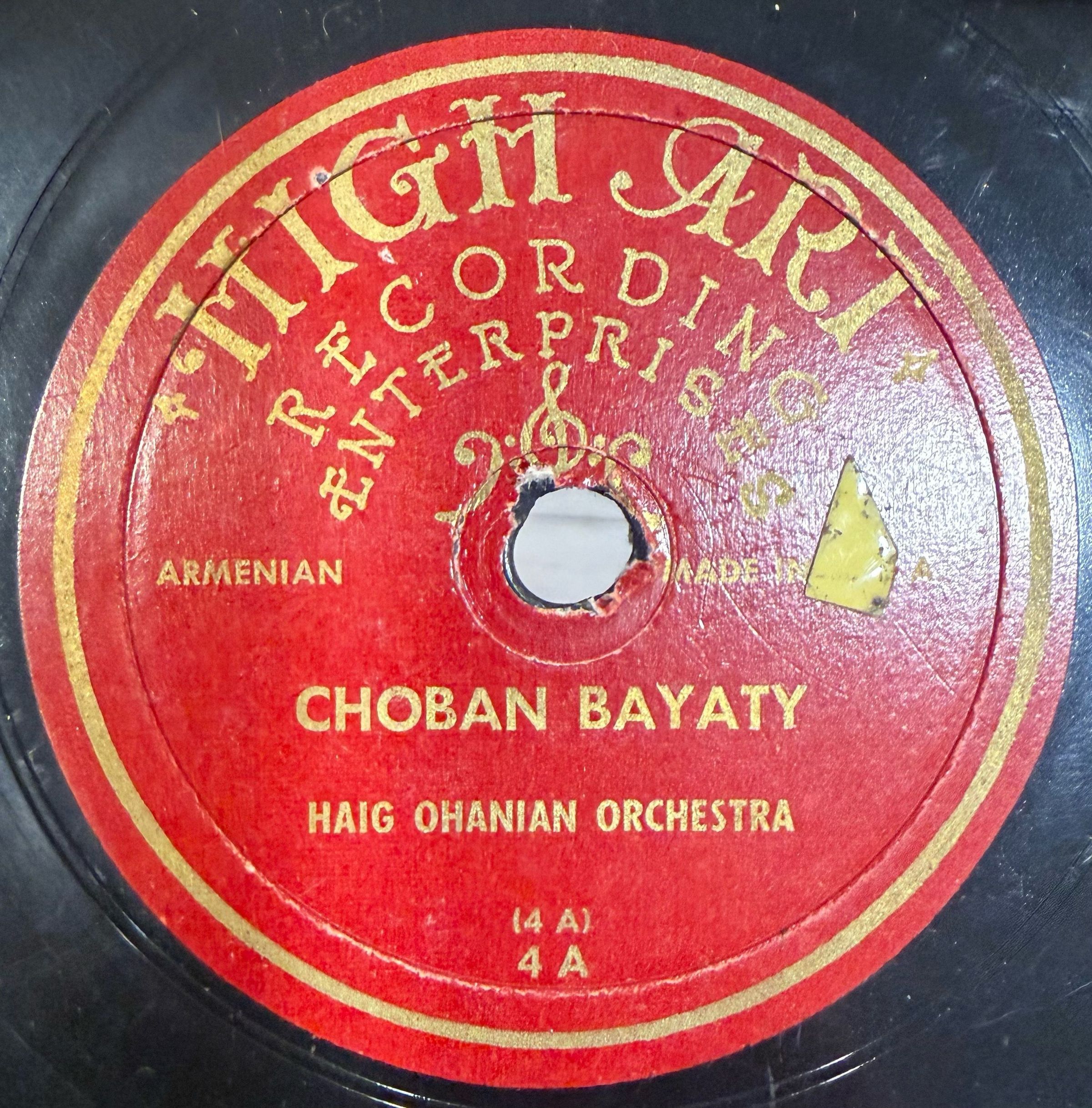
Arphine Eghikian/Haig Ohanian Orchestra, Inch Konym/Choban Bayaty
Name/Title
Arphine Eghikian/Haig Ohanian Orchestra, Inch Konym/Choban BayatyDescription
The Haig Ohanian Orchestra was an Armenian-American ensemble centered around tar player, arranger, producer, and broadcaster Haig Ohanian, one of the lesser-documented but historically important figures in early Armenian recorded music in the United States. Although often remembered under the name of the orchestra itself, the group was essentially an extension of Ohanian’s broader musical activities, which included recording, publishing, radio broadcasting, and adapting Armenian repertoire for diaspora audiences. Haig Ohanian was born in 1904 in Tiflis. He immigrated to the United States in 1924 and became active in Armenian musical circles at a moment when immigrant communities were creating their own independent recording infrastructure outside the major American labels. The orchestra emerged primarily during the 1940s and was active especially in the Detroit Armenian community. Its sound stood apart from the better-known oud-and-clarinet dance orchestras that later became dominant in Armenian-American nightlife. Ohanian’s ensemble instead revolved around the tar, a long-necked Caucasian lute associated with Armenian, Azerbaijani, Persian, and broader Transcaucasian traditions. The orchestra paired this distinctly Eastern instrument with small ensembles arranged in a more Westernized style. Contemporary accounts suggest Ohanian often wrote formal arrangements and employed professional session musicians, many of whom were not Armenian, creating a hybrid sound that blended Armenian folk and art repertoire with orchestral and American popular influences. The recordings associated with the Haig Ohanian Orchestra were issued largely through Ohanian’s own private imprint, High Art Records. Rather than releasing isolated singles alone, High Art frequently produced multi-disc 78 rpm album sets. One side would often feature instrumental tar performances by Ohanian and his orchestra, while companion sides included vocal selections performed by Armenian-American singers. Among the vocalists associated with these productions was Maria Arakian, and later accounts also connect the recordings with soprano Araxie Serkaian Terterian. Surviving titles include pieces such as “Dance of Karin,” “Hoynar,” “Yes Boojoor,” “Enzely Dance,” and “Aye Yayli,” preserved today through archival reissues and museum collections. Ohanian’s ambitions extended beyond records. In 1943 he launched the Armenian Radio Hour in Detroit, considered one of the oldest Armenian-language radio programs in the United States. The broadcasts became an outlet for the orchestra’s recordings and helped circulate Armenian music to listeners who otherwise had limited access to live performance. Through radio, the Haig Ohanian Orchestra reached audiences well beyond Michigan and contributed to preserving Armenian musical identity among second-generation immigrants. Ohanian continued radio activity into the 1950s and appears later to have relocated to the New York–New Jersey area while remaining musically active for decades afterward; documented performances survive as late as 1982. Historically, the Haig Ohanian Orchestra occupies an unusual place in Armenian diaspora music. It was neither a village folk ensemble nor a classical orchestra, but an early experiment in translating Armenian and Caucasian musical traditions into an American recording and broadcasting environment. While later Armenian-American dance bands became more commercially visible, Ohanian’s recordings remain valuable evidence of an earlier generation attempting to preserve older repertoire while adapting it to new audiences and technologies.Audio Format
78 RPM RecordRecording Type
MusicCategory
Vinyl Record