Vark Srpuyn Aleksianosi
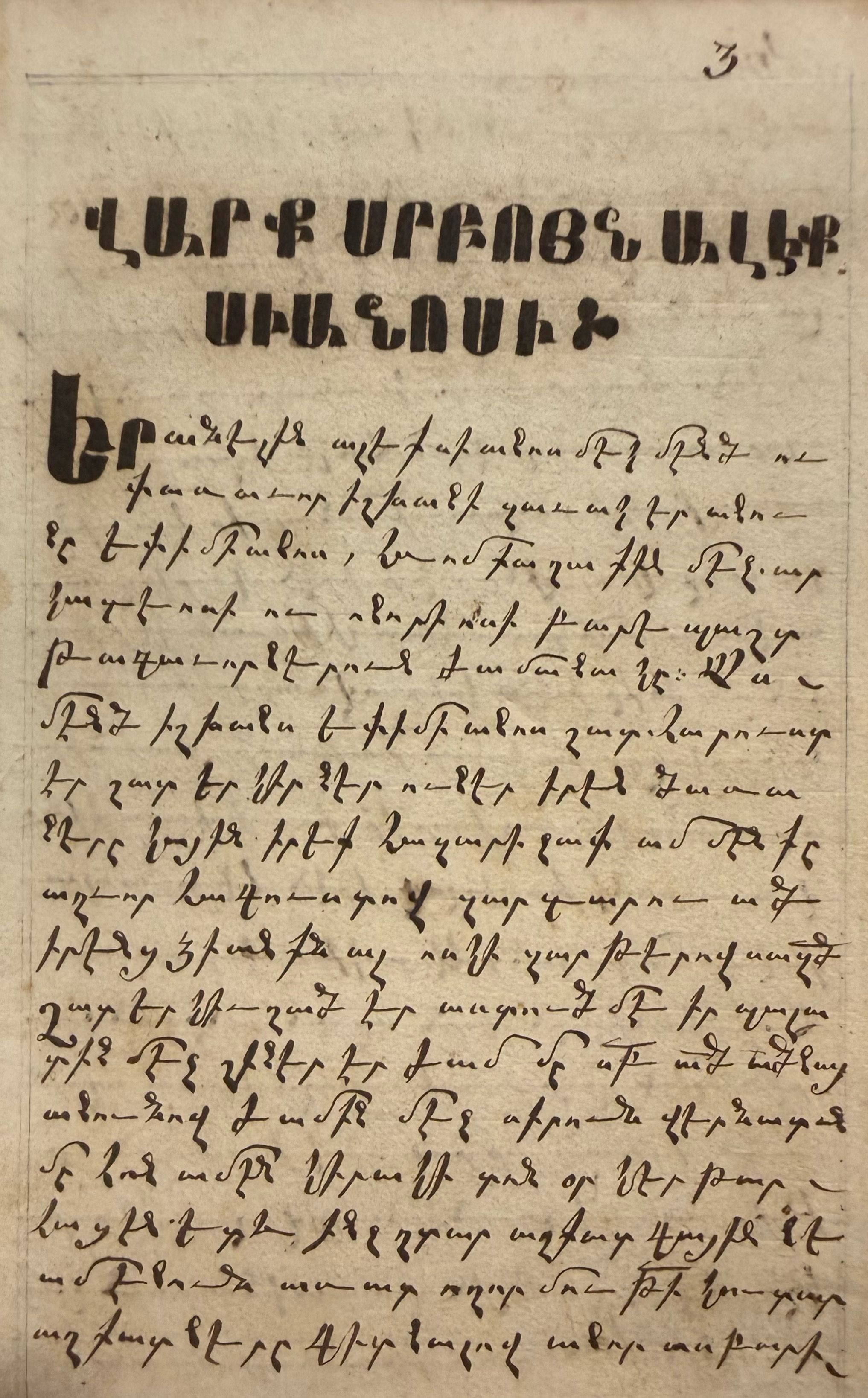
Name/Title
Vark Srpuyn AleksianosiDescription
Alexios the Man of God, known in the Armenian tradition as Alexianos the Voluntary Pauper, was one of the most venerated ascetic figures of Late Antiquity, whose story spread from Syria and Byzantium to Armenia and the wider Christian East. According to early Greek and Syriac sources, Alexios was born in Rome around the end of the fourth century to the noble couple Euphemianus and Aglais. On the day of his arranged marriage, moved by divine inspiration, he secretly left his bride and family to dedicate himself wholly to God. Traveling eastward, he lived in humility and anonymity for many years near Edessa in Syria, where his extreme poverty and piety earned him the title “Man of God.” When fame threatened his solitude, he departed again, only to be brought back to Rome by divine providence. There, unrecognized by his parents, he lived as a beggar in their household, enduring hardship and insult until his death. After his repose, a letter discovered in his hand revealed his identity and his hidden sanctity. His feast is celebrated on March 17 in both Eastern and Western Churches. In Armenia, the legend of Alexios was transmitted in two principal forms that illuminate the country’s dual cultural connections to both the Greek and Syriac Christian worlds. The first, known as the synaxaric version, follows the Byzantine pattern and names the saint Alexianos, the Voluntary Pauper (Ալէքսիանոս կամաւոր աղքատ). In this form, the saint’s life and the names of his parents correspond to the Greek originals, and the narrative focuses on his voluntary renunciation of wealth and status. This text circulated in medieval Armenian synaxaria such as those preserved in the Matenadaran manuscripts M1512, M1502, and M792, and his commemoration was incorporated into the Armenian liturgical calendar by the fourteenth century, celebrated on the seventeenth of March (the ninth of Areg). In Armenian collections, Alexianos frequently appears alongside St John the Recluse, who bears the same epithet “Voluntary Pauper,” a sign that Armenian compilers perceived both saints as embodying the same ascetic ideal. Even in manuscript illumination, their iconography occasionally overlaps, reflecting a shared hagiographic type centered on self-chosen poverty and hidden sanctity. A second Armenian version, longer and stylistically distinct, presents the saint as entirely anonymous, referred to only as “the blessed one,” “the voluntary pauper,” and “the son of the king of Rome.” This text, known as Arm II, survives in manuscripts such as M789 and was published by the Mekhitarists in Venice in 1855. It omits all personal names except that of Bishop Rabbula of Edessa and includes additional episodes and dialogues that do not appear in Greek or Syriac sources. Its deliberate emphasis on anonymity and humility, expressed in the saint’s insistence that his name be forgotten, closely parallels early Syriac ascetic ideals and may represent an adaptation of a pre-Byzantine Syriac source. In this way, the Armenian cult of Alexianos bridges the two great traditions from which it descends. The synaxaric “Alexianos” reflects the integration of Byzantine hagiography into the Armenian Church’s liturgical and artistic life, while the anonymous version preserves traces of earlier Syriac spirituality characterized by nameless holiness and radical self-effacement. Within Armenian Christianity, Alexianos thus stands as both a localized expression of the universal legend of Alexios the Man of God and a testament to Armenia’s position as a mediator between the Greek and Syriac worlds of Christian devotion.Category
Books