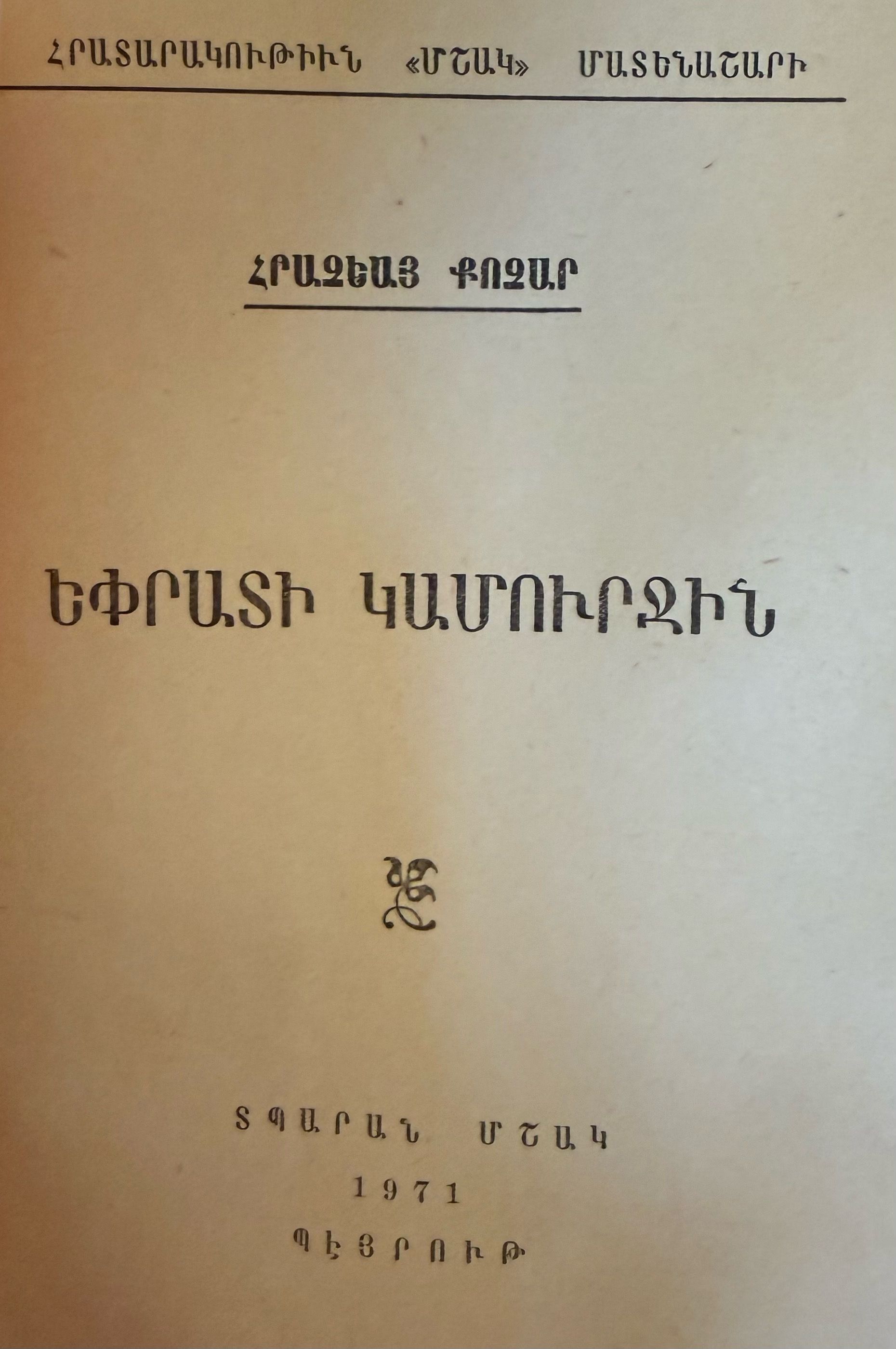
Epradi Gamurjen (Hrachia Kochar, 1971)
Name/Title
Epradi Gamurjen (Hrachia Kochar, 1971)Description
Hrachia Kochar (1910–1965) was an Armenian writer and publicist, born Hrachia Gabrielian in the village of Gumlupuchak in the Bagrevand district of Western Armenia. Orphaned at a young age, he survived the deportations and massacres of 1915 and crossed into Eastern Armenia with other refugees. His childhood experiences of displacement, hunger, loss, and the destruction of his birthplace profoundly shaped his later writing. He became one of Soviet Armenia’s prominent prose writers and journalists, serving as a war correspondent during World War II. His best known works include Karot (Longing), Nahapet, Yeprati Kamurjen (At the Euphrates Bridge), and Spitak Girք (The White Book). Yeprati Kamurjen was among Kochar’s late works, written in the final period of his life and published in 1965. The title refers to the Euphrates, a river deeply associated with the geography and memory of Western Armenia. The work belongs to the body of Kochar’s late fiction dealing with the Armenian Genocide, deportation, loss of homeland, and the memories carried by survivors and their descendants. Rather than treating the catastrophe only as a historical event, Kochar approached it through personal memory, longing, and the emotional relationship between Armenians and the homeland they had lost. The Euphrates becomes both a physical landscape and a powerful symbol of separation, survival, and remembrance. Yeprati Kamurjen was subsequently included in Spitak Kirk (The White Book), a collection of Kochar’s later novellas and stories. The 2001 National Library of Armenia edition contains Karot, Nahapet, Yeprati Kamurjen, The General’s Sister, The White Book, and Mother Tongue. Literary commentary on Kochar’s late works emphasizes the recurring theme of karot, or longing, for the ancestral homeland and the persistence of the Armenian national tragedy in his imagination. The work is particularly significant because Kochar himself was a survivor of the generation that experienced the destruction of Western Armenian communities firsthand. His late writings therefore occupy an important place in Armenian literature about memory and the lost homeland, connecting personal experience with the collective memory of the Armenian people.Category
Books