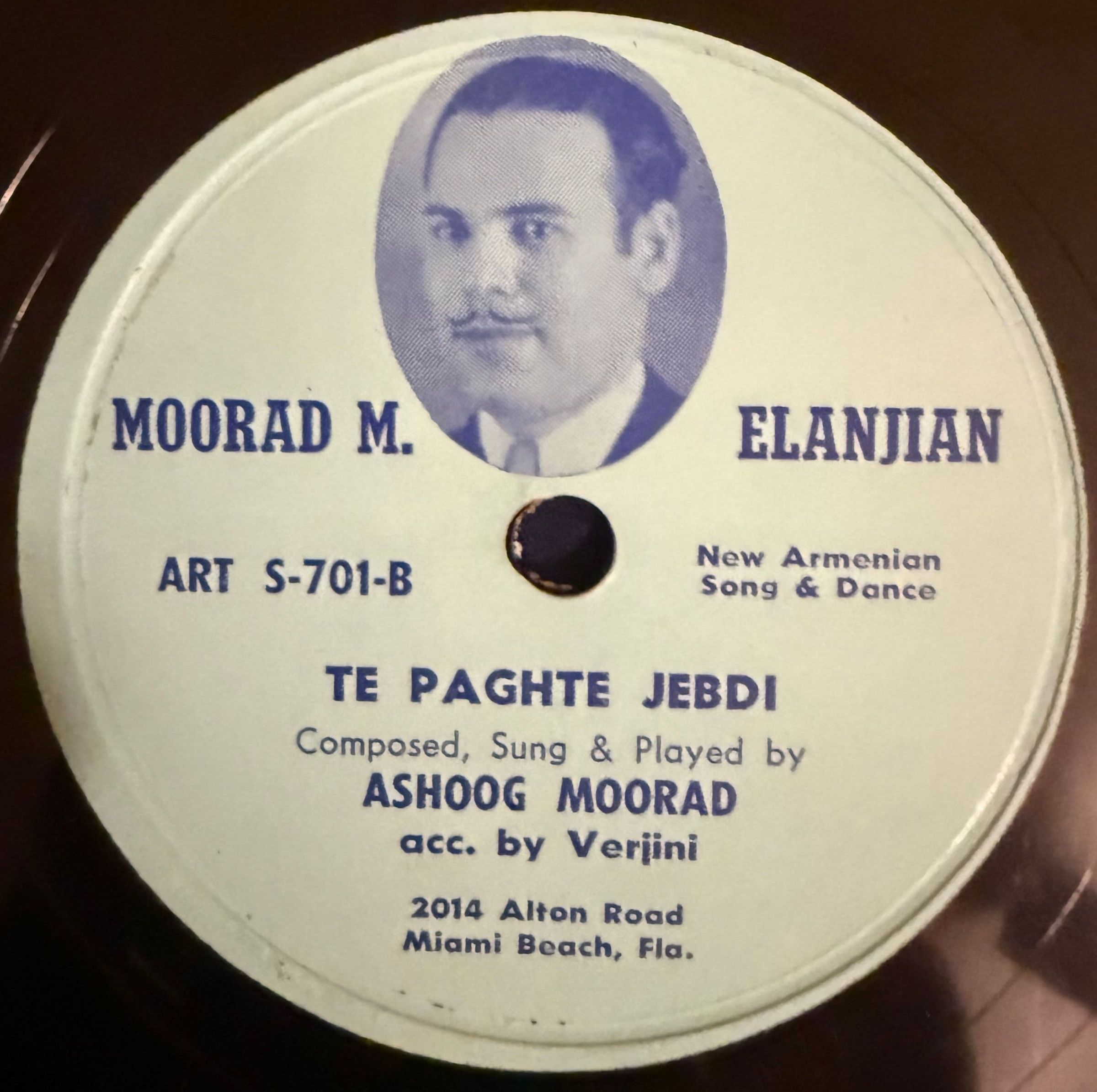
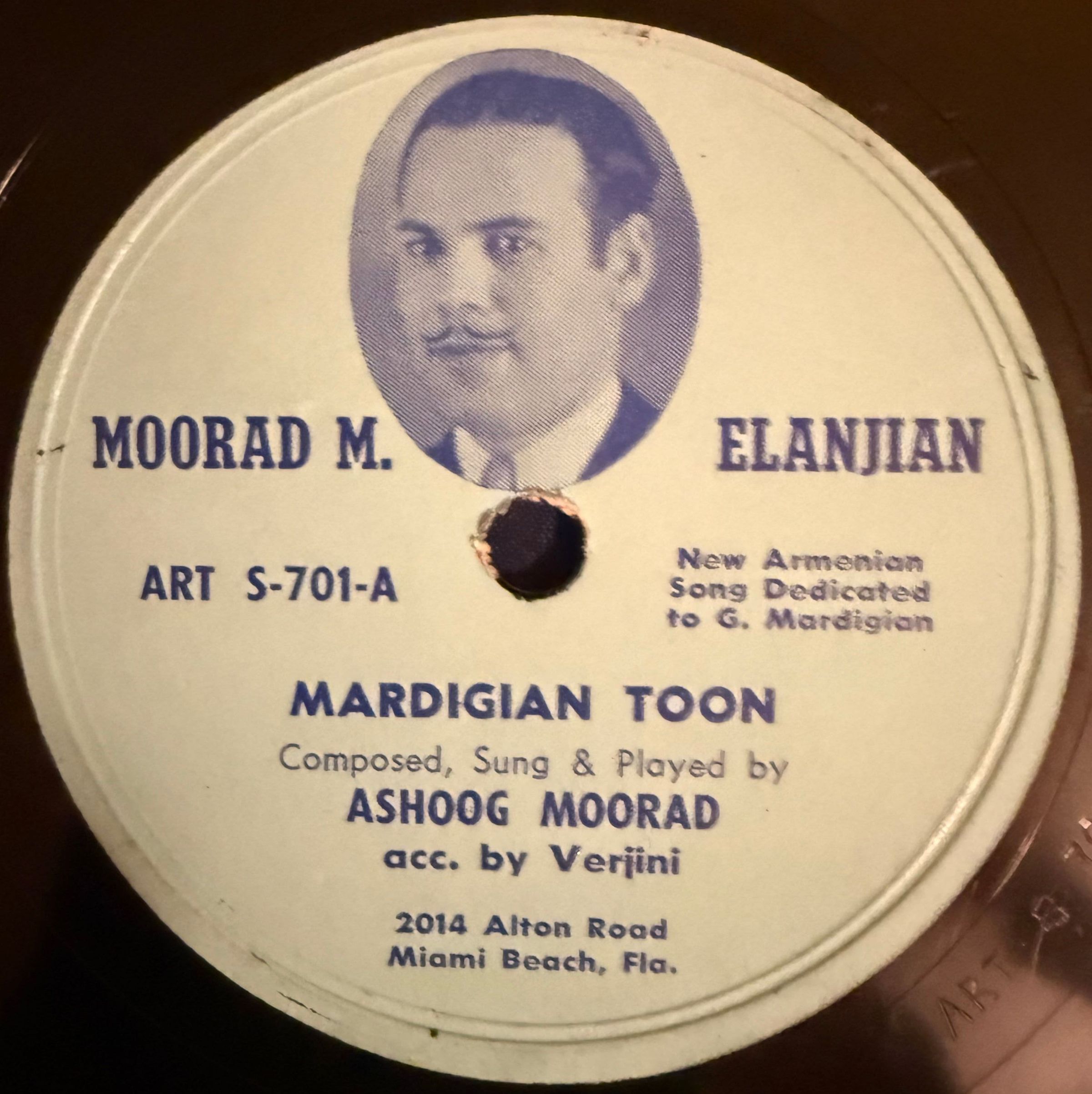
Moorad M. Elanjian, Te Paghte Jebdi/Mardigian Toon #2
Name/Title
Moorad M. Elanjian, Te Paghte Jebdi/Mardigian Toon #2Description
Moorad M. Elanjian (January 15, 1904 – January 13, 1982), also known as James Elanjian and by the musical alias “Oudi Moosheg” (lit. “Moosheg the oud player”), was an Armenian-American singer-songwriter, oud player, composer, tailor, hotel operator, and independent recording artist. Although almost forgotten during his lifetime and omitted from most histories of Armenian-American music, Elanjian left behind one of the more unusual self-produced musical projects of the mid-twentieth-century diaspora: a body of original Armenian- and Turkish-language compositions recorded and privately issued in Florida during the 1950s. His work occupies a distinctive place between older Armenian ashough traditions of original song composition and the emerging commercial Armenian-American music scene. Moorad Elanjian was born on 15 January 1904 in Arapgir into an Armenian family. His biography is complicated by shifting names, fragmented records, and multiple migrations across several countries. His family later relocated to Adana, where his sister Mariam (also rendered Miriam) was born in 1907. Like many Armenian families, the move appears to have been motivated by economic opportunity, as Adana had become an important destination for Armenian internal migration in the late Ottoman period. Following the upheaval and violence of the Adana massacre, the family moved again; Moorad’s brother George was born around February 1910 in Sivas. The family survived the period of the Armenian Genocide and spent time in Europe afterward before dispersing across the diaspora. His younger brother George eventually emigrated from Cherbourg-en-Cotentin to the United States in 1927 and settled in Philadelphia with paternal relatives. George later earned a medical degree in 1944 and moved to Michigan in 1945 to establish his practice. During the 1930s, Moorad and other family members spent periods in Havana, likely waiting for immigration opportunities under the restrictive quota system that sharply limited immigration from Armenian-populated regions. His sister Mariam entered the United States through Florida in 1933 with her husband Leon Barsamian. Moorad himself arrived through Ellis Island on 23 March 1937 and settled in Cambridge. In 1938 he married Heranoush (Harriet) Soukoian, originally from Harput. Their son, Charles George Elanjian, was born in Cambridge on 3 June 1940. By this period Moorad had already begun using the Americanized first name James and was employed as a tailor. When he filed his citizenship papers in November 1944, he listed an alias: “Oudi Moosheg.” This detail strongly suggests that he had already established some musical identity and performance activity in the Boston Armenian community. By late 1947 or early 1948 Elanjian had separated from his family and relocated to New York City. In 1949 he advertised in the Armenian newspaper Hairenik announcing that his ensemble, the Gaidzag (Lightning) Band, was prepared to perform not only Armenian repertoire but also American dance music. The advertisement presents Elanjian as both a traditional musician and someone adapting to changing tastes in postwar Armenian-America. In the early 1950s he moved again, this time to Miami Beach, where he worked as a tailor for Jordan Marsh and operated a small hotel on Alton Road. This period became his most productive musical phase. In early 1954 Elanjian submitted fifteen original, unpublished songs in Armenian and Turkish to the U.S. Copyright Office. Several years later he privately financed and issued a series of records containing his own compositions. Unlike most Armenian-American releases of the era—which focused on dance standards or inherited repertoire—Elanjian emphasized original songwriting. One Hairenik advertisement from 12 August 1954 promoted the recordings with unusual pride: “For many years the Armenian newspapers have been requesting new songs. After numerous requests, Ashough Mourad has started recording new and popular songs he’s composed with his own lyrics. These five discs are now available.” The wording consciously positioned him as an ashough—a bardic singer-songwriter in the older Armenian and Ottoman tradition. The first of Elanjian’s surviving recordings was “Mardigian Toon” (Մարտիկեան Տուն), written in honor of George Mardikian. The song praised Mardikian for humanitarian efforts remembered within the diaspora as having helped save approximately 4,000 Armenian lives. It also referenced Mardikian’s appearance on the television program This Is Your Life in May 1954. The composition is notable because it revived an older tradition of dedicatory praise songs to living public figures while transplanting that format into postwar Armenian-American culture. A later release included an instrumental oud taxim and another commemorative song honoring Drastamat Kanayan, the Armenian military and political figure known by the nom de guerre Dro. Family recollections portray Elanjian as financially comfortable during the 1950s. According to his nephew George Elanjian Jr., Moorad’s brother visited him once in Florida and later remarked that Moorad appeared wealthy enough to deliberately drive an unimpressive car to avoid attention. Contemporary reporting also indicates that Elanjian invested significant sums in stock purchases, suggesting that financing his record pressings may not have represented a major financial burden. In the early 1970s he retired to Fresno, historically one of the major centers of Armenian life in the United States. On 6 November 1981 he married Virginia Dalton (née Boyajian). Some uncertainty remains whether she may have been identical to “Verjini,” the woman credited on his 1954 recordings, though no definitive evidence currently confirms this. Moorad Elanjian died on 13 January 1982, only two days before his seventy-eighth birthday. His obituary referenced membership in Armenian General Benevolent Union and St. Paul Armenian Church, but made no mention of his music. Elanjian’s recordings survived largely outside institutional memory and were rediscovered decades later through archival work and reissue projects. Today his small discography stands as a rare example of an Armenian immigrant independently composing, recording, and distributing original music in America during the 1950s—bridging Ottoman-Armenian musical culture, diasporic memory, and postwar self-expression. His family’s story continued across multiple continents: his sister Mariam participated in the Armenian repatriation movement and lived for a period in Yerevan, while her son Harut Barsamian later published the memoir Resurrection with Cane and Shoe: My Feverish Life Across Continents.Audio Format
78 RPM RecordRecording Type
MusicCategory
Vinyl Record