Name/Title
Ottoman Armenian Document #50Scope and Content
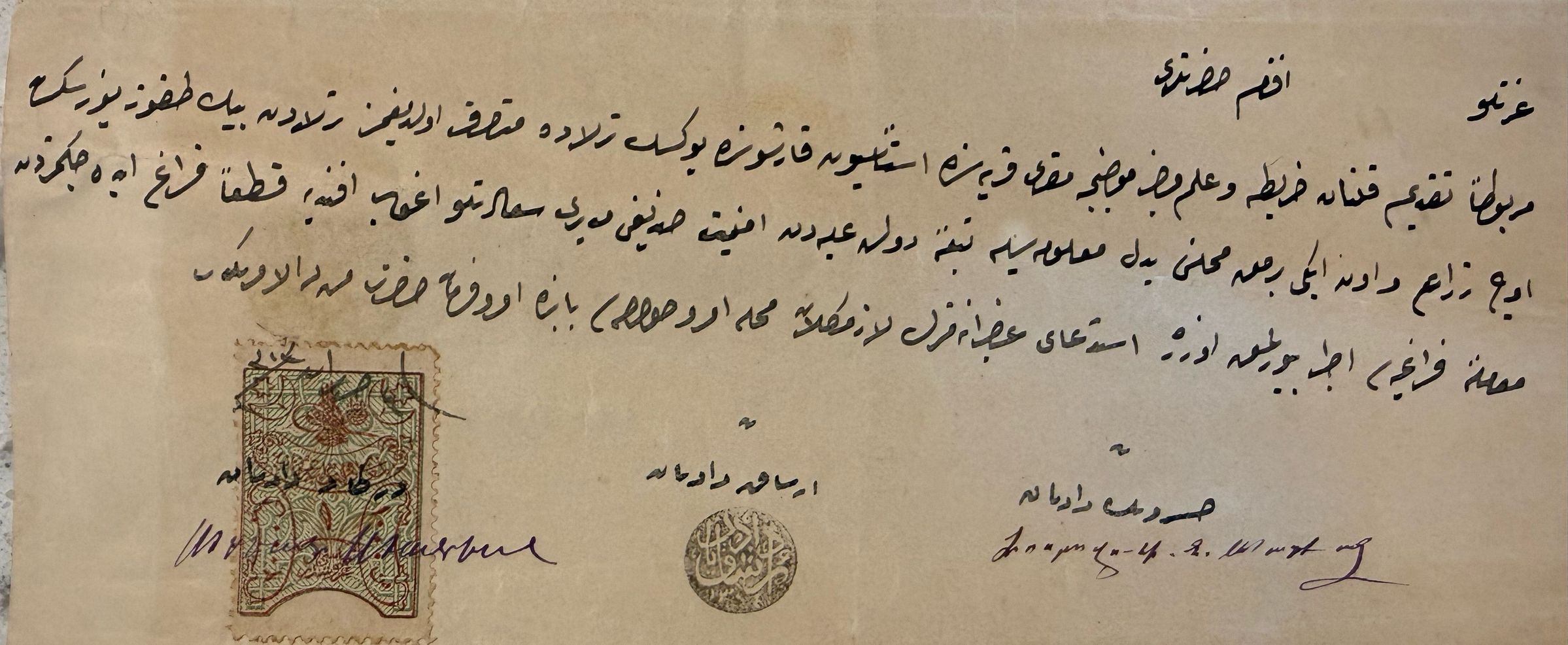
My most honored and esteemed sir,
In accordance with the attached map and information report respectfully submitted, [it is stated that] from the field which we possess (hold in usufruct) in the “Yuksek Tarla” (now Yüce Tarla) opposite the station in Makri village (today Bakırkoy), [an area of] 1,983 ziraʿ (square cubits) …
This original Ottoman document is dated 4 June 1303 (16 June 1887) and concerns the sale of an agricultural field located in Makri Village known today as Bakırköy, Istanbul specifically opposite the railway station, in an area described as “Yüksek Tarla” (now Yüce Tarla) According to the attached map and supporting documents referenced in the text, the sellers formally declared and proved their ownership of a field measuring 1,980 zira.
The document notifies the relevant official authorities that the field would be sold for a price of 12 muhassın to Saadetli Agop Efendi, an Armenian Ottoman citizen and Director of the Emniyet Sandığı. In the Ottoman period, the Emniyet Sandığı functioned as a credit and lending institution, providing loans secured against collateral, making Agop Efendi a figure of notable financial and administrative standing.
What makes this document exceptionally valuable is the identity of the sellers: members of the Dadyan (Dadian) family, one of the most prominent Armenian families in Ottoman history. The document bears the signatures or seals of three family members; Hosrov Dadyan, Arşak Dadyan, and Dirtad Dadyan. Hosrov Dadyan was a distinguished senior engineer and machinist, and the second son of Ohannes Bey Dadyan, who served as Barutcubaşı (Chief Gunpowder Master). Arşak and Dirtad were his sons. The Dadyan family was renowned for its industrial expertise, long-standing monopoly over the Ottoman gunpowder industry, close ties to Ottoman banking, and advisory roles within the state.
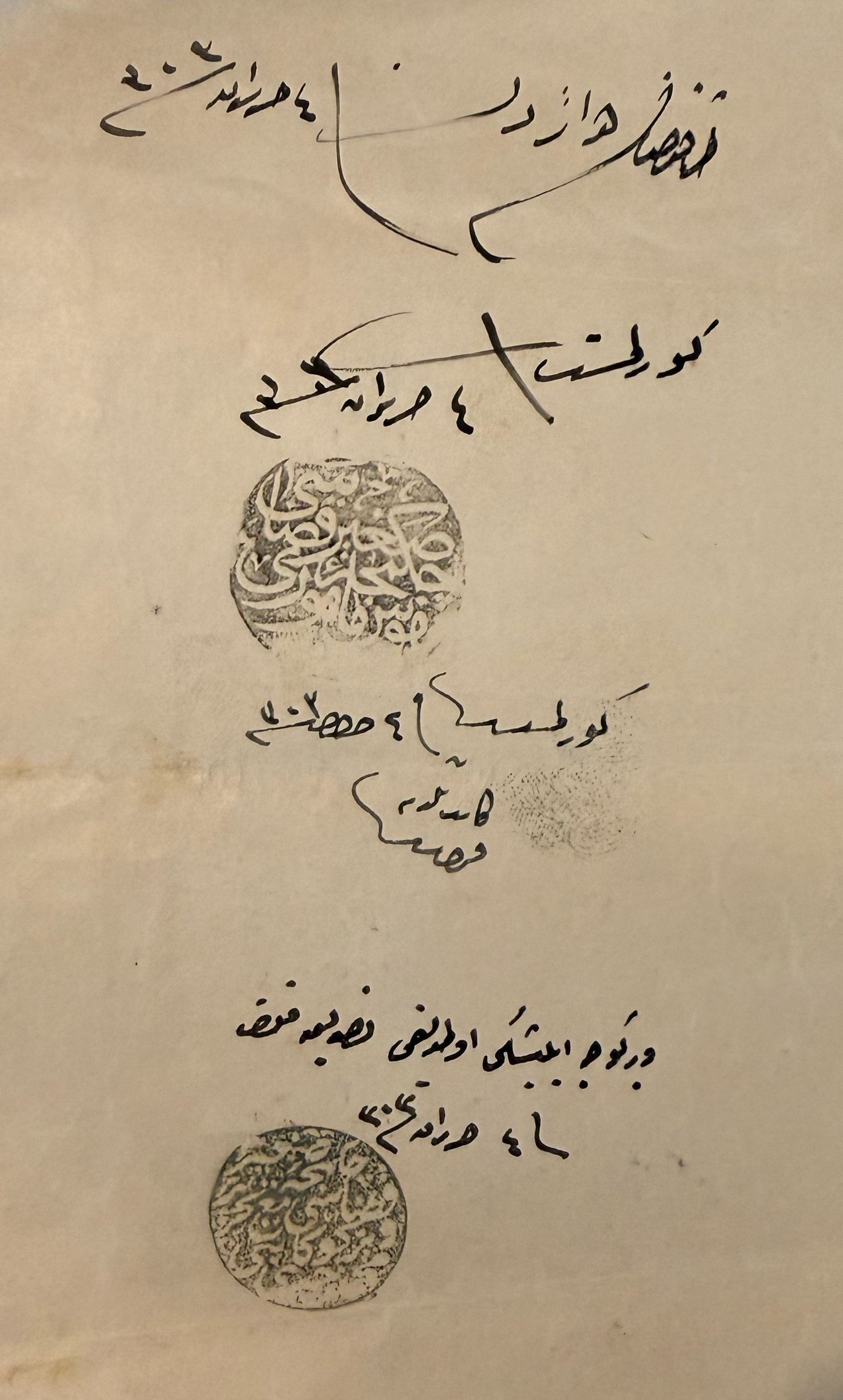
The document includes a revenue stamp and, on the reverse, official administrative seals and endorsements, including statements confirming that there were no outstanding tax obligations and that the document was reviewed and approved by the relevant authorities. Together, these features make the document a highly significant and collectible piece reflecting Ottoman land transactions, Armenian elite families, and late 19th-century administrative practices.
Key Features:
• Type: Ottoman land sale document
• Location: Makri Village (modern Bakırköy), Istanbul; opposite the railway station, Yüksek Tarla
• Property Type: Agricultural field
• Size: 1,980 zira
• Sale Price: 12 muhassın
• Buyer: Saadetli Agop Efendi, Director of the Emniyet Sandığı
• Sellers: Members of the Dadyan family
• Signatories: Hosrov Dadyan, Arşak Dadyan, Dirtad Dadyan
• Date: 4 June 1303 (16 June 1887)
• Features: Ottoman revenue stamp; official seals and endorsements on the reverse
• Historical Significance: Documents a land sale involving the Dadyan family, one of the most influential Armenian families in Ottoman industrial, financial, and political historyGeneral Notes
Note Type
Historical NoteNote
Nerses Hosrof Bey Dadyan (1825–1872)
Nerses Bey, the second son of Hovannes (Ohannes) Bey, traveled to Europe with his father in 1842, where he studied geometry. He later became a member of the council of the Ministry of Police (Zaptiye Nezareti). He also served as chairman of the Zeytinburnu Iron and Steel Factory.
He married in 1846 and had sons named Simon, Vahram, Arshag, and Dirtad, and daughters named Areknaz and Srpuhi. Among their descendants were: the daughter of the architect Simon Bey, Zaruhi, who married and became Mrs. H. Feruğyan; and the daughters of Dirtad Bey, Anna and Mari, the latter of whom married and became Mrs. Gerevamyan.
Arshak Dadyan Efendi (1867–1894)
Arshak Dadyan, one of the sons of Nerses Hosrof Bey Dadyan (1825–1872), was born in Constantinople. He studied for four years at the Mekteb-i Sultani (Galatasaray High School) and for a period at the School of Forestry and Mines. He could read and write Turkish, French, Greek, and Armenian. He began his first government post in the Department of Consular Affairs of the Ministry of Foreign Affairs, later transferred to the telegraph office of the Ministry of Foreign Affairs, and finally was reassigned to the Foreign Correspondence Bureau.
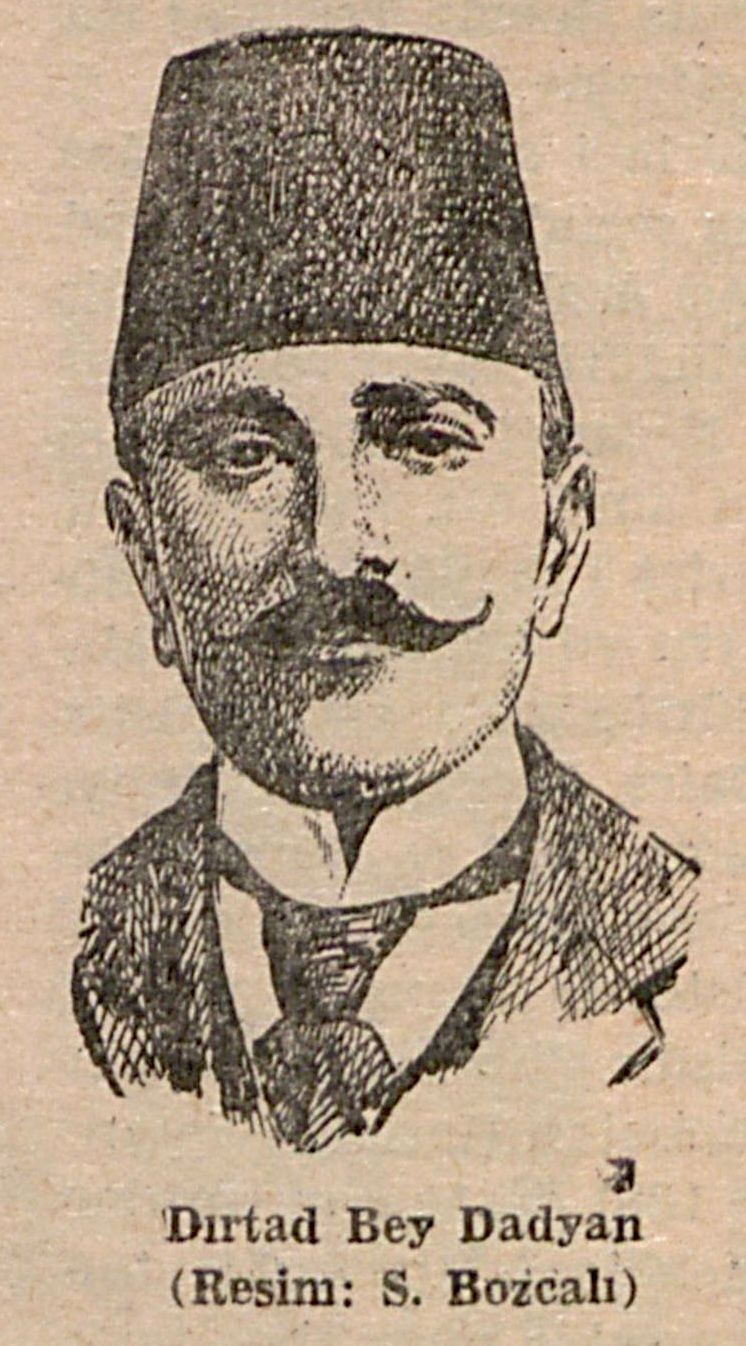
Dirtad Bey Dadyan (1860 – 1916)
He was the second son of Nerses Hosrov Bey Dadyan; a mining engineer, he was better known for his service in communal (community) affairs. He was born in Beşiktaş in 1860 and died in Istanbul in 1916. In 1882 he graduated from the Mekteb-i Sultani (Galatasaray High School). According to the late Toros Azatyan, in 1883 he had the Makruhyan Primary School in Beşiktaş repaired and served as its director for twelve years. In 1886 he founded the Makruhyan Society of Education Supporters. In 1888, together with his brother Vahram Bey, he established a Gymnastics Society. From 1888 until his death he served on the Administrative Board of the Beşiktaş Armenian Church, eventually assuming the presidency of that board. He was also elected from Beşiktaş as a member of the Patriarchate’s General Assembly and took part in its Lay (Cismani) Council. Dirtad Bey married Fartune, the daughter of Enovk Demircibaşyan. They had two daughters; one of them, Madame Mari Gerevamyan, was known for her music criticism written for the French-language newspaper Stamboul, which was published in our city until last year. She is a distinguished musician and pianist.Create Date
January 19, 2026Update Date
January 21, 2026