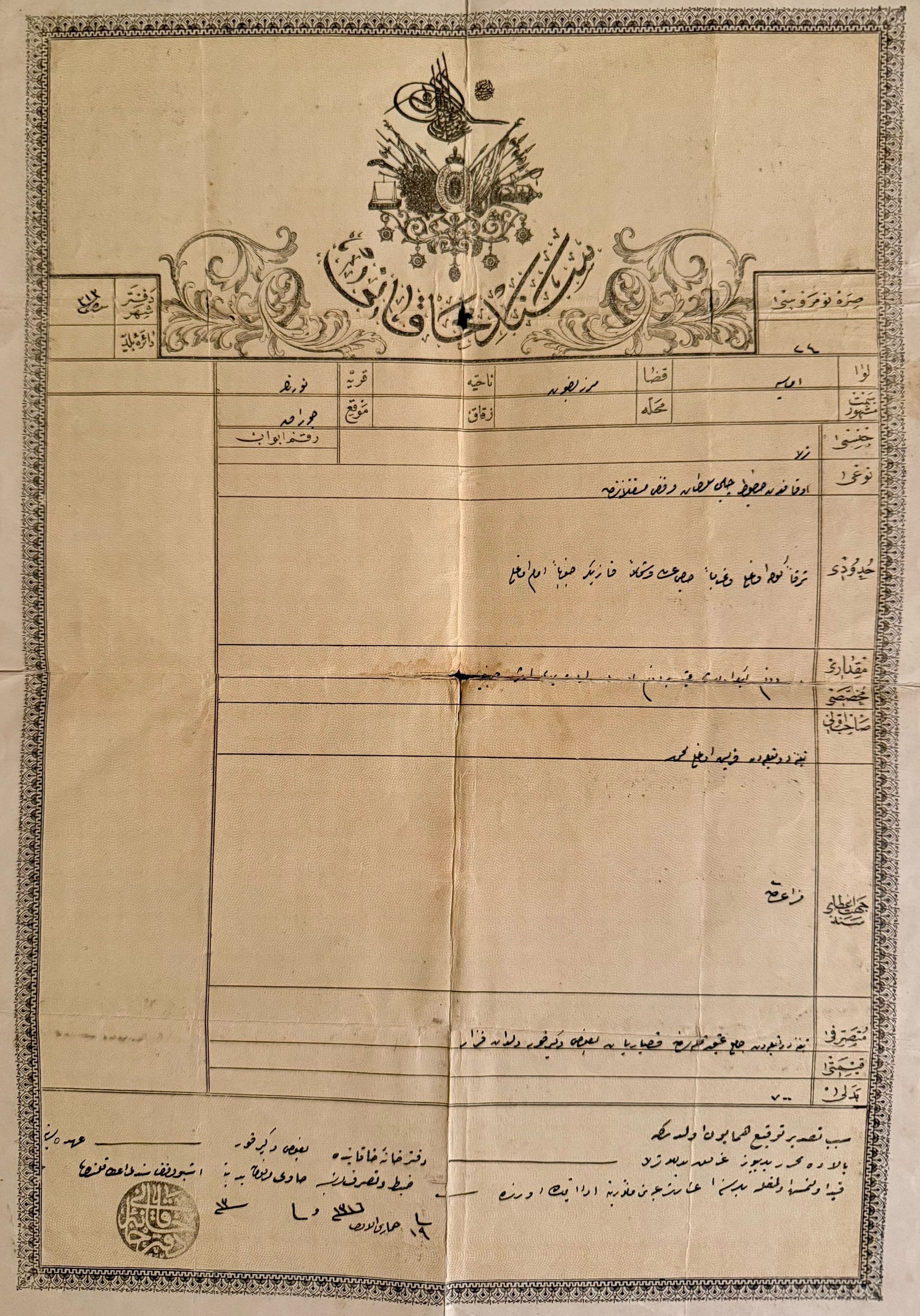
Property Deed #51

Name/Title

Property Deed #51

Scope and Content

This is an original Ottoman Turkish land deed (tapu) documenting a field property located in Nureni (today Aktarla; 40.7220000, 35.5469000) village of Merzifon (Amasya), in an area recorded as “Çorak.” The document is dated 19 Cemaziyel Evvel 1316 (5 October 1898) and it records the property as part of a vakıf holding, specifically described as “Evkafdan mazbut Çelebi Sultan Vakfı müstegallâtından,” indicating that it belonged to a centrally administered religious endowment. The deed documents a transfer (ferağ) of the property from Ferit oğlu Mehmed to buyers identified as Kasparyan Bogos and Kirkor, sons of Kazar (Ghazar?), who are recorded as residents of the Cami-i Atik neighborhood. The sale price is given as 700 kuruş. The boundary descriptions list neighboring landholders including Köse oğlu, Hacı Ali, Faiz Bey, and İmam oğlu. The village of Nureni corresponds to modern-day Aktarla. According to local historical tradition, the name “Nureni” is associated with “Nor Ani” (“New Ani”), reflecting the idea that the settlement was founded or repopulated by refugees who migrated from Ani following its decline, particularly in the aftermath of the late medieval disruptions and Timur’s invasions. Key details: • Type: Ottoman land deed (tapu) • Location: Merzifon, Nureni village (modern Aktarla) • Area: Çorak • Property type: Field (vakıf land – Çelebi Sultan Vakfı) • Administrative status: Evkafdan mazbut (state-administered vakıf property) • Boundaries: East—Köse oğlu; West—Hacı Ali; North—Faiz Bey; South—İmam oğlu • Transferor: Ferit oğlu Mehmed • Buyers: Kasparyan Bogos and Kirkor, sons of Kazar • Transaction type: Sale (ferağ) • Price: 700 kuruş • Date: 19 Cemaziyel Evvel 1316 / 5 October 1898

Category

Property Deeds

Relationships

Related Person or Organization

Person or Organization

Boghos Kasparyan Collection

General Notes

Note Type

Historical Note

Note

An academic article titled “The Effects of the Armenian Relocation on Population and Economy: The Case of Merzifon,” written by Abdurrahman Bozkurt and published in 2020 (see weblink) and offers a detailed analysis of the demographic and economic changes in the Merzifon district following the 1915 Armenian relocation, with particular emphasis on how the local economy was restructured and what became of Armenian properties and social status. Drawing on archival records, the author highlights the roles Armenians played in local industries and the administrative monitoring of Armenian families during this period. The article identifies Hacı Bogos Kasparyan as a skilled fabric roller/polisher in the weaving industry. Born around 1862, he is noted as having likely converted to Islam during the Armenian Genocide, adopting the name Fuad, and residing in the Cami-i Atik neighborhood with his wife, Makruhi Khisarlian, and their three daughters, Lusaper, Nevart, and Vahanush. The document further records that his wife and daughters were registered under new Muslim names: Pakize, Latife, Nadire, and Vasfiye. Moreover, the article notes that individuals exempted from deportation (tehcir dışı bırakılan kişiler) were reported to the central government by name on 1 September 1915, indicating that his conversion and official confirmation had already taken place by the time Mustafa Efendi sought repayment of his sister’s debt (Ottoman Armenian Document #52). Several members of the family emigrated from Merzifon to the United States in the early twentieth century. In 1921, Lusaper emigrated and was able to retain the surname Kasparyan. She later married Leon Luscinian, became known as Lucy Luscinian, and settled in Baltimore, Maryland. The couple had four children. Lucy applied for U.S. citizenship in 1925 and passed away on 26 March 1988. Vahanoush, born in 1905, later emigrated to the United States with her mother Makrouhi (born 1877), who adopted the name Maria after their arrival. Makrouhi entered the country as a widow, indicating that Boghos had died—most likely as a result of the Armenian Genocide. They arrived in the United States on 30 March 1927. Nevart, also a widow, emigrated under the surname Kechichian. She arrived with her two children, a son, Haig, and a daughter, Zabel. Vahanoush Kasparian married a John J Yorganjian. Gave birth to John James Yorganjian Jr. in 1935, who lived in Philly. Her husband died in 1974, and she died in 1977, buried in Lake Worth.

Create Date

May 24, 2026

Update Date

July 10, 2026