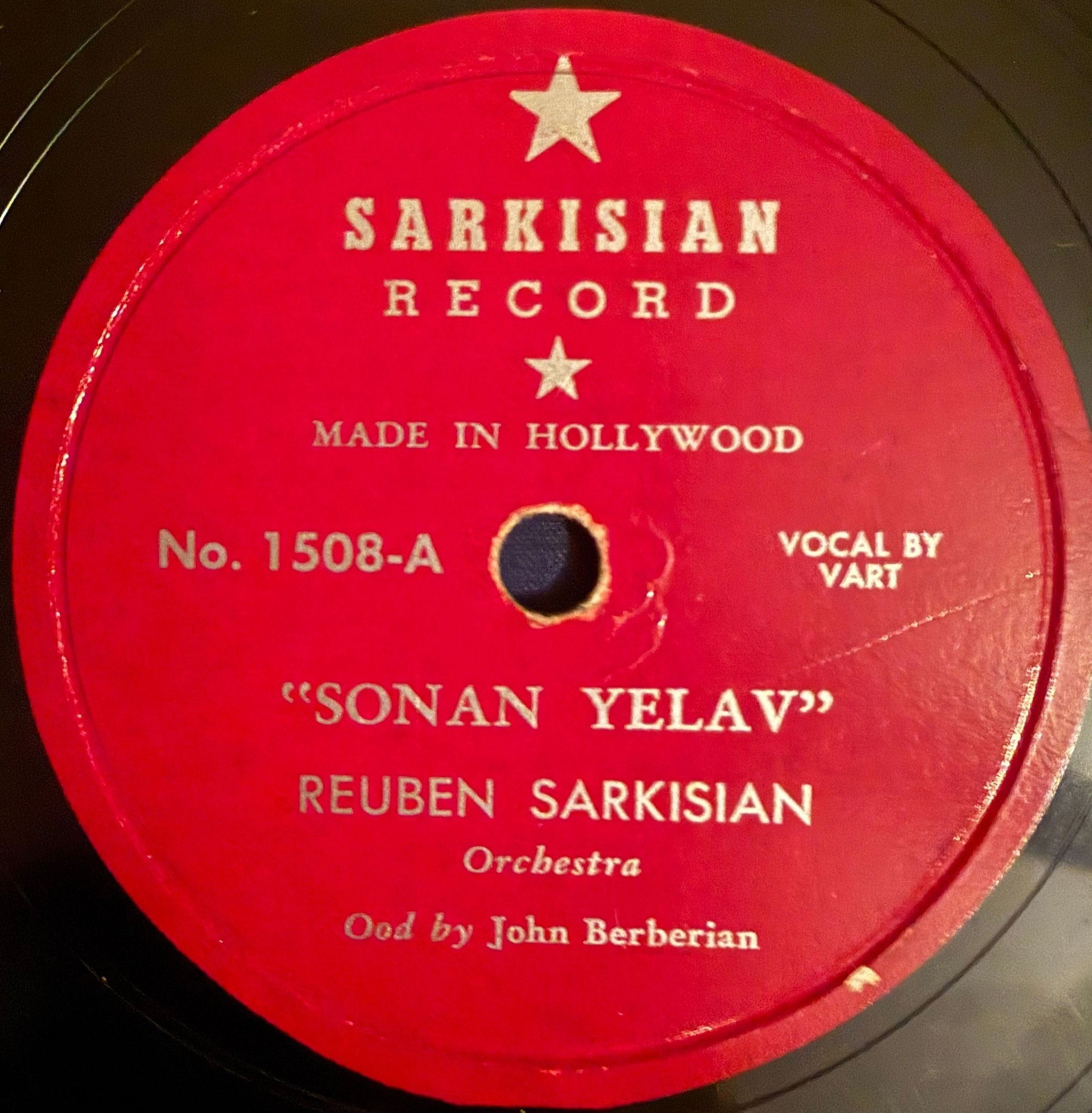
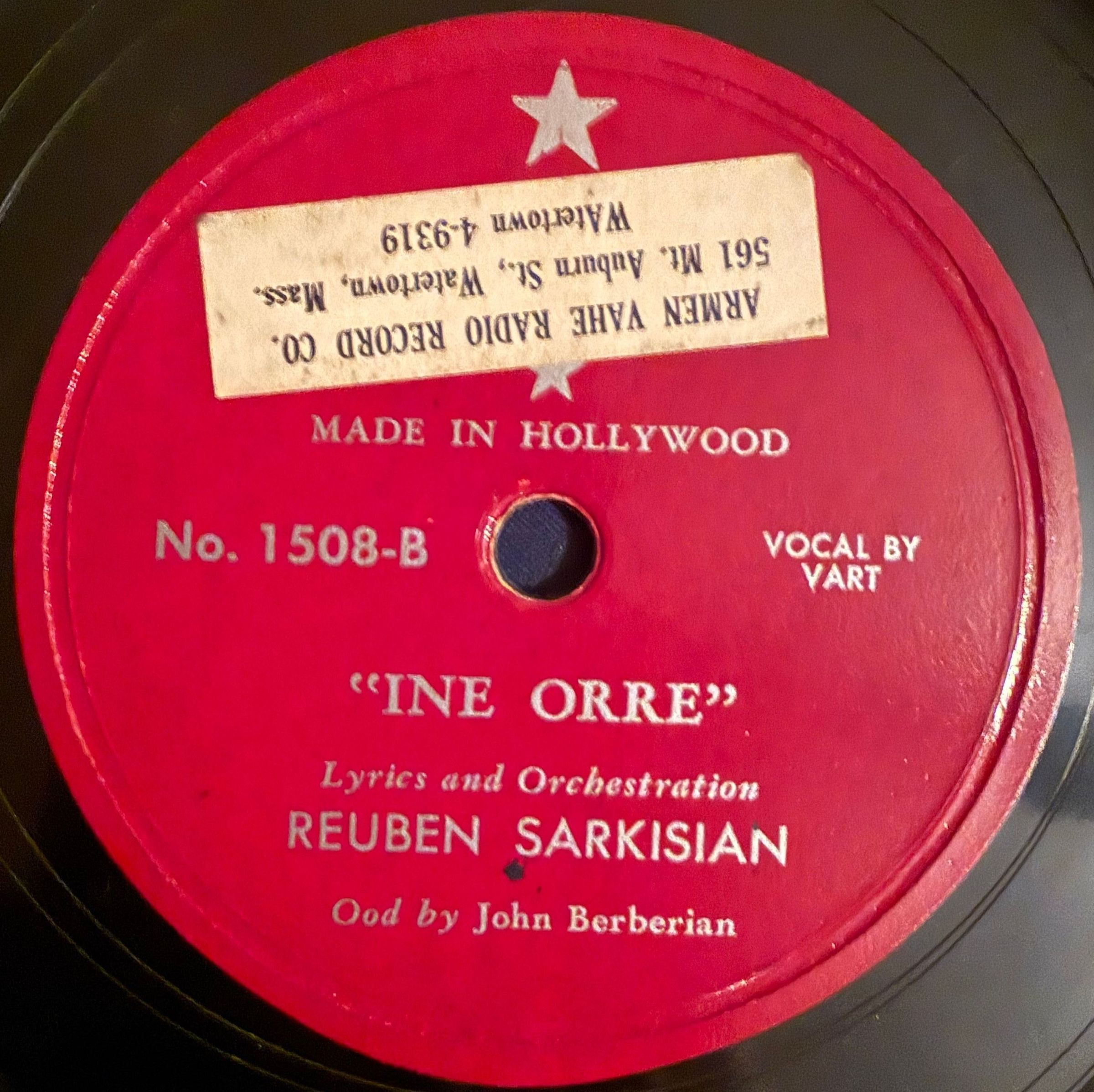
Reuben Sarkisian, Sonan Elav/Ine Orre
Name/Title
Reuben Sarkisian, Sonan Elav/Ine OrreDescription
Reuben Sarkisian (also rendered as Ruben Sarkisian in some sources) was an Armenian-American violinist, composer, lyricist, bandleader, and independent record producer whose work became an important bridge between the musical traditions of Kharpert and the developing Armenian-American dance music scene of the mid-twentieth century. Born on December 24, 1891 in Mezre (Mamuret-el-Aziz/Kharpert, present-day Elâzığ Province, Turkey), he grew up in a household where music was central to everyday life. His father Hagop was an accomplished amateur violinist and encouraged his son’s early training. As a child, Sarkisian was exposed not only to Armenian village and urban repertories but also to the broader Ottoman musical environment surrounding Kharpert, experiences that later shaped his style as a performer and arranger. Sarkisian attended a French Catholic school in Mezre and became fluent in French, an education that later proved useful after emigrating to the United States in 1911 to join family members already settled in Massachusetts. During the First World War he enlisted in the U.S. military Air Corps and trained as an aerial photographer under French instructors. He reportedly suffered a serious back injury during a fire at the air base, an injury that affected him for years afterward. After the war he became deeply involved in the Armenian musical life of New England, especially around Boston and Haverhill, performing at weddings, dances, and community gatherings. He married Vart Sarkisian, herself a singer from Kharpert who emigrated to the United States in 1920. Together they formed one of the most recognizable husband-and-wife ensembles in Armenian-American recorded music. Reuben served primarily as violinist, arranger, and songwriter while Vart became the featured vocalist. Seeking a better climate for his health, the family relocated to California, where their musical activity expanded. In 1947 the couple launched Sarkisian Records, an independent label through which they self-produced and distributed Armenian recordings. Between roughly 1947 and the early 1950s the label issued around thirty songs, almost all centered on social dance music. Reuben composed and arranged the recordings and frequently wrote original Armenian lyrics, adapting melodies from across the eastern Mediterranean into Armenian performance contexts. One of his better-known adaptations was an Armenian version of the Greek song “Misirlou,” which he titled “Inne Orre”; the melody later circulated more widely in Armenian-American recordings under different titles. The Sarkisian recordings also documented an important generation of diaspora musicians and included collaborations with figures such as John Berberian, Harry Parigian, Peter Gamoian, and other performers from Armenian, Assyrian, Greek, and Middle Eastern musical circles in California. Although Reuben stopped making commercial recordings around 1955 after becoming dissatisfied with the economics of record distribution, he continued performing publicly. Interest in his work revived in the 1970s when folklorist Richard Spottswood highlighted his recordings and included his performance of “Hallay” in the Library of Congress series Folk Music in America. Sarkisian subsequently appeared at folk festivals and gained recognition beyond Armenian audiences. After Vart’s death in 1976, he continued to perform locally until his own death in Fresno, California, on June 12, 1981. Today Reuben Sarkisian is remembered as one of the key preservers and interpreters of the Kharpert musical tradition in the Armenian diaspora and as an early example of Armenian independent record production in the United States. There is not a great deal of published biographical information on Harry Parigian, but a few details can be pieced together from Armenian-American recording history and surviving discographies. Harry Parigian (sometimes spelled Parikian or Barikian in transliteration) was an Armenian-American musician active primarily in California during the late 1940s and early 1950s. He appears to have been part of the generation of diaspora musicians who helped shape the postwar Armenian dance-music scene in the United States, especially in the Fresno–Los Angeles network of performers. He was known as a string instrumentalist and is documented playing both banjo and mandolin, and in some recordings has been associated with ensemble accompaniment that drew from Armenian, Middle Eastern, and eastern Mediterranean dance traditions. Parigian is most closely connected with the recordings of Reuben Sarkisian and Vart Sarkisian. During the early Sarkisian Records sessions in California, Reuben Sarkisian assembled a rotating orchestra that included Harry Parigian alongside oud player John Berberian, percussionist Joe Elby, and dumbeg player Peter Gamoian. On those sessions Parigian contributed banjo parts and helped create the distinctive rhythmic texture of the recordings. He also appears on recordings connected to the Gamoian family. Surviving documentation identifies him playing mandolin on recordings made with Enoch Gamoian and Peter Gamoian, including dance repertoire such as “Tamzara” and “Hoy Nar.” Around the same period he recorded four songs with Reuben Sarkisian’s orchestra, among them “Anousiges Yeg,” showing that he moved in overlapping circles of Armenian-American performers rather than remaining tied to one ensemble.Audio Format
78 RPM RecordRecording Type
MusicCategory
Vinyl Record