Turkish Republic Armenian Document #18
Name/Title
Turkish Republic Armenian Document #18Scope and Content
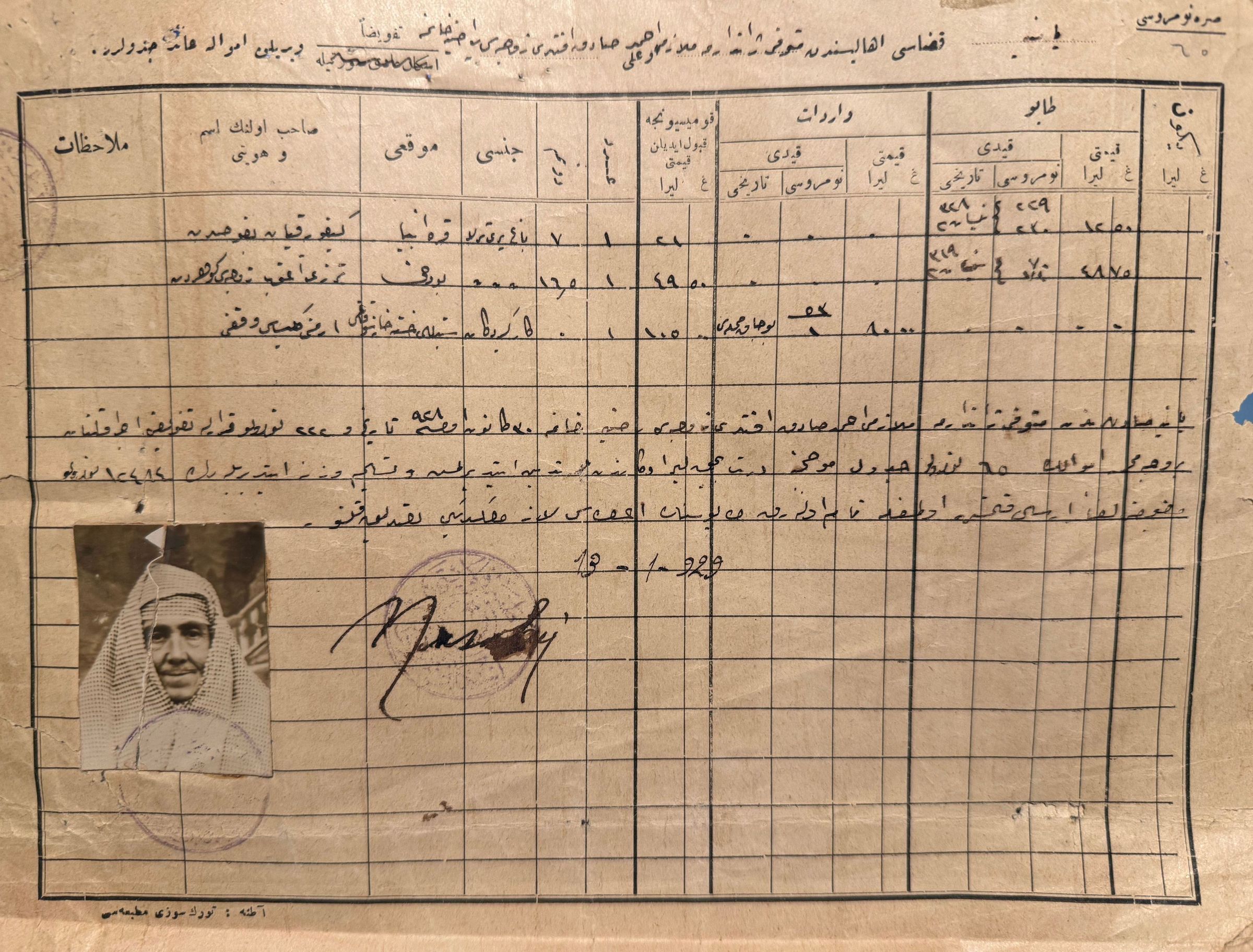
Ottoman Turkish Document on Emval-i Metruke – Transfer of Abandoned Armenian Properties to a Balkan Migrant Family (Adana, 1929) This Ottoman Turkish official document, dated January 13, 1929, records the transfer of abandoned Armenian properties (Emval-i Metruke) to a Balkan migrant family in Adana. Issued only a few months after the Turkish Alphabet Reform of November 1, 1928, it remains written in the Arabic-based Ottoman script, reflecting the slow administrative transition to the new Latin alphabet. The heading reads “Verilen emvale aid cedveldir” (“Register of Allocated Properties”) and identifies the issuing body as the Emval-i Metruke Commission, the special state authority responsible for managing and reallocating properties left behind by deported Armenians following the deportations (tehcir). Such assets were frequently reassigned to Muslim refugees resettled from the Balkans and other regions of the former Ottoman Empire. The register documents the transfer of three separate properties in Adana to Raziye Hanım, widow of Jandarma Lieutenant Ahmed Sadık Efendi, a migrant from Yanya (Ioannina). The first property is a seven-dönüm vineyard or field in Kara Enbiya (circa 37.0081997, 35.2861222), formerly owned by Kevorkian Boghos, recorded under Tapu numbers 229–230, dated April 1912, and valued by the commission at 21 lira. The second is a 160-dönüm vineyard or field in the same area, formerly belonging to Kohar, wife of Terzi (Terziyan?) Hagop, recorded under Tapu numbers 80–81, dated April 1903, and revalued at 49 lira 50 kuruş. The third property is a stone-built shop (kârgir dükkân) on Sümbüllü Hospital Street in Adana, formerly owned by the Armenian Church Foundation. At the bottom of the document, it is stated that these three properties were officially awarded by Decision No. 222, dated December 30, 1928, for a symbolic payment of 4.5 lira, and that the title deeds were to be transferred to Raziye Hanım. The document bears an official seal of validation and includes a portrait photograph of the recipient. Following the Armenian Genocide of 1915 and the 1923 Greco-Turkish population exchange, Adana’s demographic and urban landscape changed dramatically. Many Armenians and Greeks left the city, leaving behind residential, agricultural, and commercial properties. The Ministry of Exchange, Development, and Settlement (Mübadele, İmar ve İskân Vekâleti) allocated these abandoned properties to Muslim refugees (mübadil) arriving from Greece and other former Ottoman territories. Refugees were settled either in the city center of Adana, where they received houses along with small parcels of farmland, vineyards, or shops, or in rural villages established on abandoned Armenian and Greek farms. Key neighborhoods in the city included Çınarlı, Çarçabuk, İcadiye, Hanedan, Hankurbu, Hacıfakı, Hurmalı, Alidede, Şabaniye, Durmuşfakı, and Hacıhamid. Surrounding villages included Yılanlı, Zeytinli, Zincirli, and Kara Enbiya, which provided access to agricultural land and communal support networks. The houses left behind often reflected the cultural practices of their former owners. Urban homes frequently followed the haremlik-selamlık layout, separating private and social spaces, while rural estates combined residential and agricultural functions. Refugees adapted these properties to their own needs, modifying interiors and farming practices while retaining much of the original architecture.Category
Misc. Documents