Label
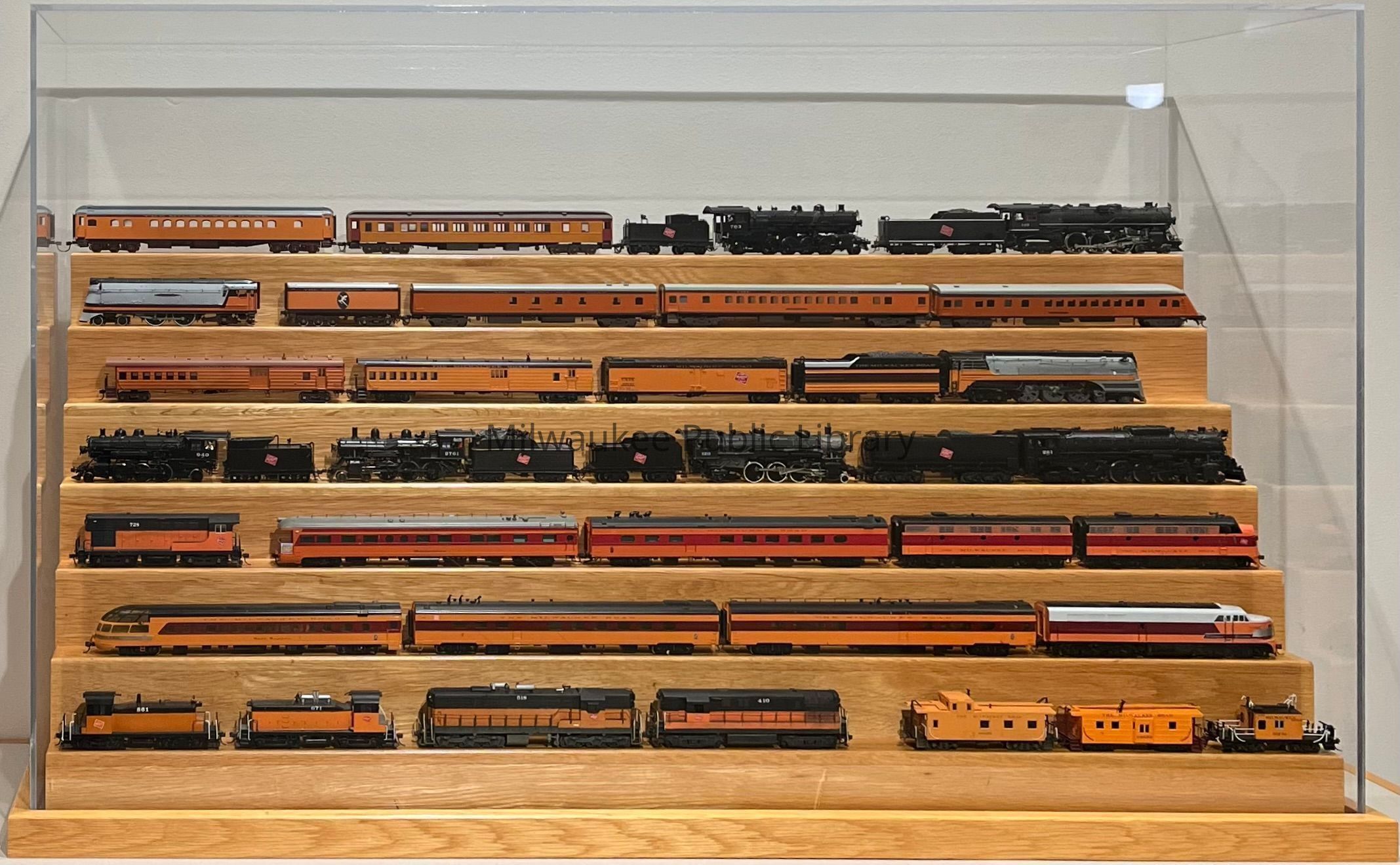
These Milwaukee Road trains come from a donation by John Medd of Deerfield, Illinois, and the Milwaukee Road Historical Association. The models represent a snapshot of equipment used on the railroad during roughly the last fifty years of the Milwaukee Road's operation. Each locomotive and car tells part of the story of how the railroad's trains changed over time, and the descriptions that follow explain why each one is significant.
Milwaukee Public Library holds the Milwaukee Road Archives. In 1981, the Milwaukee Road donated its extensive records to the library, establishing a permanent home for the railroad's drawings, photographs, and documents. Displaying these models alongside the archival materials helps connect the trains you see here with the historical records that document their design, construction, and operation, and helps preserve the story of the Milwaukee Road for future generations.
[From top left to bottom right]:
1. Coach 4000: The Milwaukee Road's first attempt at streamlined passenger cars, Coach 4000 was rebuilt from a sleeping car. While modern in appearance, it proved too heavy for the fast, lightweight trains being developed in the 1930s.
2. 1920s Coach: Before the 1930s, most Milwaukee Road passenger cars were heavy steel cars riding on six-wheel trucks. Although durable, they required large amounts of fuel, leading railroads to seek lighter, faster designs.
3. Engine 143: Built by Baldwin in 1931, this Class $6-a Hudson-type locomotive marked the beginning of the Milwaukee Road's modern steam power and became the backbone of its passenger fleet. Even while hauling heavyweight cars, these powerful engines could reach speeds of 85 to 90 miles per hour, allowing trains to cover long distances quickly.
4. Engine 703: Built by the American Locomotive Company in 1912, this Class L2 "Mikado" was primarily used for freight service. Strong and reliable, these locomotives were common across the system and remained in service until the end of steam in the 1950s.
5. The Hiawatha: Introduced in May 1935, the Hiawatha was among the fastest and most popular trains of its era. Typically operating with six streamlined cars, it featured air-conditioning, roomy seating, and smooth-riding wheels, making it the preferred service between Chicago, Milwaukee, and Minneapolis-St. Paul.
6. Combine Cars: Combine cars carried both mail or express shipments and passengers in a single car. Used mainly on branch lines and short runs, they provided vital passenger service to small towns and connections to mainline trains.
7. Express Refrigerator Car: Used on passenger trains, these cars transported perishable goods such as flowers and fruit. Early versions were iced, while later cars used mechanical refrigeration. When not hauling refrigerated goods, they carried general express shipments.
8. Streamlined F7 Engine: To meet growing demand after the success of the Hiawatha, the Milwaukee Road introduced new locomotives and upgraded cars in 1939. These engines served popular passenger trains for several years before being displaced by emerging diesel technology.
9. Engine 940: Built in 1908 at the Milwaukee Road's shops, this Class K1as "Prairie" locomotive was used mainly for freight service. Originally assigned to western lines, it served reliably for 46 years.
10. Engine 2716: Constructed by Baldwin in 1907, this Class G6e locomotive handled both freight and passenger service. As larger engines were introduced, it was reassigned to branch-lines and commuter service. Many engines of this type lasted until the end of steam operations.
11. Engine 120: A "Pacific" type locomotive, Engine 120 was designed for high-speed passenger service. As larger engines were introduced, it was reassigned to branch-lines and commuter service. Many engines of this type lasted until the end of steam operations.
12. Engine 261: Built in 1944, this Class S3 "Northern" locomotive is on loan from the National Railroad Museum. Designed for both passenger and freight service, it was retired after only ten years due to dieselization but remains operational today on excursion service.
13. Diesel Number 728: Built in Beloit, Wisconsin, in 1951, this switch engine was used in yards and industrial service. Its marine-style engine was unusual, but these locomotives often lasted about 30 years. One still operates at the Illinois Railway.
14. Business Car Wisconsin: Business cars were used by railroad officials and guests for inspections and development trips. Often attached to regular trains, access was restricted to railroad personnel and invited passengers. Several business cars still exist today.
15. Diner 122: Dining cars were essential on longer trips and once offered meals comparable to fine restaurants. Over time, rising costs led to simpler menus and food service across the railroad industry.
16. EMD E9: Built in the 1950s, these passenger diesels operated in paired A and B units. They powered the Milwaukee Road's premier passenger trains, and some survive today in museums and tourist service.
17. Skytop Observation Car Dell Rapids: Introduced in 1947 for transcontinental service, this Brooks Stevens-designed car featured large side and overhead windows offering panoramic views, especially in mountainous regions. Its location at the end of the train and comfortable seating made it unique.
18. Diner 121: Dining cars were standard on trains to Minneapolis and St. Paul from 1947 until passenger service ended in 1971. Fresh food was often loaded along the route, allowing meals to vary by region.
19. Tap Lounge 162: Lounge cars offered snacks and refreshment as an alternative to full dining service. Car 162 was later converted into a business car after passenger service declined.
20. Locomotive Number 8: Built for the Olympian Hiawatha in 1947, this locomotive operated between Chicago and Seattle. While less successful in mountainous terrain, it performed well in the Midwest and served for about 15 years.
21. Diesel Number 861: Built in 1940, this diesel switcher helped usher in the transition from steam to diesel power. Cheaper to operate and maintain, it remained in service for 40 years.
22. Diesel 671: Another NW2 switch engine built in 1940, this locomotive handled yard work and occasional road service. Like many diesels, it lasted more than four decades before retirement.
23. Diesel Number 518: Built in 1953 by EMD, this road switcher was known for reliability. It worked primarily on branch lines, spending much of its career in Avery, Idaho.
24. Diesel Number 410: Constructed in 1954 by Fairbanks-Morse in Beloit, Wisconsin, these locomotives handled freight service, particularly around Kansas City. Their strength earned them the nickname "Junior Train Masters."
25. Caboose 991605: One of the Milwaukee Road's early steel cabooses, this car replaced weaker wooden designs beginning in 1929. It served 36 years before being destroyed by fire in 1965.
26. Caboose 01859: Introduced in 1939, rib-sided steel cabooses were stronger and more durable. Built in Milwaukee and used widely, many survived into the era when cabooses were replaced by electronic end-of-train devices.
27. Caboose 01732: Beginning in 1955, terminal cabooses were built from old tender frames for rugged yard service. Extremely durable and inexpensive, they were the last cabooses built in Milwaukee and were retired after the Soo Lines acquired the Milwaukee Road in 1985.