Label
Kathe Kollwitz, German, 1867-1945
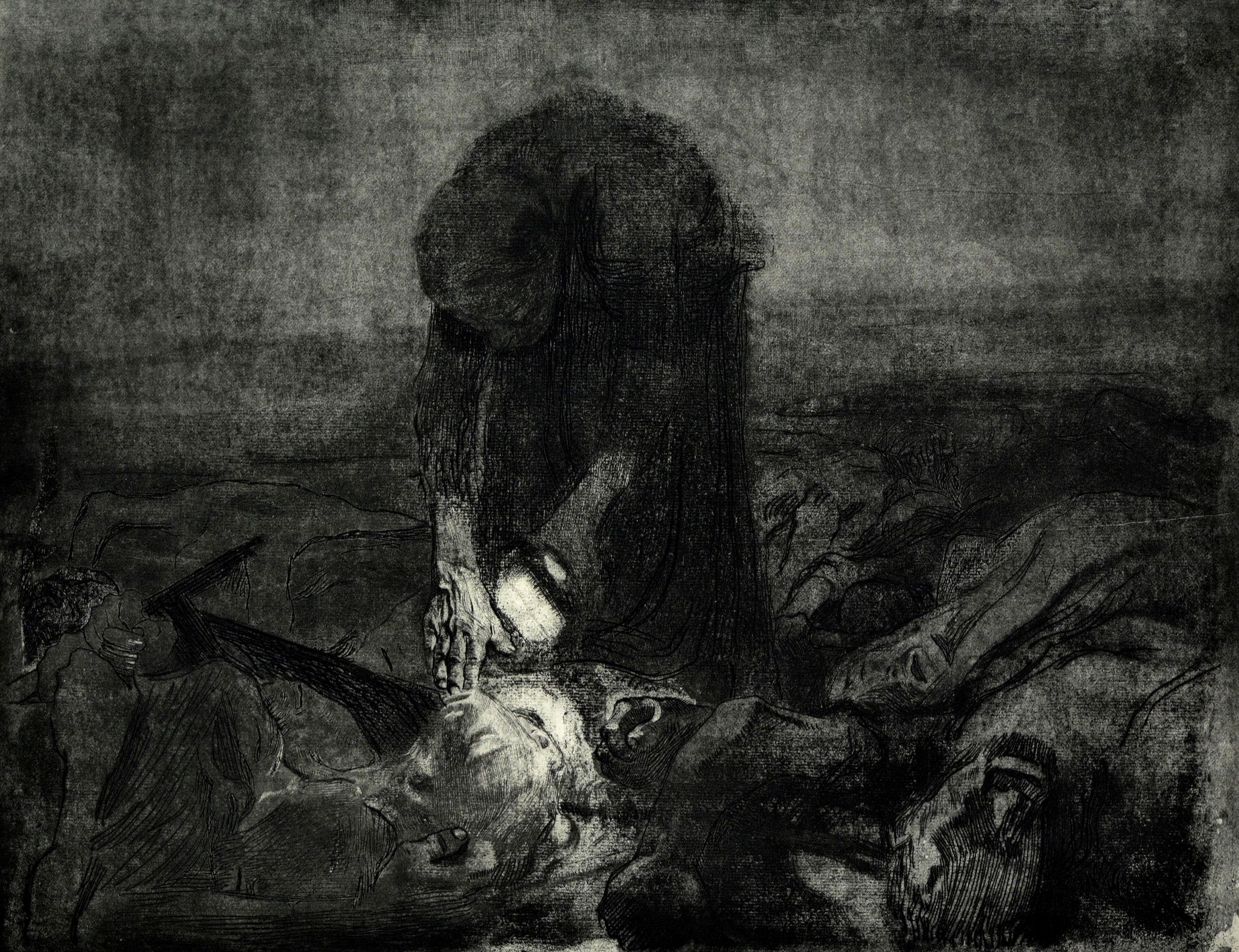
After the Battle, 1907, reprinted 1921
aquatint, etching and drypoint
Museum Purchase, 1971
Käthe Kollwitz grew up in an intellectual, liberal family that was sympathetic to socialism, and she devoted her career to raising awareness of the plight of the poor and the oppressed. She largely made prints because they could be printed in large editions and thus were more accessible to the working class. From 1902-1908, she created a series of works about the Peasants’ War of 1524-25. Heavy taxation and new restrictions on their traditional rights led the German peasantry to take up arms against their overlords, but their uprising was brutally suppressed. Kollwitz was particularly sensitive to the heroism and suffering of women, and four of the seven prints in this series feature women. This print depicts a woman on a battlefield searching for a lost loved one. With a lantern in one hand she reaches down to touch the face of a child, which is etched more vaguely and in a lighter tonality than the rest of the print. This emphasizes his fragility and ephemerality. Around him are the bodies and body parts of others killed in battle; three well-defined hands frame his face.
This work was made from a plate created by Kollwitz in 1907. The plate was reworked to create a darker background and was reprinted under the artist’s supervision in 1921 by the publisher Emil Richter. It is signed and dated. The work would have had renewed meaning for Kollwitz at that time, as her son Peter had been killed during World War I. In 1922-1923, she did a series of woodcuts titled War.