Label
2022, Whose America?
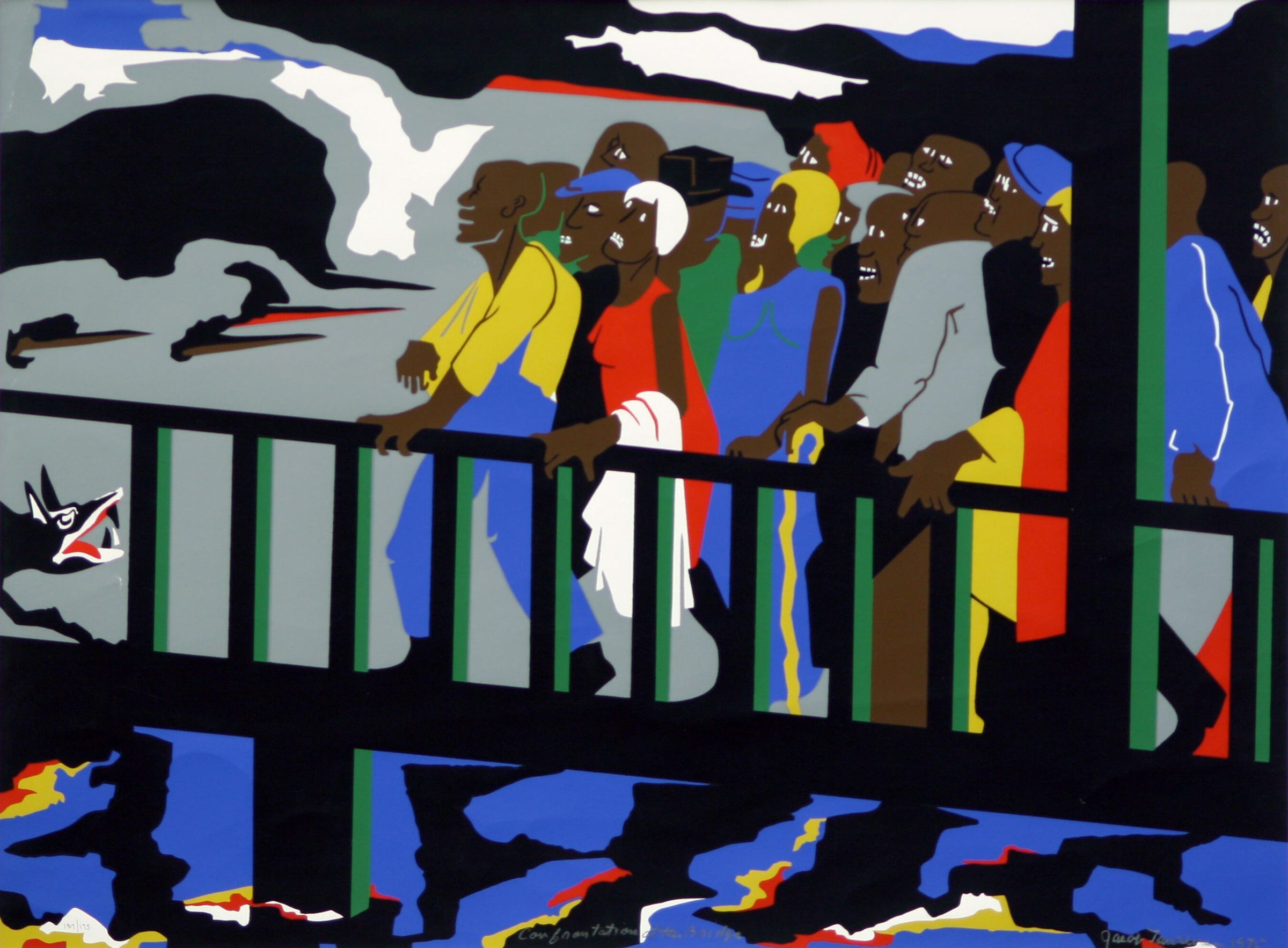
The figures in this print are composed of simple, flat blocks of bold colors. However, the artist has imbued them with vivid expressions, depicting their anger, fear, trepidation, and resilience.
Confrontation at the Bridge illustrates the first attempt of three marches from Selma to Montgomery, Alabama, to protest local interference with Black voting rights. On March 7, 1965, the marchers were stopped on the Edwin Pettis Bridge by a group of State Troopers who forced them to retreat using whips, nightsticks, and tear gas, represented here by the snarling dog to the left. On March 25, the protesters successfully completed the march, thanks to federal protection offered by President Lyndon B. Johnson. Brave acts of protest like this inspired the passing of the Voting Rights Act in 1965.Label
Label from 2014.Art for Social Change:
1965 saw some of the worst white on black violence of the Civil Rights Movement when non-violent protestors in Selma, Alabama, attempted to secure the right of African Americans to vote. This violence peaked on March 7, "Bloody Sunday," when marchers crossing a bridge on their way to Montgomery, Alabama were tear-gassed and savagely beaten by Alabama state troopers and a white mob.
In this image, the forward motion of the protestors is enhanced by the diagonal of the bridge and the repeating verticals of its railing. A gray-haired lady, a man with a cane, and two blond-haired figures imply that people of many ages and races attended the event. The white troopers and mob are not visible, but their violence is suggested by dagger-like shapes, as well as shapes that look like a helmet and a nose. A police dog with snarling teeth is at the lower left.Label
2024 post:
Throughout 2024, we're looking back at the 100 year history of art at the Mulvane. This 1975 work by influential artist Jacob Lawrence depicts an attempted march from Selma to Montgomery, Alabama, organized by Martin Luther King, Jr. to protest local interference with Black voting rights. The marchers were stopped at the Edwin Pettis Bridge by a group of state troopers who forced them to retreat using whips, nightsticks, and tear gas, represented here by the snarling dog to the left. The protesters were later able to successfully complete the march. Brave acts of protest like this helped bring about the 1965 Voting Rights Act, which significantly reduced barriers faced by Black voters.