Label
Francisco Goya, Spanish, 1746-1828
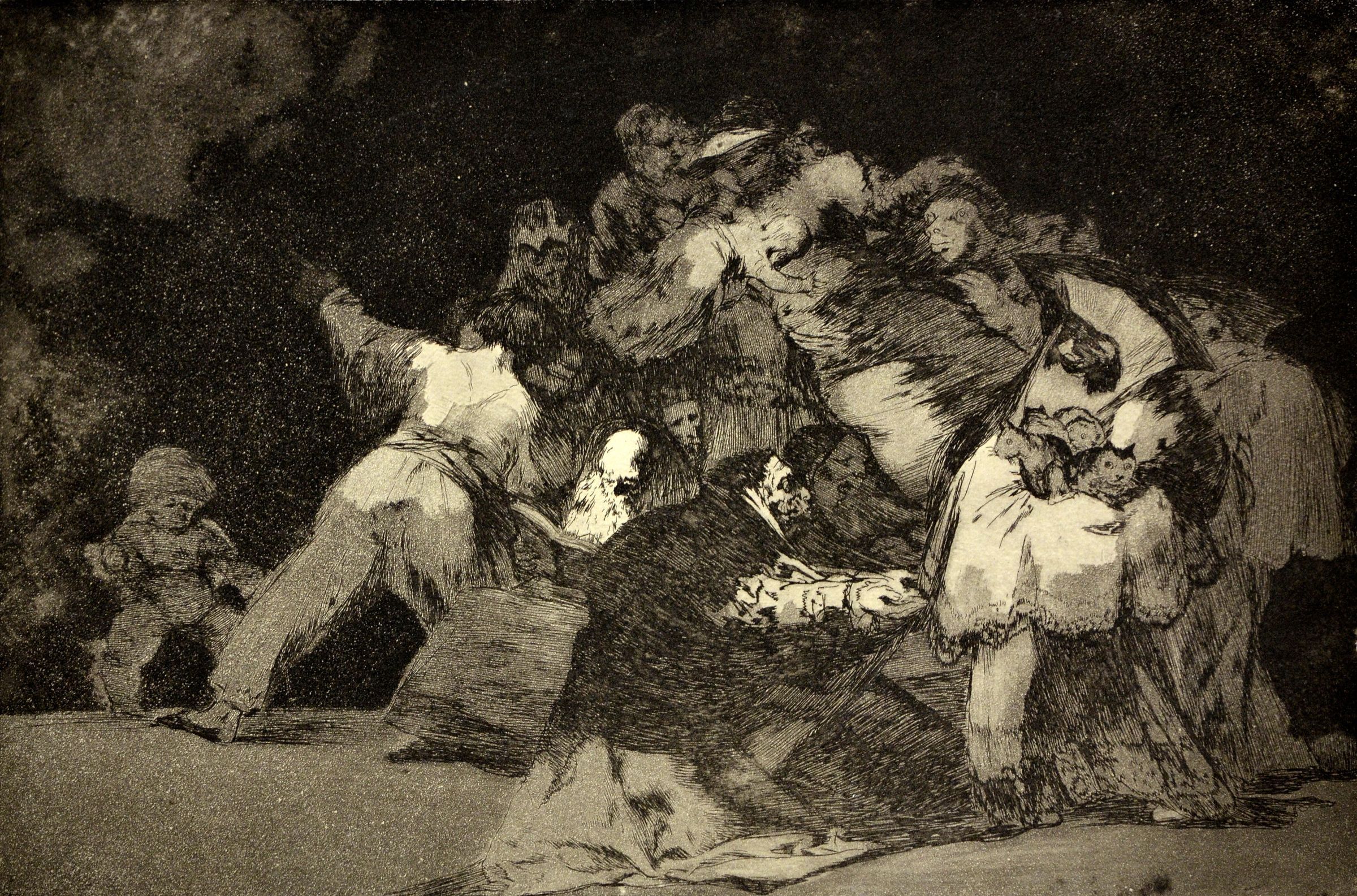
General Absurdity, from Los Disparates [The Nonsense], c. 1819-1824
etching, aquatint, and drypoint
Museum Purchase, 1966
As a young man, Goya was sympathetic to the optimistic ideas of the Enlightenment, the eighteenth-century philosophy that held that humans could be guided by reason to build a just society. Unfortunately, his life experiences ultimately caused him to question those beliefs and led him to depression and despair. Like other Enlightenment thinkers Goya was skeptical of what he saw as the corruption of the Catholic Church and of monarchies. He became increasingly disillusioned about human nature after witnessing the vicious and violent treatment of the Spanish people by Napoleon’s troops, during the French invasion and occupation of Spain from 1808-1814. This disillusionment led ultimately to his creation of Los Disparates (The Nonsense), a series of twenty-two prints that focus on the absurdity of humanity.
Los Disparates have been particularly hard to interpret because they are, of course, nonsense. Some have identified the figure with a sword in the left rear of this print as Napoleon threatening Spain, but Spain itself seems to be a mishmash of madness. At the top of the triangular composition is a woman, apparently held up by the crowd, nursing a baby. At bottom center, two men who may be clerics, as identified by their dress, reach out to a woman holding a litter of kittens. In the center middle ground is a seated man reading a book whose bearded face is in full light. He appears to be a prophet, who, like his Old Testament counterparts, reflects on the madness around him.