Label
2024 post:
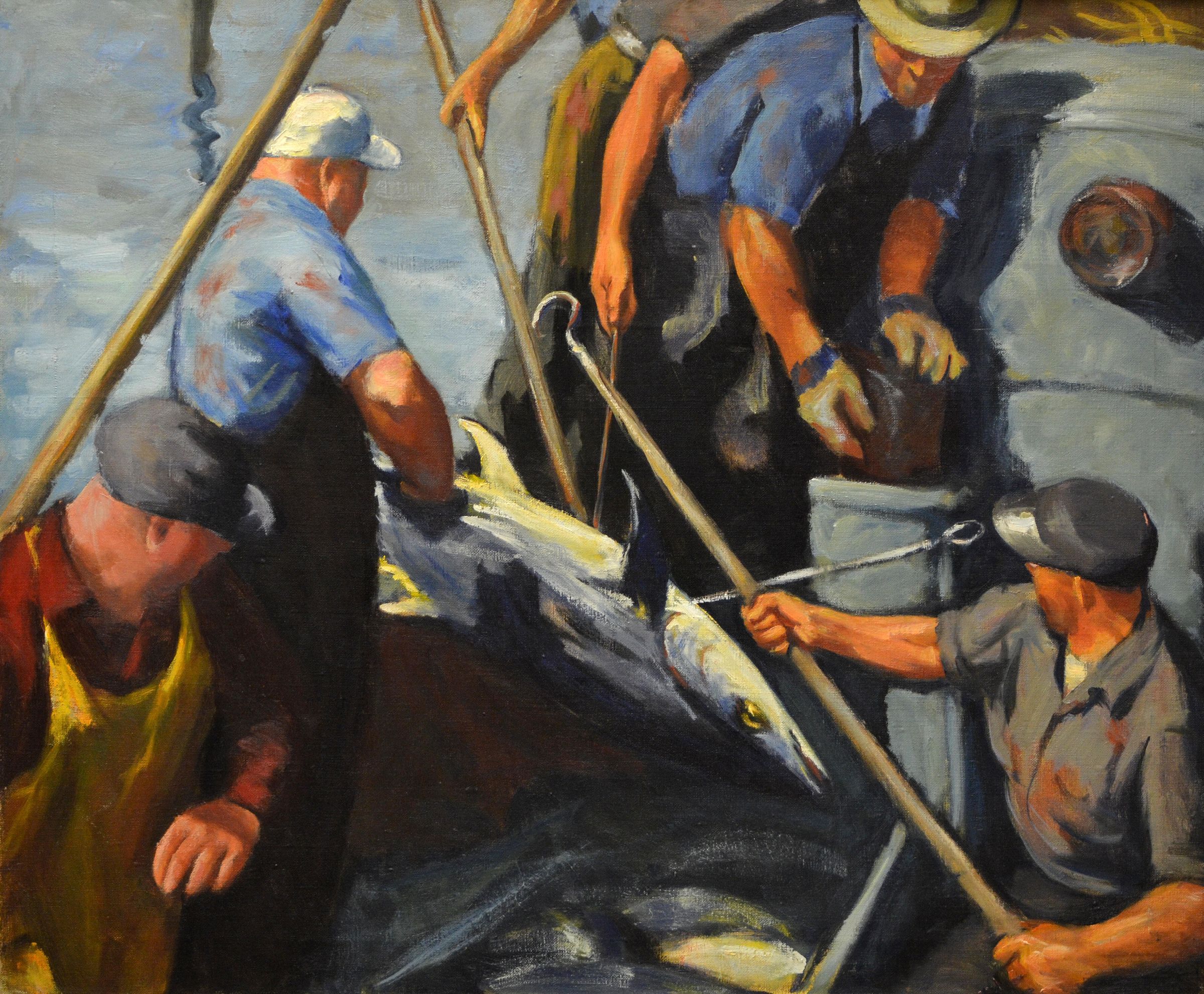
Throughout 2024, we're looking back at the 100 year history of art at the Mulvane. This work came into the collection in 1943 as part of a gift from the Works Progress Administration Federal Art Project. Created in 1935 by George Yater, it depicts fishermen at sea. They use gaffs, long poles tipped with spikes or hooks that are used to spear and haul a fish out of the water.Label
George Yater, American, 1910-1993
Gaffing Horse Mackerel, c. 1935-1939
oil on canvas
Works Progress Administration Allocation, 1943
The image depicts men fishing for tuna off the coast of Provincetow4n, MA, an artists’ colony where George Yater lived for many years. While smaller fish are caught with nets, large tuna, locally referred to as horse mackerel, are often taken by a stick with a hook called a gaff.
A permanent resident in the artists’ colony in Provincetown, Yater worked in the easel painting division of the Works Progress Administration/Fine Art Project from 1935-1939. While the WPA/FAP allowed artists to choose their own subjects, they were encouraged to paint typically American scenes. The heroic presentation of the American worker was a favorite subject in WPA art in general. Here Yater emphasizes the power of the fishermen by tightly focusing on them and showing very little of the boat. While realistic, the painting was also clearly influenced by Modernism. Like the French artist Degas, Yater cuts off parts of the figures at the top and sides, giving the impression that the work is a random snapshot of the event. The slightly elevated viewpoint lifts the figures in the back higher than those in the front creating a strong, solid triangular composition enforced by the diagonals of the gaffs. This triangular composition, as well as the repetition of similarly shaped forms, recalls Frenchman Paul Cezanne’s bather paintings. Yater’s compositional decisions create a work that captures a single second in time, while simultaneously communicating the timeless strength of the fishermen. His rugged, thick paint handling also contributes to this impression.