Label
Rembrandt van Rijn, Dutch, 1606-1669
Sheet of Studies: head of the artist, beggar couple, heads of an old man and woman, etc., 1631-1632, posthumously reprinted
etching
Gift of the Karl A. Menninger family, 2011
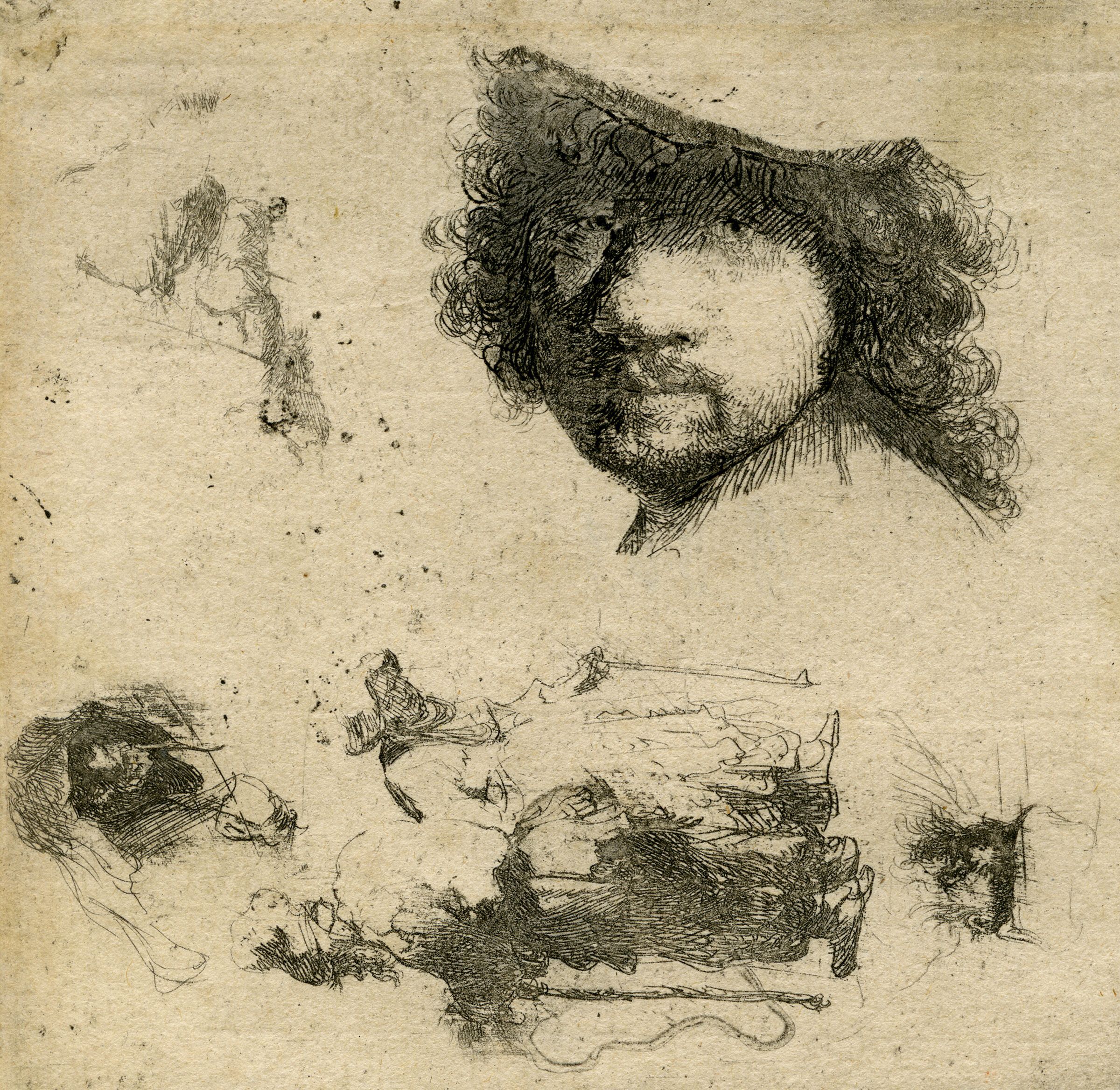
Rembrandt van Rijn’s Sheet of Studies: head of the artist, a beggar couple, heads of an old man and woman, etc. probably started as a self-portrait, but the artist apparently became unhappy with it and used the etching plate for other sketches. A beggar couple and the head of an old woman were drawn perpendicularly to the self-portrait at the left, and a head of an old man sits similarly to the right. Upside down at the upper right is a partial image of a crouching man. These subjects can be found in other Rembrandt works of the same period. The source of artist’s discontent may have been his hair, the lines of which were filled in by varnish so they would not print. This left only short, stubby lines above the brow.
Rembrandt made over seventy self-portraits, many more than any previous artist. In his early career, at least, he used himself as a model to explore different facial expressions or varying effects of light and dark. Here, for example, the eyes are cast in deep shadow. Rembrandt was known for this subtle chiaroscuro and for the freedom and looseness of his etched line, which contrasts with the repetitive and regular line work of most contemporary etching. Beggars were everywhere in sixteenth and seventeenth-century Europe and became an important theme in Rembrandt’s work around 1630. In the sixteenth century beggars were frequently satirized as frauds leeching off the working populace, but during the seventeenth century attitudes toward these unfortunates became more tolerant. In this work, Rembrandt depicts his beggars in a calm and emotionally neutral manner.Label
From the Permanent Collection
Rembrandt van Rijn’s Sheet of Studies: head of the artist, a beggar couple, heads of an old man and woman, etc., 1631-1632, is not simply a self-portrait but what is called a model sheet. Model sheets were typically made as preparatory sketches for other works or as models for students to copy. Rembrandt apparently turned the etching plate repeatedly in creating the image. A beggar couple and the head of an old woman were placed perpendicularly to the left and a head of an old man was place similarly to the right of self-portrait. Upside down at the upper right hand is a partial image of a crouching man.
Rembrandt made over seventy self-portraits during the course of his career, many, many more than any artist prior to this time. Self-portraits made in his early career, such as the Mulvane work, served a number of functions. The point of some of these works was not exclusively, or even primarily, to create a recognizable image of the artist. Instead the artist at times used himself as a model to explore different facial expressions or different effects of light and dark, as here in which the eyes are cast in deep shadow.
While Rembrandt used himself as a model, he also understood that the public valued images of him. In 1628, Arnold van Buchel, a Dutch art connoisseur [devotee, aficionado], wrote that Rembrandt, then only twenty-two years old, was already a “highly regarded” artist; portraits of him were collected because he was famous. These portraits had the added benefit of being done in his innovative style. He was known for his subtle chiaroscuro, the treatment of light and dark, and for the freedom and looseness of his etched line, which contrasted with the repetitive and regular line work of most contemporary etching.
Beggars were also an important theme in Rembrandt’s work around 1630. These unfortunates were everywhere in sixteenth and seventeenth century Europe. In the sixteenth century they were frequently satirized in art as frauds leeching off the working populace. The seventeenth century, on the other hand, witnessed a growing tolerance for beggars. While elements of caricature persist in some of Rembrandt’s early images of beggars, in their emotional neutrality they seem to foreshadow the more sympathetic approach taken by Dutch artists later in the century.
Most model sheets were produces as drawings, and these were highly prized by collectors. Rembrandt was one of the first artists to produce model sheets as prints, clearly finding them to be commercially viable. However, the purpose of this specific model sheet is unclear because it was originally printed only a very few times. Moreover, in the first printing the etching plate wasn’t prepared properly, thus resulting in unintended blotches of ink. The Mulvane self-portrait came from a later printing, likely done after Rembrandt’s death, for which one centimeter was cut off from the left side, and the imperfections were removed.
At least one scholar has speculated that this etching started out as a self-portrait, but that Rembrandt, dissatisfied with it, drew other objects on it. A couple of facts support this assertion. Originally, the lines of his hair extended above where they abruptly terminate now. The artist, apparently unhappy with this section, covered the lines with varnish, making it impossible for ink to get into them. Thus, these lines would not print. Secondly, Rembrandt created only a very few impressions of the image, suggesting that he did not consider it to be commercially viable.
Contemporary artists typically destroy their metal plates after they are finished printing from them. This was not, however, the case in the past. The Mulvane etching is different in a few ways from those known to have been printed during Rembrandt’s lifetime. Most notably the original print is one centimeter wider at the left than the Mulvane version, which is also printed on a later type of paper. Thus scholars believe that this impression, and a number of others like it, were printed after Rembrandt’s death. This makes the print less valuable; nevertheless the plate from which it was created was etched by Rembrandt himself and worthy of study today. The Mulvane is not alone in owning posthumously printed pieces. Rembrandt restrikes, as these are called, were being created from his plates well into the eighteenth century.
To Learn More:
Erik Hinterding. Rembrandt Etchings from the Frits Lugt Collection, 2 vols. Bussum, Netherlands: Thoth and Paris: Fondation Custodia, 2008.
Suzanne Stratton. “Rembrandt’s Beggars: Satire and Sympathy,” Print Collector’s Newsletter, vol. 17, no. 3 (July-August 1986), pp. 77-82.
Ernst van de Wetering, et. al. Rembrandt by Himself. London: National Gallery Publications, Limited and The Hague, Netherlands: Royal Cabinet of Paintings Mauritshaus, 1999.