Label
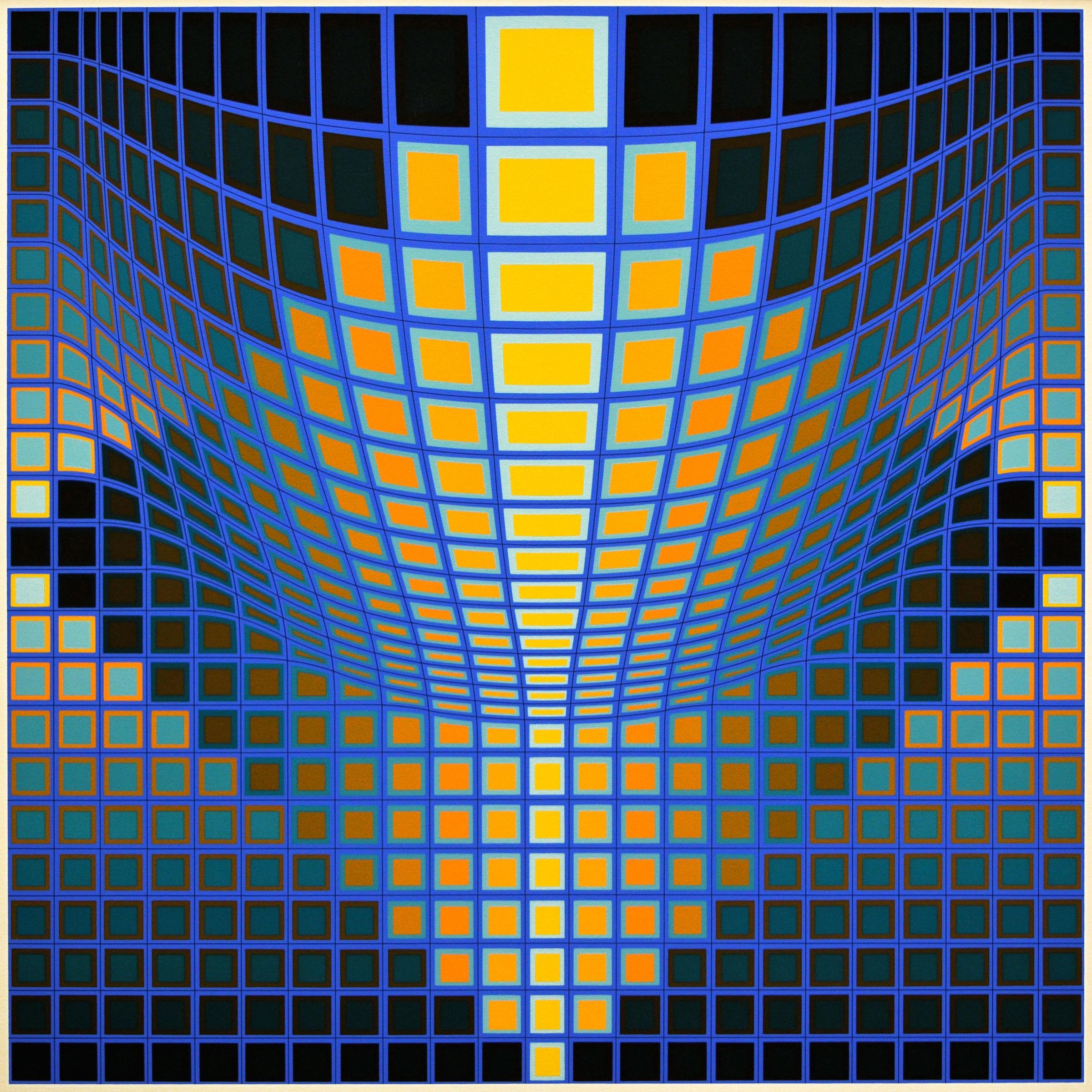
Victor Vasarely was born in Hungary in 1908. He has worked in Paris since the late 1940s, and is best known for his geometric-abstract, optical experiments printed serigraphically on paper. Vasarely, always interested in the relationship between art and technology, was a founder of GRAV (Groupe de Recherche d'Art Visuel) in 1960. He wrote that the multiple image, created by advanced technical means, was the art of the future, which would exist in multiples: "The masterpiece is no longer the concentration of all the qualities into one final object, but the creation of a point-of-departure prototype, having the specific qualities, perfectible in the progressive numbers." [quoted in Hunter and Jacobus, Modern Art: 1992, p. 337]. Vasarely and other artists of GRAV (which is also a pun on gravure, the French word for engraving) sought a depersonalization and demystification of art and the artistic process in the post World War II world. Their work is closely related to the optical experiments of Josef Albers and his students, the American Op artists of the same period. The bright color and sharp linearity of this image are typical of Vasarely's work, as is the impression of movement where none exists.