Label
Jacques Callot, French, 1592-1635
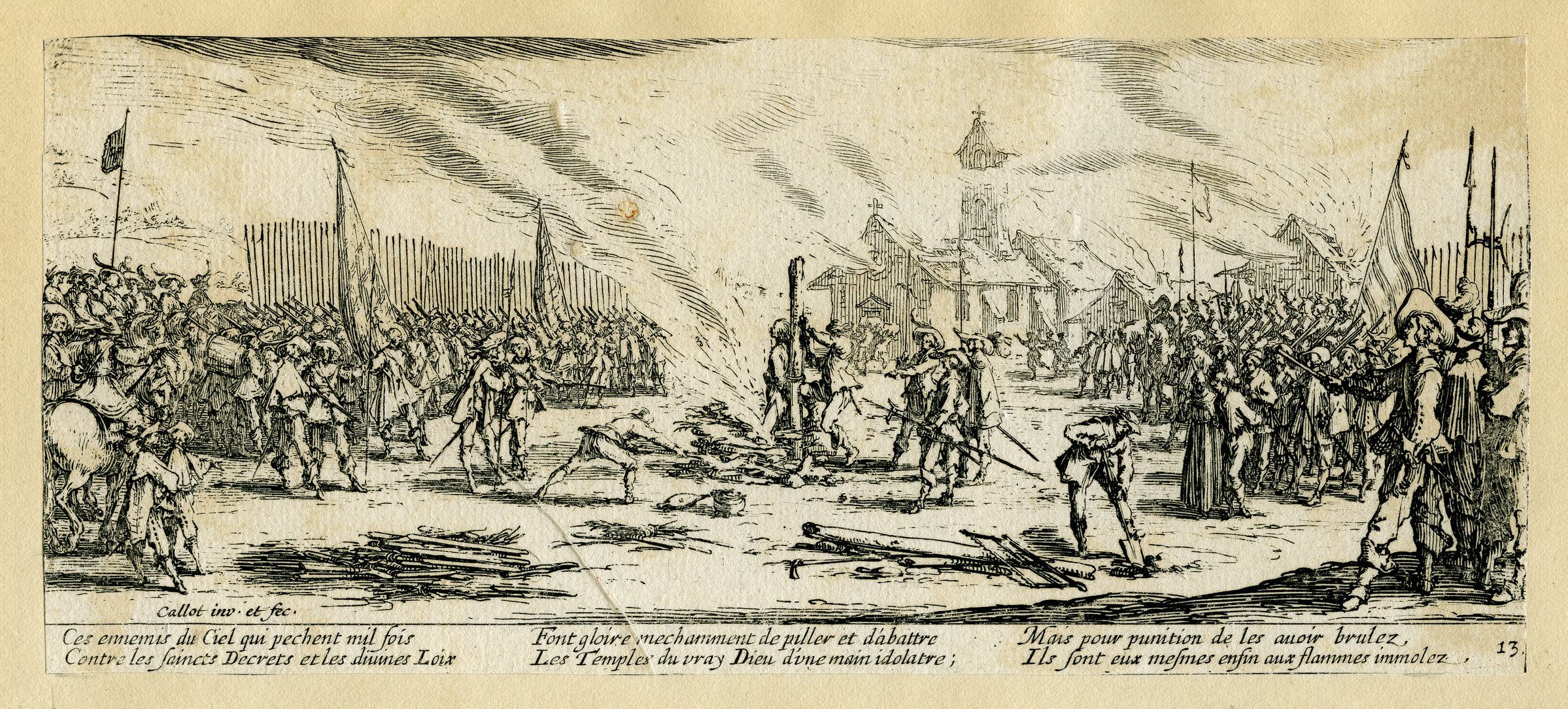
The Stake, from The Miseries and Woes of War, 1633
etching
Museum Purchase, 2002
The Miseries and Woes of War consists of eighteen scenes of war, including four scenes of soldiers plundering and burning the countryside and four scenes of soldiers being severely punished for their crimes. The Stake depicts a soldier being burnt at the stake; this was then considered a just punishment for his heinous crimes. To deter such behavior, the punishment takes place in front of a large assembly of soldiers.
One of the most innovative printmakers of his age, Jacques Callot worked for an international clientele. When his major patron, Cosimo II de Medici, the Grand Duke of Tuscany, died in 1621, Callot returned from Italy to his native Lorraine, then an independent duchy in what is now northeastern France. This Catholic duchy was involved in the Thirty Years War (1618-1648) against German Protestants, and in 1633 was invaded by the French monarchy, which had long desired to annex it. Thus Callot had seen much of war and its consequences. The series cannot, however, be seen specifically as anti-French, as it was published in Paris in 1663, when freedom of the press was unheard of. Instead, it shows the life of the soldier who is both punished for crimes and, in other prints, rewarded for good behavior. In general the series brings to mind the horrors Europeans faced during a time of prolonged religious warfare, like the Sunni/Shiite conflict among Muslims today.