Label
(from 2014.Old Walks and New)
George Melville Stone, American (Kansas), 1858-1931
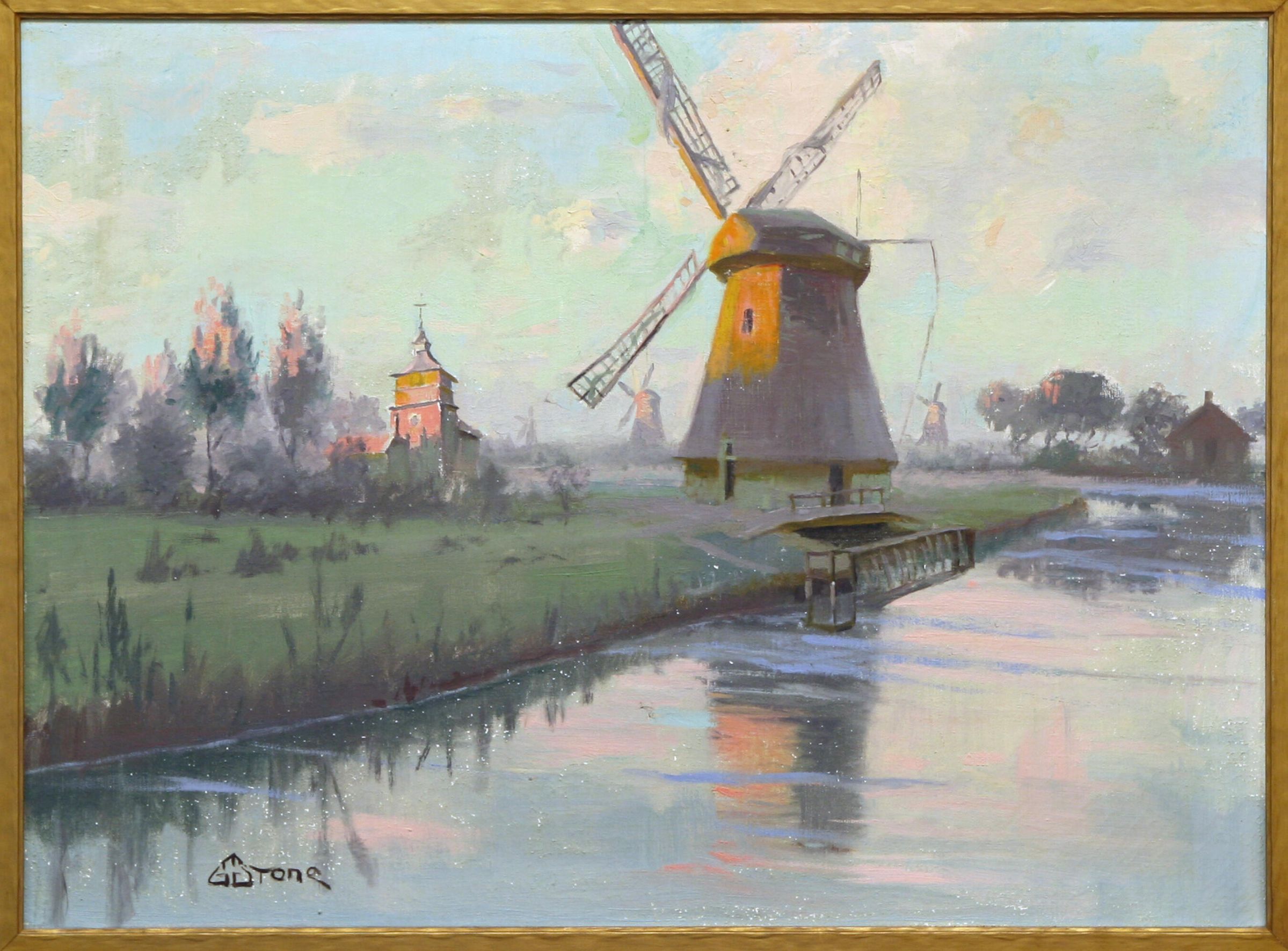
Old Dutch Windmill, c. 1907, oil on canvas
A native Topekan, Stone traveled to the Netherlands in 1907. Many American artists painted in Holland in the late 19th and early 20th centuries, attracted, as was Stone, by its quaint, picturesque costumes, customs, and architecture. Clearly influenced by French Impressionism, Stone here uses a high key palette of soft pinks, greens, and blues. Stone studied in Paris from 1887-1890 at the Académie Julien and with the American expatriate Henry Mosler. In 1903 he founded the Washburn College Art Department, teaching there frequently until his death in 1931.Label
(from 2014.Old Walks and New)
Conservation
You may have noticed white spots in this painting where paint has flaked off. This could have happened for any number of reasons. Modern museums work hard to prevent this kind of damage, but old paintings like this have not always been handled properly. Museums normally do not exhibit works in this condition because of the fragility of the paint surface, but the Mulvane staff thought viewers might be interested in the conservation problems that museums deal with.
This painting could be conserved. A conservator would treat the painting with a clear layer of removable varnish. On top of this varnish layer, the conservator would fill in the white spots with matching colors. This in-painting, as it is called, would not be on the original surface, thus preserving under the varnish the original color strokes laid down by the artist. Conservation can be very costly. The Mulvane Art Museum is currently completing an assessment of works such as this so that we can create a conservation plan and budget to help us raise funds for conservation and preservation of works in our collection for future generations.