Label
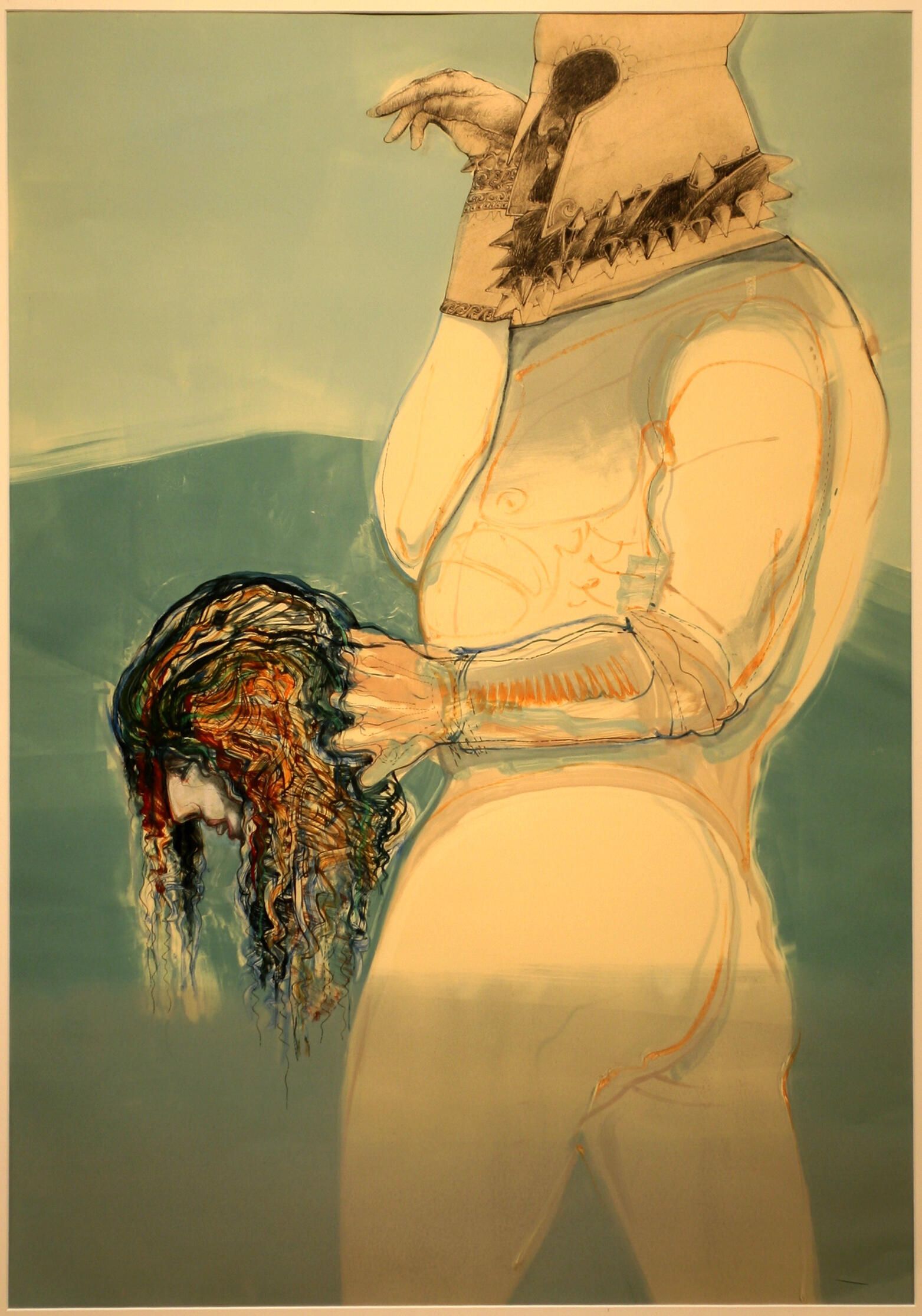
2022, Echoes of the Classical World
King Polydectes wanted to take Danae as a wife, and needed to get rid of her son Perseus who stood in his way. The king gave Perseus the dangerous and distant mission of bringing him the head of the gorgon Medusa. With the assistance of Hermes and Athena, Perseus was well equipped with winged sandals, and the cap of Hades. Using Hermes’ sandals, Perseus flew to the island that the gorgons called home. To avoid petrification, Perseus averted his eyes in order to slay the gorgon who lay asleep. Using his bronze shield as a mirror, Perseus was able to avoid looking into the petrifying gaze of Medusa. With the guidance of Athena and his own skills as a warrior, Perseus was able to behead the monster, escaping with his life and obtaining the prize: the head of Medusa.
Text by Kolten Brenner, Washburn studentLabel
Robert Nelson, American, b. 1935
Perseus Grasping the Head of Medusa, 1984
lithograph
36 ½ x 25 ½ in.
Gift of Mulvane Women's Board.
85-33-236
Exhibition Label: Who Does Not Wear a Mask? from Aug. 24th to Sept. 22nd, 2013.
Robert Nelson’s lithograph depicts the Ancient Greek myth of Perseus and Medusa. The son of Danaë and the Greek god Zeus, Perseus was challenged to cut off the head of the gorgon Medusa. Gorgons were ferocious creatures with writhing black serpents covering their heads. Even worse, if you looked at a gorgon, you were instantly turned into stone. Perseus was able to carry out his task by wearing the “cap of darkness,” given to him by the gods, which rendered him invisible to the gorgons.
In Nelson’s print, Perseus is shown holding Medusa’s head and shielding his eyes with his right hand. Here the “cap of darkness” takes the form of the so-called “Corinthian” helmet, the most popular type of headgear for Greek soldiers from the end of the eighth century into the fifth century B.C. With a nose guard, it covered almost the entire head and neck excluding openings for the eyes and a slit at the center of the face. While Perseus’s helmet is authentic, his wristband and spiked collar appear to be fanciful inventions, despite the fact that they carry Greek-style ornamentation. Could the collar have been inspired by contemporary Goth/punk/biker jewelry? Regardless, it is a savagely fitting match for Medusa’s terrifying powers.