Label
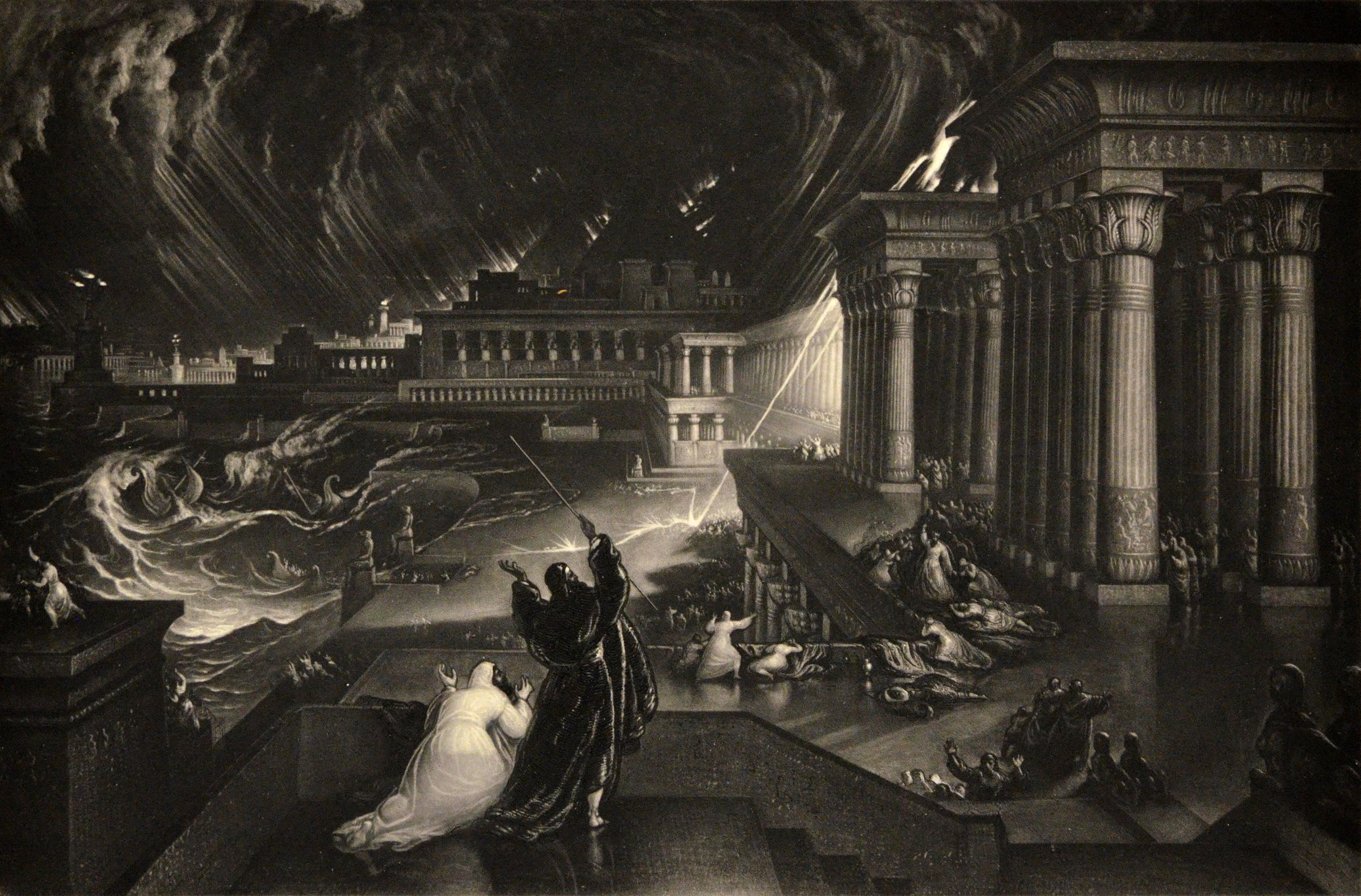
John Martin, English, 1789-1854
Seventh Plague, designed and engraved 1833, reprinted 1838 by Charles Tilt
mezzotint
Museum Purchase, 2002
This print was created as part of Martin’s Illustrations of the Bible. In the biblical book of Exodus (9:13-35), God calls Moses to free the Israelites who are enslaved in Egypt. The Egyptian king will not emancipate them, so Moses brings down ten plagues on the country. This work illustrates the seventh plague in which Moses “stretched forward his rod toward heaven, and the Lord sent thunder and hail, and fire rained down upon the earth.” In the late eighteenth and early nineteenth centuries, England witnessed a spiritual revival, and many artists, including Martin, created biblical subjects in which God reveals his power on earth. Such spectacular themes captured the public’s imagination, and prints of them were very popular, selling both to wealthy and middle class patrons. The incredible architecture of this print seems to have been based on contemporary archaeological publications on the ancient Egyptian city of Thebes.
Mezzotint is a process in which a rocker, a metal tool with a rough surface, is rocked over a metal plate making a surface of tiny protruding shards of metal that hold ink. When printed this creates the black overall tonality of the print. The image is made by polishing out the shards in places to create white or lighter areas. The mezzotint process makes possible the strong dark and light contrasts, which greatly add to the drama of the piece.