Label
2024 post:
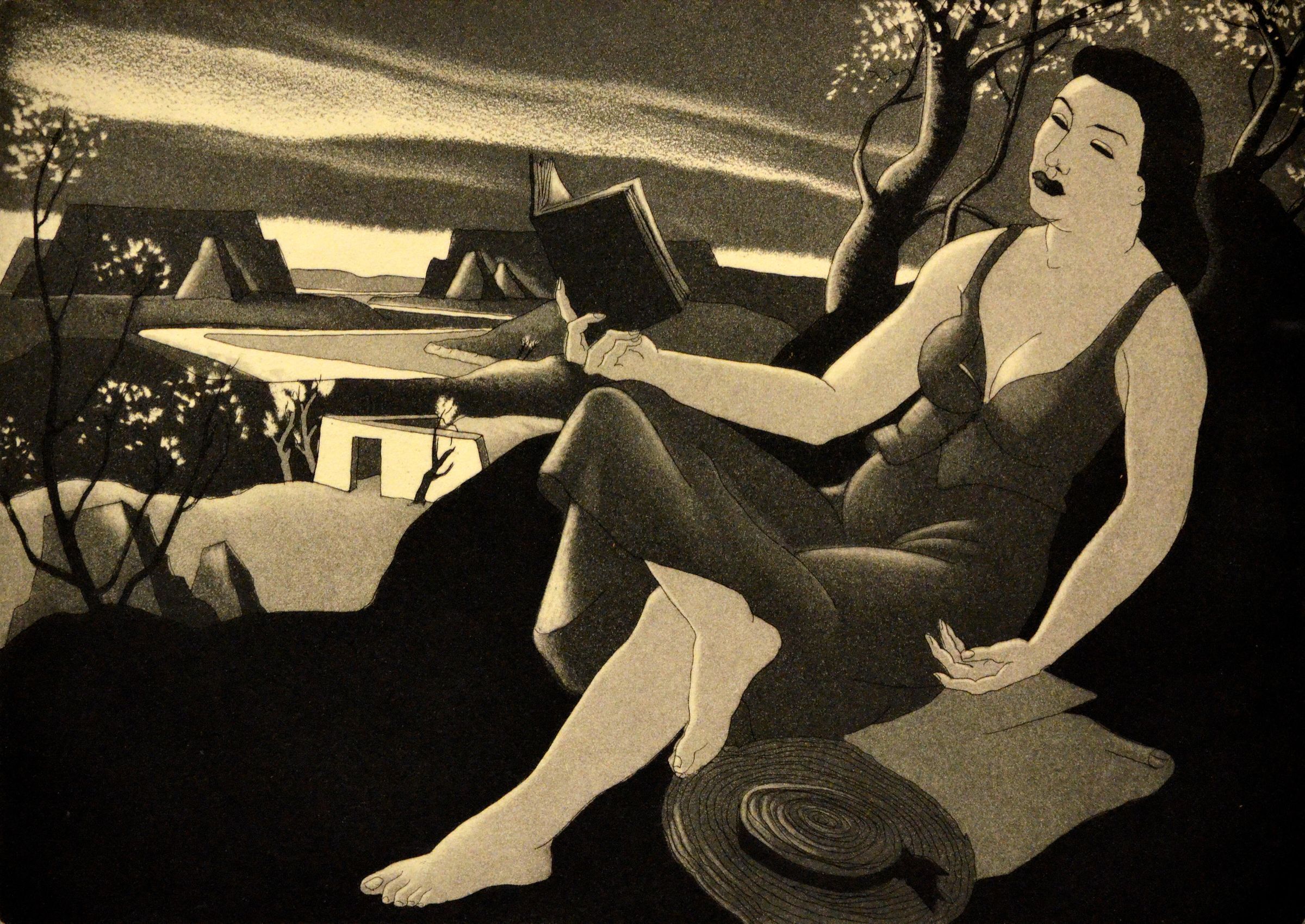
Throughout 2024, we're looking back at the 100 year history of art at the Mulvane. This 1941 etching by Doel Reed feels appropriate to share on this spring day. It depicts a woman enjoying the season in a rocky mesa landscape that seems inspired by the Southwestern United States, where the artist lived for many years.Label
Doel Reed, American, 1894-1895
Spring, 1941
aquatint and etching
Gift of Dr. Dorothy Fuller, 1981
Spring was “inspired by some of the strange formations in the western part of Oklahoma,” which are seen in the distance. A scantily clad woman reads drowsily, luxuriating in the newly warm spring. Traditionally the seasons of the year have been linked to the ages of man, and here Reed draws an analogy between the new fertility of spring and of the young woman. This comparison is emphasized by the framing of the woman’s head between two newly leafed trees. Their sinuous curves reflect those of her body. Reed frequently created images of young women. One commentator noted, “his figures in landscapes often have the mystery and grace of goddesses out of some timeless place; they are not real.”
Reed was a member of the Prairie Printmaker group, founded in 1930. Spring was the group’s 1941 annual gift print for associate members. From 1924-1959, Reed taught at Oklahoma A & M (now Oklahoma State University), where he was the first artist on the faculty. He is considered to be one of the finest American aquatint artists of the twentieth century. To create an aquatint, an artist first “stops out,” or completely covers with an acid resistant material, sections of the etching plate that s/he wishes to remain white. Acid resistant, powered rosin is then sprinkled over the plate in places that are to be gray or black. The plate is then put in an acid bath that etches out the spaces between the granules of rosin. To create darker areas, the artist stops out sections that are to be lighter and then again places the plate in the acid bath. Reed repeated this process up to ten times. When printed, the most heavily etched areas would hold the most ink and the totally stopped out areas the least with many variations in between, thus creating many different values of gray, black, and white.