Label
Pieter Bruegel the Elder, Flemish, c. 1526-1569
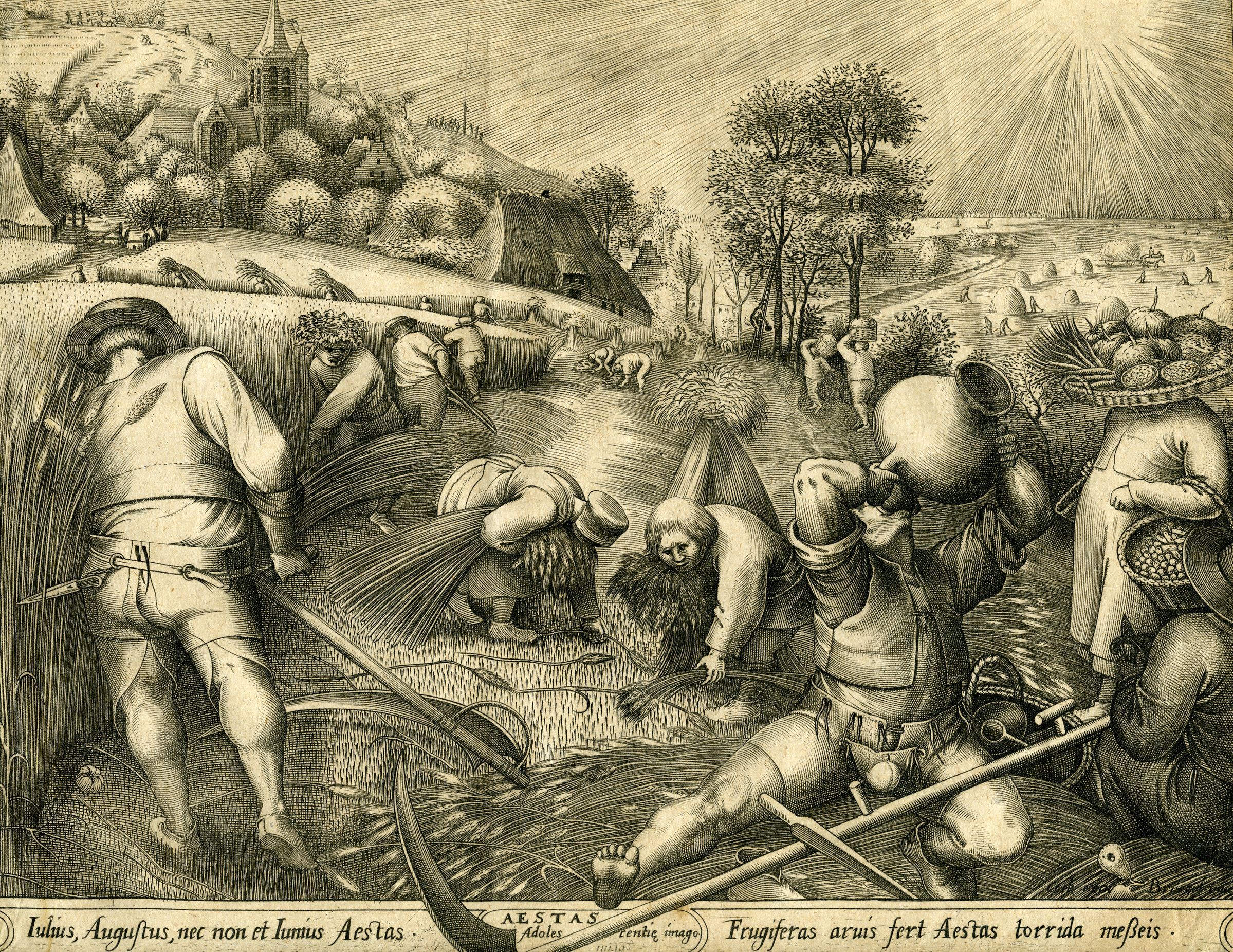
Summer, 1568, engraved by Peter van der Heyden, 1570
engraving
Museum Purchase, 2001
According to Bruegel scholar Manfred Sellink, Summer is “among the most outstanding of Bruegel’s drawings.” In it June is represented by the picking of fruit in the center background and by the peasant with two baskets of produce at the right. July haying also takes places in the background with windrows of fresh cut hay on the left and haystacks on the right. In the front the wheat harvest symbolizes August.
Fifteenth and sixteenth-century religious calendars were sometimes decorated with scenes of the rural peasantry representing the months or the seasons, but Bruegel was one of the earliest artists to use these subjects for large-scale paintings. Such secular depictions were relatively new in Western art, which had been dominated by religious themes. In the 1650s, Bruegel travelled to Italy, and his interest in Italian art apparently reemerged in the last few years of his life. For example, in this work the large foreground figures with well-defined musculature and in complex, twisted poses recall the monumental work of Michelangelo. Bruegel shows these lower-class workers as strong and powerful, and he has carefully observed rural life. But he does poke a little fun at these peasants. For example, the figure in the right foreground has indecorously kicked off one shoe as he greedily drinks from a water jug. The upturned scythe between his legs may allude to another appetite. The scythe and the barefoot appear to extend beyond the border of the picture, perhaps referring to a Dutch phrase “to go beyond all bounds,” i.e. going outside the limits of acceptable behavior.