Name/Title
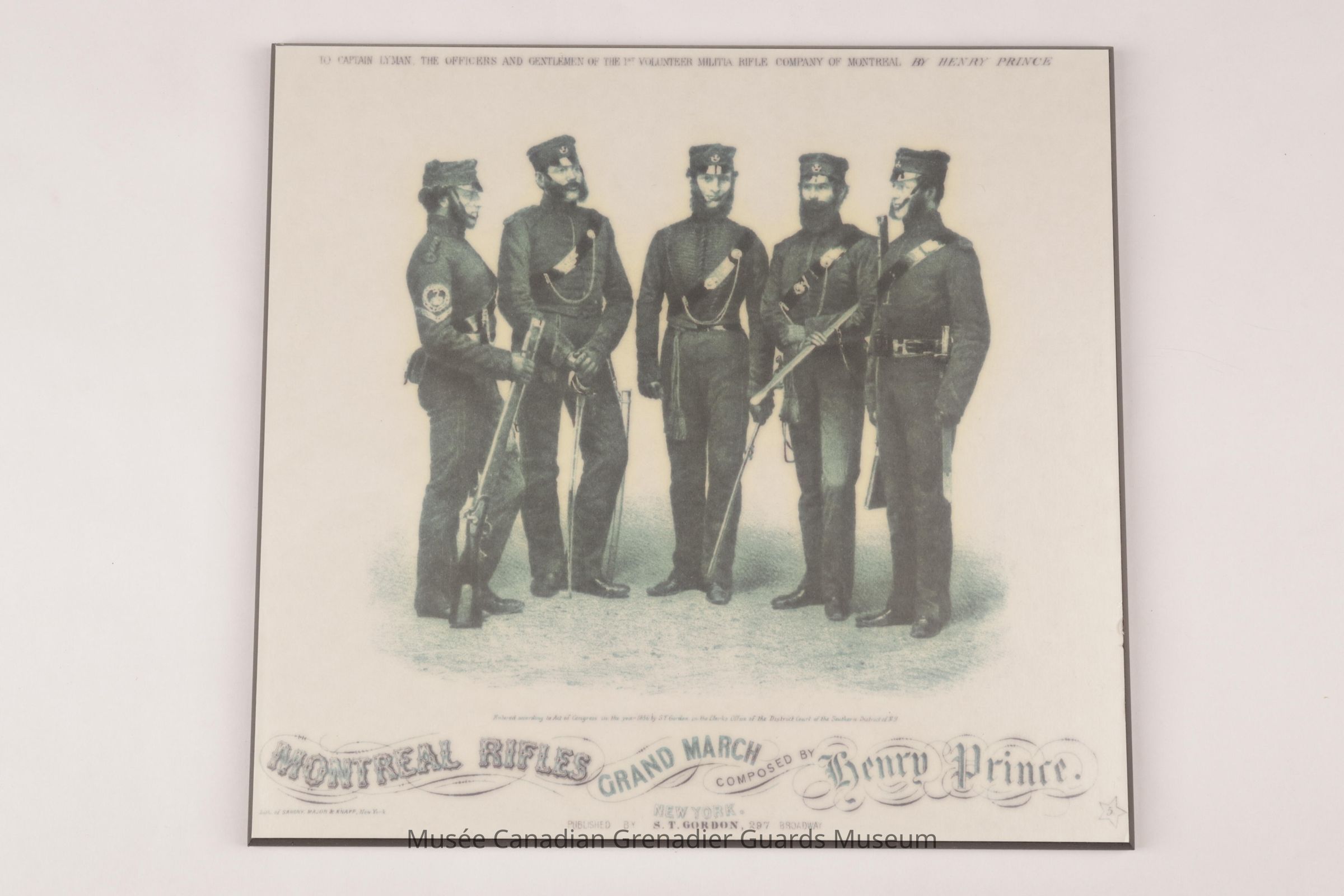
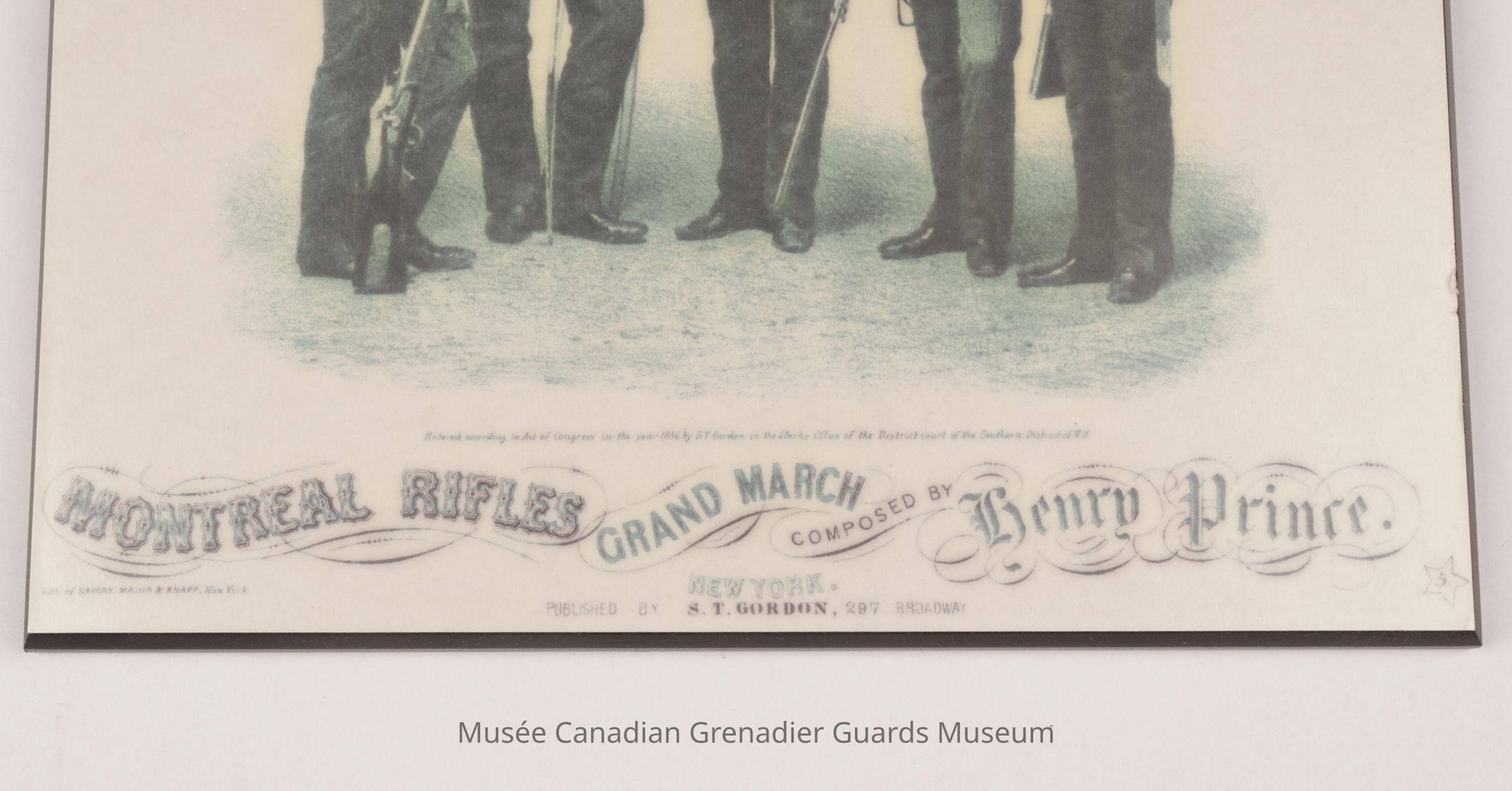
1854 - Album cover [and audio file] of "The Montreal Rifles Grand March" composed by Monreal Rifles Officer (CGG) Ensign Henry Prince - CGG's first Regimental March Pass song, First Band Master, and first big music starDescription
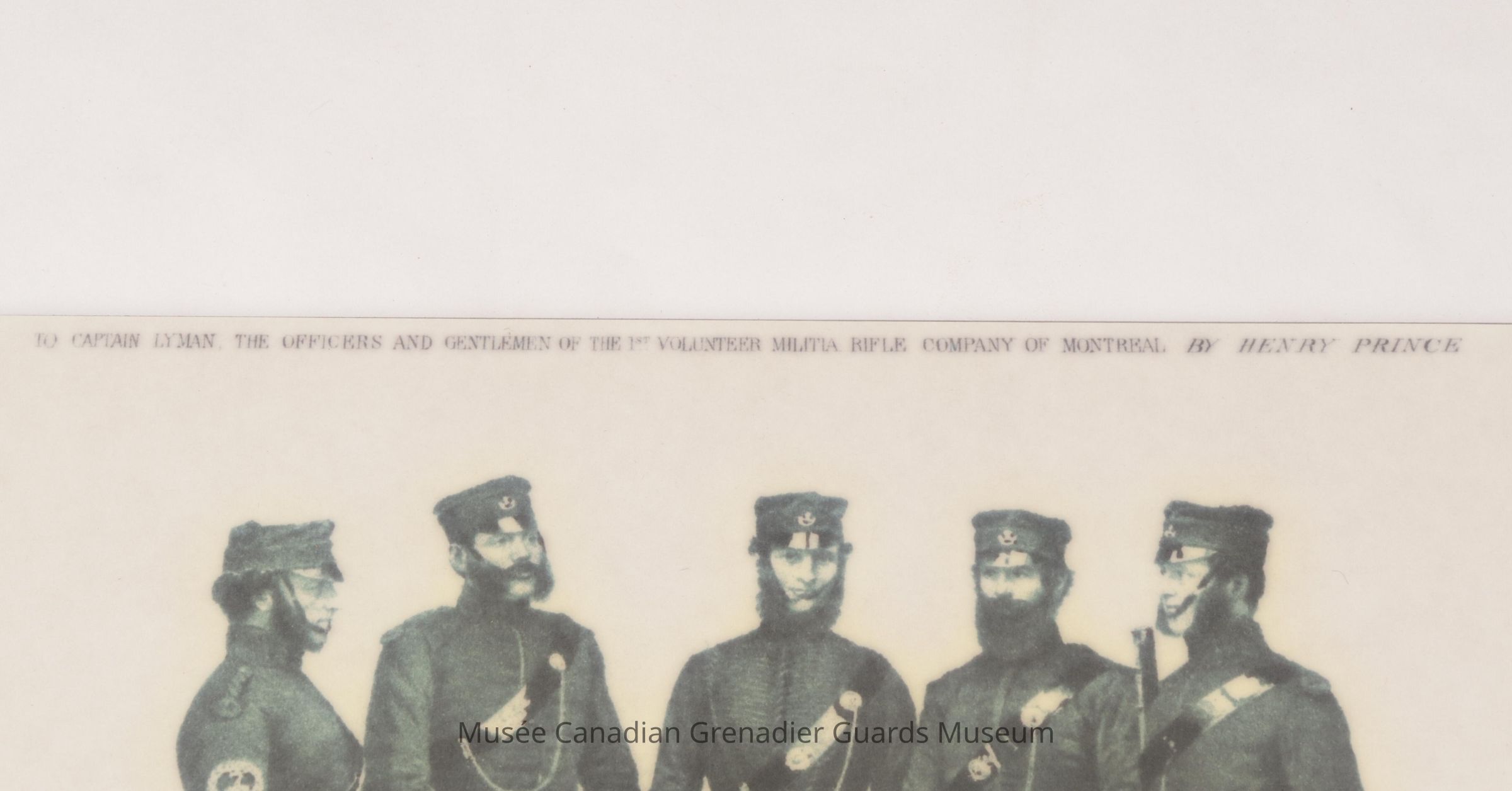
1854 - CGG's first regimental March Pass song, dedicated to To Captain Lyman, the officers and gentlemen of the 1st Volunteer Militia Rifle Company of Montreal by (Ensign) Henry Prince 'First' Band Master, and first big music star
ABOUT THE COMPOSER - HENRY PPRINCE (1811-1892)
Henry Prince was a famous Montreal born music dealer, bandmaster, and composer. In 1854 he acquired the instrument retailing and sheet music business of Mead, Brother and Co, and continued its operation under his own name. He issued sheet music from 1854 to 1878, most of it printed and copyrighted through Johns Hopkins in Baltimore, Maryland USA. As a composer, Prince wrote quadrilles, polkas, and other dance music. His works include the patriotic songs 'Form! Riflemen Form!' (1859) and 'Shoulder to Shoulder on to the Border,' as well as Mermaid Polka (dedicated to the ladies of Canada) and Irresistible Polka (for the ladies of Montreal). Some of Prince's most 'Canadian' compositions, including the Jubilee or Celebration Polka (1855), dedicated to executives of the Canadian Grand Trunk Railway, were published in the USA with Prince listed on the cover as an agent.
Prince remained in business until 1888. A bandmaster of note, he led the Volunteer Militia Rifle Band and played a cornet solo at a Grand Military Concert (17 Sep 1857) in Montreal. Gustave Smith called Prince 'a true gentleman' and remarked on his 'fine talent on a cornet'.
ABOUT THE MONTREAL RIFLES (LIEUT.- COL. LYMAN): Written by Captain Ernest Chambers 1897
"The Montreal Rifle Rangers was organized in August 1854 by a few patriotic gentlemen who had been in the old rifle companies in 1837-38 and considered themselves to be the successor of Major Griffin s old Rifle Corps of the 1837 Rebellion period. At the time of the 1837 Rifle Corps organization the Imperial troops, with the exception of the since disbanded Royal Canadian Rifles, had been withdrawn from Canada."
"In 1854, the organization of the Rangers was completed as soon as possible and Lieut.-Col.,
Theodore Lyman was elected to be its Captain. The first officers were Theodore Lyman, Captain ; John W. Haldimand, Lieutenant; and J. E. Malhiot, Ensign. The company numbered 64 rank and file. , and Lieut.-Col. Lyman, who survived up to 1897 remarked that the men of The Montreal Rifles included representatives of all the nationalities that made up the population of Montreal. He also remarked that
holiday visits by several military organizations (New York, Vermont, Maine) from the United States had inspired the formation and organization of the first company."
"The uniform of the company was of dark green cloth, of equal quality for officers and men, and consisted of a braided jacket with scarlet facings, and trousers with a scarlet welt down the side. A shako with a device in bronze in front, and surmonted by a ball, and a forage cap with a horizontal leather peak and a band of silk braid with a silver bugle in front, formed the head gear. The accoutre
ments were of English patent leather, a waist belt with a plated clasp, and a cross-belt with a cartridge box, on which was a silver crown and in the case of the officers and sergeants a breastplate in silver, bearing in relief the city arms and a silver whistle and chain. (The cost of a private s outfit was seventeen pounds ten shillings sterling.)"
"In 1855, as soon as the new Volunteer Militia Bill was reported, Captain Lyman secured an interview with Sir Edmund Head, the then governor, to obtain official recognition. The Rangers being thus the first to apply for admission under the Act were on the 3ist August, 1855, gazetted as the "First Volunteer Militia Rifle Company of Montreal" holding seniority over all other active volunteer corps
in Canada, and by its smart appearance on parade and superior efficiency, imparted
a very decided impetus to the volunteer movement throughout the country. By the new bill, two rifle companies were allotted to Montreal, and in September, 1855, Captain Fletcher was transferred from the Fire Brigade to command Number Two Company."
"The impetus given to the volunteer militia movement resulted in a succession of other Rifle companies being organized. Sir Edmund Head discussed the designation of the new force with Captain Lyman, and it was decided to call the force neither volunteers nor militia, but "Volunteer-Militia", which was not only the first volunteer company general volunteer militia movement in Canada, but also in Great Britain." - Captain Ernest Chambers, 1897
The Rangers were meant to perpetuate a unit of the Montreal volunteers active in the 1837-38 Rebellion called the Montreal Rifles. a bn. of 5 coys. commanded by LCol. Henry Griffin. A detachment of this unit fought at the Battle of St. Eustache on Dec. 14, 1837. A Cpl. of this unit, Thomas Ross, later served as the first Officer Commanding of the GGFG in 1872.
The Montreal Rifle Rangers had a strength of 67 all ranks and at least 3 of the other ranks received commissions in the regular British Army, two serving actively in the Crimean War.Context
To Captain Lyman, The Officers, and The Gentlemen of the 1st Volunteer Militia Rifle Company of Montreal.Created By
Zarina CarlevarisCreate Date
July 13, 2022Updated By
R. John Dolbec C/Sgt. (ret.)Update Date
February 19, 2026