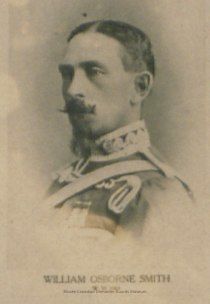
Name/Title
1854 - Lieutenant Colonel William Osborne-Smith, CMG (1833–11 May 1887) - Canadian Militia officer (1st PWR), Canadian Veteran of the Crimean War, Fenian Raids, and the 1885 Northwest Rebellion, Founder of the Victoria Rifles of Montreal, and first temporary head of the North-West Mounted PoliceScope and Content
1854 - Lieutenant Colonel William Osborne-Smith, CMG (1833–11 May 1887) - Canadian Militia officer (1st PWR), Canadian Veteran of the Crimean War, Fenian Raids, and the 1885 Northwest Rebellion, Founder of the Victoria Rifles of Montreal, and first temporary head of the North-West Mounted Police
One of the most interesting and historic members of The Regiment was Lieutenant-Colonel William Osborne Smith, CMG. Although relatively unknown to us today, he was a very influential and experienced Officer who chose to serve with the 1st Prince of Wales Regiment from July 1857 until 1861. During that time, he was appointed to No 6 company.
ABOUT THE CGG SOLIDER:
Lieutenant-Colonel William Osborne Smith, CMG, was a Welsh-born British Army and Canadian Militia officer who became one of the leading figures in Montreal’s nineteenth-century volunteer military establishment. Commissioned into the 39th Foot in 1855, he came to Canada following service during the Crimean War period, settled in Montreal, and organized the Victoria Rifles in 1861. Smith commanded militia forces during the Fenian emergencies of 1866 and 1870 and was appointed a Companion of the Order of St Michael and St George for his services on the Quebec frontier during the Eccles Hill campaign. Sent west in 1871, he commanded Military District No. 10 at Winnipeg, briefly served as the first temporary commissioner of the North-West Mounted Police, and led troops providing security during the negotiation of Treaty No. 4. He later raised and commanded the Winnipeg Light Infantry during the North-West Rebellion of 1885. Fort Osborne and Winnipeg’s Osborne district preserve the name of an officer regarded as an important early contributor to Canada’s professional military and mounted-police institutions.
LCOL OSBORNE-SMITH'S HISTORIC MILITARY ACCOMPLISHMENTS:
He served in the Crimean War: William Osborne Smith was commissioned into the British Army's 39th Foot in 1855. He served in the Crimea and came to the province of Canada with his regiment in 1856. He married Janet Colquhoun of Montreal in 1858. When his unit was transferred to Bermuda in 1859, Osborne Smith, then a lieutenant, sold his commission and became a merchant in Montreal.
He was a founding Commander of the Victoria Rifles of Canada - He was appointed commander with the rank of lieutenant-colonel of a battalion formed unofficially in December 1861 during the Trent crisis and gazetted on 22 Jan. 1862 as the 3rd Battalion Volunteer Militia Rifles. The battalion was later allowed to assume officially the title Victoria Rifles
He was the Commanding Officer of Canadian Forces at the Quebec Frontier during the Fenian Raids of both 1866 and 1870 and provided key assistance to the Fenian Red River Campaign in 1871: During the Fenian raids of June 1866 Smith was in command on the frontier south of Montreal. On 5 June he made an arduous march with the Victoria Rifles,1st Prince of Wales Rifles, and other troops from Hemmingford to Huntingdon to avert an attack by Fenians assembled at Malone, NY. In the Fenian raid of May 1870 Smith was again in charge on the Quebec frontier. Before the engagement at Eccles Hill on 25 May he had posted the small force on the ground, and arranged reinforcements at the moment when Fenian raiders crossed the border and were driven back.
He was one of the first Canadian Officers to be awarded a CMG (Order of St Michael and St George): Major-General James Alexander Lindsay, the regular officer commanding in Canada East, described Smith in his report on the operations as “a most valuable officer, energetic and active.” in1871, For his services during both Fenian raids campaigns Smith received the CMG.
He was a founding Commander of the North West Mounted Police (RCMP): On September 25, 1873 LColSmith was appointed for a temporary period first Commissioner of the newly created mounted police force. Proceeding with its mobilization, Smith swore in the first members at Lower Fort Garry, supplied uniforms from militia stores and commenced training. He was relieved by his permanent successor George Arthur French.
He has a Canadian Fort named after him: Originally Smith was in command of a 300 men including an artillery detachment, maintained at Winnipeg. A new post was constructed there and named Fort Osborne, after Smith. The garrison, although not mounted, made its influence felt over a wide area.
He was a founding Commander of the Winnipeg Light Infantry: In the North West Rebellion of 1885 Smith raised the Winnipeg Light Infantry Battalion. This unit was sent to Calgary to join the Alberta Field Force commanded by Major-General Strange. The Winnipeg Light Infantry under Smith’s command took part in the operations of Strange’s column, including the inconclusive engagement of Frenchman Butte, At the end of the campaign Smith apparently suffered an injury from which he never fully recovered.
He held provincial and Federal political positions after his military career: William Osborne Smith continued in the militia and oversaw the signing of Treaty No.4 in 1874. He left the militia department in 1881 and ran successfully for both federal and provincial office. Smith died on May 11, 1887 at 54 years of age, during a visit to his native Wales.
LCol William Osborne Smith carries the distinction of having the only regimental number that carries a fraction: His regimental service number was 2.5Created By
Lieutenant Michael Hayes-Rivet, retired.Create Date
July 15, 2026Updated By
Lieutenant Michael Hayes-Rivet, retired.Update Date
July 15, 2026