Name/Title
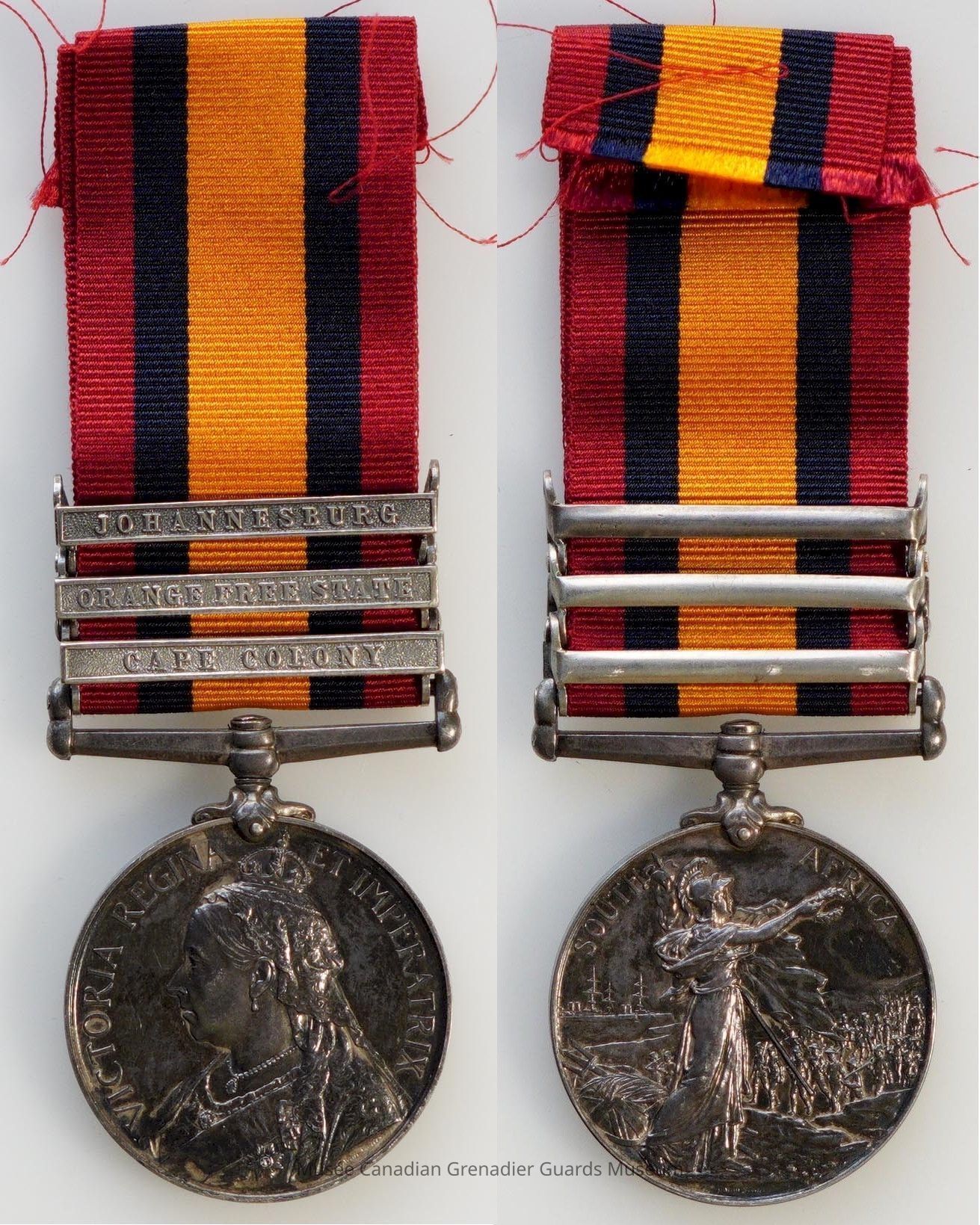
1899 - 2nd Boer War Medal named to 1st Prince of Wales Regiment Fusiliers (CGG) Private Michael Kealey 7656 - E Company Royal Canadian RegimentScope and Content
FOR ARCHIVE PURPOSES ONLY - ITEM WAS SOLD ONLINE AND IS NOT IN CGG MUSEUM COLLECTION
1899-1902 - 2nd Boer War - A Canadian Queen's South Africa Medal named and officially impressed to ''7656 PTE. M. KEALEY, R: CANDN: REGT'' with Cape Colony, Orange Free State & Johannesburg Clasps.
ABOUT THE CGG SOLDIER
Private Michael Francis Kealey was born in Ottawa, Ontario on 11th of October 1876 in Ottawa, Ontario and relocated to Montreal where he attended Mcgill University and joined the 1st Prince of Wales Regiment Fusiliers (CGG) in 1898. He was one of 32 active CGG members at the time (and 40 CGG members) to volunteered to join the Canadian Contingent as part of E Company, 2nd Special Service Battalion Royal Canadian Regiment, or as part of the South Africa Constabulary as part of the British Army in South Africa. After returning to Canada in 1901, he returned and lived the rest of his life in Ottawa where he became a well-known public-school administrator. He passed away on 25th September 1939.
ABOUT THE 2nd BOER WAR (1899-1902)
The South African War (1899-1902) or, as it is also known, the Boer War, marked Canada's first official dispatch of troops to an overseas war.
In 1899, fighting erupted between Great Britain and two small republics in South Africa. The two republics, settled by Boers, descendants of the region's first Dutch immigrants, were not expected to survive for long against the world's greatest power. Pro-Empire Canadians nevertheless urged their government to help. The war, they argued, pitted British freedom, justice, and civilization against Boer backwardness.
While many English-Canadians supported Britain's cause in South Africa, most French-Canadians and many recent immigrants from countries other than Britain wondered why Canada should fight in a war half way around the world. Concerned with maintaining national stability and political popularity, Prime Minister Sir Wilfrid Laurier did not want to commit his government. Yet the bonds of Empire were strong and public pressure mounted. As a compromise, Laurier agreed to send a battalion of volunteers to South Africa.
Over the next three years, more than 7,000 Canadians, including 12 women nurses, served overseas. They would fight in key battles from Paardeberg to Leliefontein. The Boers inflicted heavy losses on the British but were defeated in several key engagements. Refusing to surrender, the Boers turned to a guerrilla war of ambush and retreat. In this second phase of fighting, Canadians participated in numerous small actions. Grueling mounted patrols sought to bring the enemy to battle, and harsh conditions ensured that all soldiers struggled against disease and snipers' bullets.
Imperial forces attempted to deny the Boers the food, water and lodging afforded by sympathetic farmers. Britain’s grim strategy took the war to the civilian population. Canadian troops burned Boer houses and farms and moved civilians to internment camps. In these filthy camps, an estimated 28,000 prisoners died of disease, most of them women, children, and black workers. Civilian deaths provoked outrage in Britain and in Canada. This harsh strategy eventually defeated the Boers.
Of the Canadians who served in South Africa, 267 were killed and are listed in the Books of Remembrance.Created By
Lieutenant Michael Hayes-Rivet, retired.Create Date
August 29, 2025Updated By
Lieutenant Michael Hayes-Rivet, retired.Update Date
July 15, 2026