Name/Title
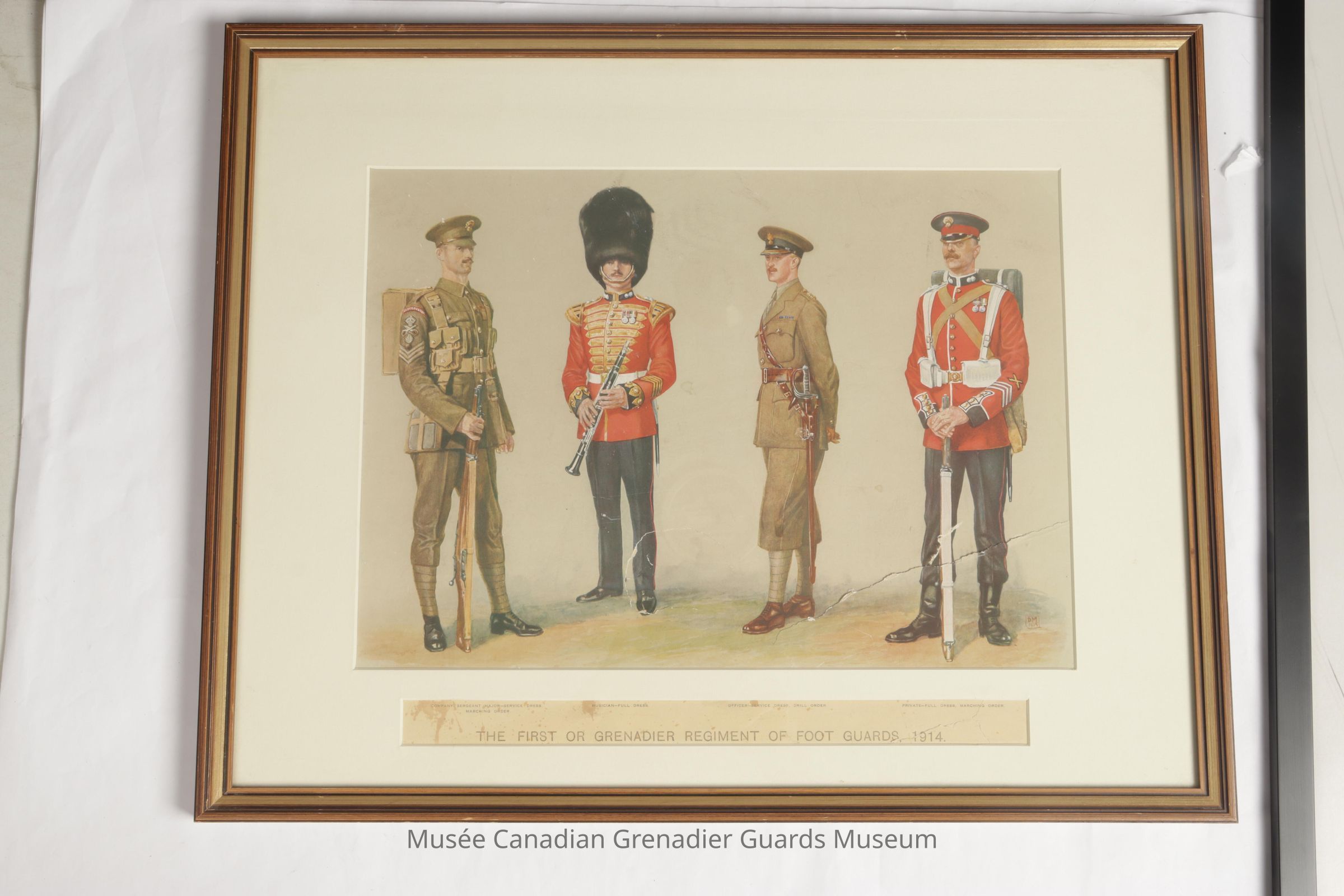
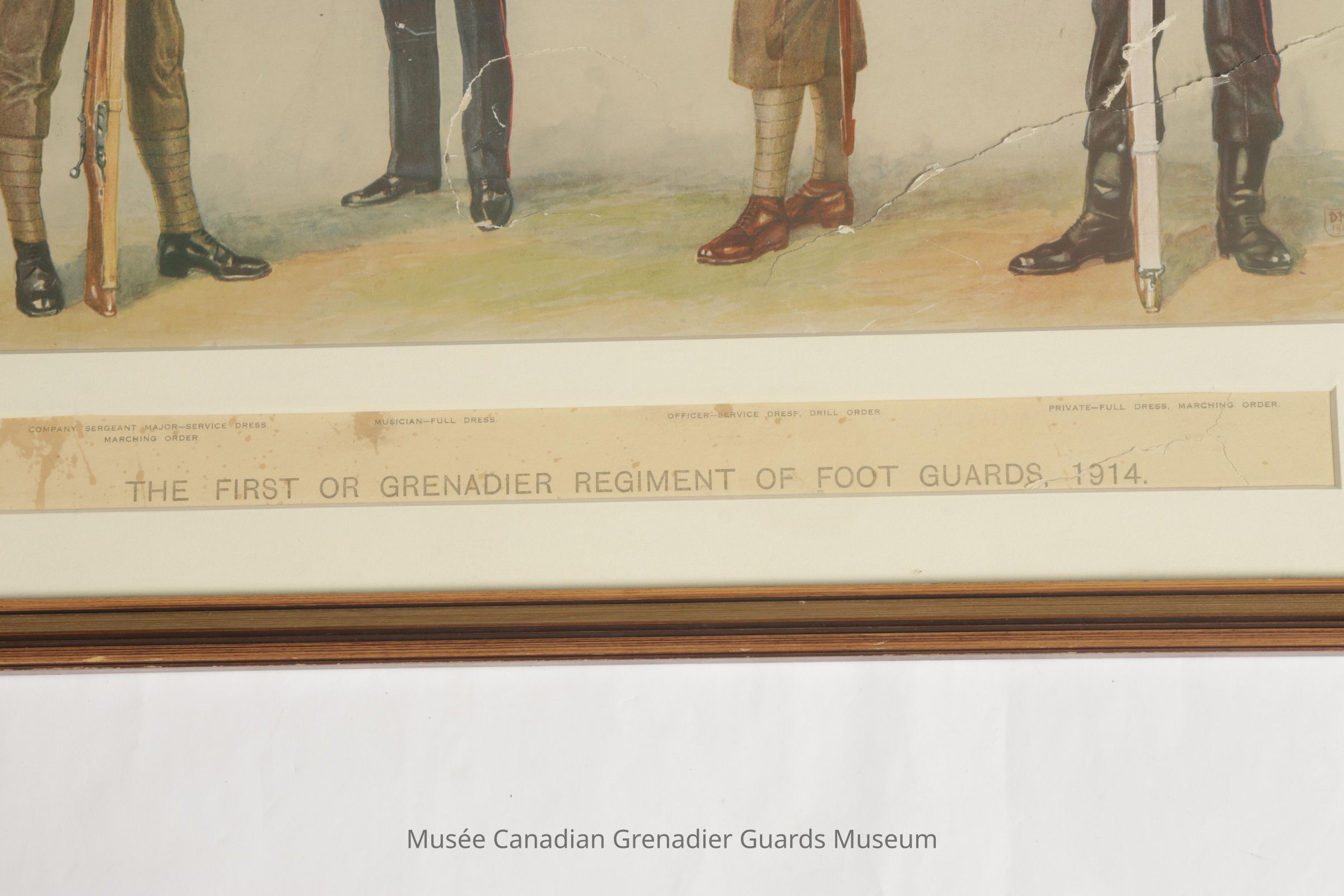
1914 - A colour lithograph print by D. MacPherson (British) of the WW1 era uniforms (Service Dress, Full Dress, and Marching Order) of The First or Grenadier Regiment of Foot Guards (UK)Description
An original Lithograph colour print by British artist D. MacPherson, who made a series of coloured prints in 1914 and 1925 to show the various forms of dress of the Grenadier Guards.
Colour Sergeant / Company Sergeant Major - Khaki Service Dress (1914)
Khaki service dress was introduced c1903 and shoulder titles were sewn on to the top of the sleeve to show the difference between the (at the time) four Guards regiments. The badges on the NCO's sleeve indicate his rank of Colour Sergeant. The crossed swords badge would normally be for a fencing instructor but in the Guards they were the khaki equivalent of the dress badge that had crossed swords below the State Colour. Colour Sergeants filled the appointments of company sergeant-majors and company quartermaster-sergeant. The web equipment supports the water-bottle and haversack so that there was no need for the cross straps. These two items would be detached in drill order.
Bandsman (Private) - Full Dress
a Bandsman clarinetist in the Grenadiers Band by D Macpherson is extremely useful in that it provides confirmation of the colours that cannot be seen in contemporary black and white photos from the era. The scarlet tunic has dark blue collar and cuffs as we would expect, and the shoulder wings have gold lace on blue cloth. The grenade badges on the collar and shoulders are almost certainly of silver wire embroidery. And we can see that there are four buttons, and gold, pointed button loops on each cuff. The short sword on the back of his waistbelt is only seen in profile, with the hilt hidden, and it is probably the same as the sword carried in the Corps of Drums except that the bottom of the scabbard is of white metal instead of brass. He is a man of long service as can be seen from the four gold-laced long service stripes on his left forearm.
Officer - Khaki 'Smart' Service Dress (1914)
The officer has the smart khaki cap with black cap-band and gold embroidered badge and peak. For active service a more practical all khaki cap was worn. The tunic was buttoned as for line regiments while the other Guards regiments grouped the buttons like the dress tunic. The badges of rank were worn on the shoulder, not on the cuff. The trousers were worn like knicker-bockers, with puttees, but within the year had been replaced by more elegant jodhpurs, either with puttees or riding boots.
Guardsman (Private) - Full Dress Marching Order
This figure shows full dress, marching order but instead of the bearskin he has the peaked forage cap which had been recently adopted following the less popular peakless cap. The cap worn here proved so popular that it lasted more than 100 years and is still in use today. His rank of private did not change to Guardsman until after WW1. He is a veteran with three good-conduct, long service stripes on his left fore-arm. These are slimmer than rank chevrons which would only be worn on the upper right arm. He has medals for the Boer War so the stripes could each represent 5 years service. His Slade Wallace equipment is supplemented by webbing straps to hold a webbing haversack and a water-bottle.Created By
Bertille L. HurelCreate Date
August 18, 2022Updated By
Lieutenant Michael Hayes-Rivet, retired.Update Date
October 26, 2024