Name/Title
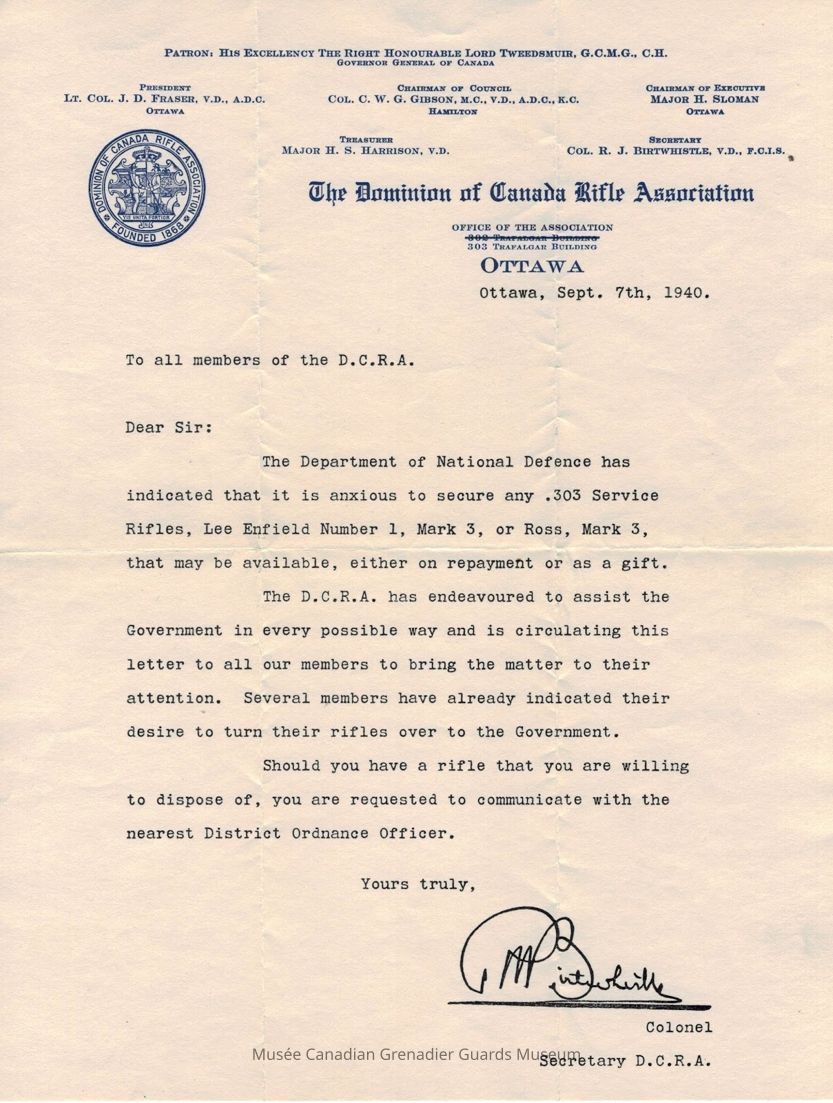
1940 - September 7th - A rare and original letter to 'all DCRA members' including D534042 WOII (CSM) Matthew Penman, EM asking on behalf of the Canadian Ministry of Defence for any .303 Lee Enfield or Ross RiflesScope and Content
For Museum records only - Part of the Lieutenant Michael A. Hayes-Rivet (MHR) Trust Collection
*** ARTIFACT ON LOAN TO CGG MUSEUM ***
1940 - September 7th - A rare and original letter to 'all DCRA members' including D534042 WOII (CSM) Matthew Penman, EM asking on behalf of the Canadian Ministry of Defence for any .303 Lee Enfield or Ross Rifles to be sent to the government as either a gift or as repayment due to rifle shortages at the start of WWII. Signed by Colonel Richard James Birtwhistle, VD, FCIS (1879-1953)
PROJECT 44' - WAR PRODUCTION IN CANADA
To organize Canadian war production, Parliament created the War Supply Board in September 1939. It was restricted on purpose with the concept of limited liability, the name later given to the Canadian government policy of limiting Canadian involvement in combat, still controlling Canadian conduct in the war. Weapons and equipment were slow in coming. On the 9th of April 1940, coincidentally the day the Germans invaded Denmark and Norway, the Department of Munitions and Supply replaced the War Supply Board. The new department essentially controlled, directly or indirectly, all matters of war supply in Canada. It also coordinated all purchases made by British and other Allied governments in Canada. Shortly after this change, the German conquest of France and the Low Countries created further pressure to increase Canadian war production. C.D. Howe, during memorial service for General James Wolfe, 1 January 1941. The Department of Munitions and Supply was headed by C.D. Howe, an American trained engineer, former business owner, and Member of Parliament. Due to this position, along with other appointments he held, Howe became known as the “the minister of everything.” On the 7th of August 1940, Howe was given the power to incorporate companies and to delegate to them any of his own legal powers and duties. Twenty Crown companies were created and worked under the department. The creation of these corporations avoided a large government bureaucracy, giving the Canadian war production much needed flexibility. The companies performed task such as manufacturing, purchasing and distributing materials, and supply regulation.
ABOUT THE CGG SOLDIER
CSM Mathew Penman, born in Dunston, England, immigrated to Canada in 1913 and joined the 1st Regiment Canadian Grenadier Guards (CGG). During World War I, he was among the 387 CGG members who volunteered to serve in the 14th Battalion (Royal Montréal Regiment) of the Canadian Expeditionary Force (CEF). Rising to the rank of Corporal, he was wounded in 1916 and later transferred to Canadian Division Headquarters, where he served as an Armourer-Sergeant, specializing in the repair of CEF bicycles. Upon his return to Canada in 1919, Penman was awarded the CEF Class A War Badge #399036 and rejoined CGG. He went on to become a highly successful competitive shooter from 1923-1963, earning the title of Québec Rifle Association Champion for eight consecutive years, from 1930 to 1938. Additionally, he won the prestigious CGG Pepler Challenge Cup twice. CSM Penman retired from active military service in 1958 as a Company Sergeant Major (CSM) but remained deeply involved with the CGG Veterans Association. Tragically, Mathew Penman passed away in 1974 while playing billiards in the CGG Sergeants Mess. His legacy as a dedicated soldier, skilled marksman, and committed veteran lives on in CGGs SGT’s Mess to this day.Created By
Lieutenant Michael Hayes-Rivet, retired.Create Date
June 27, 2026Updated By
Lieutenant Michael Hayes-Rivet, retired.Update Date
June 27, 2026