Name/Title
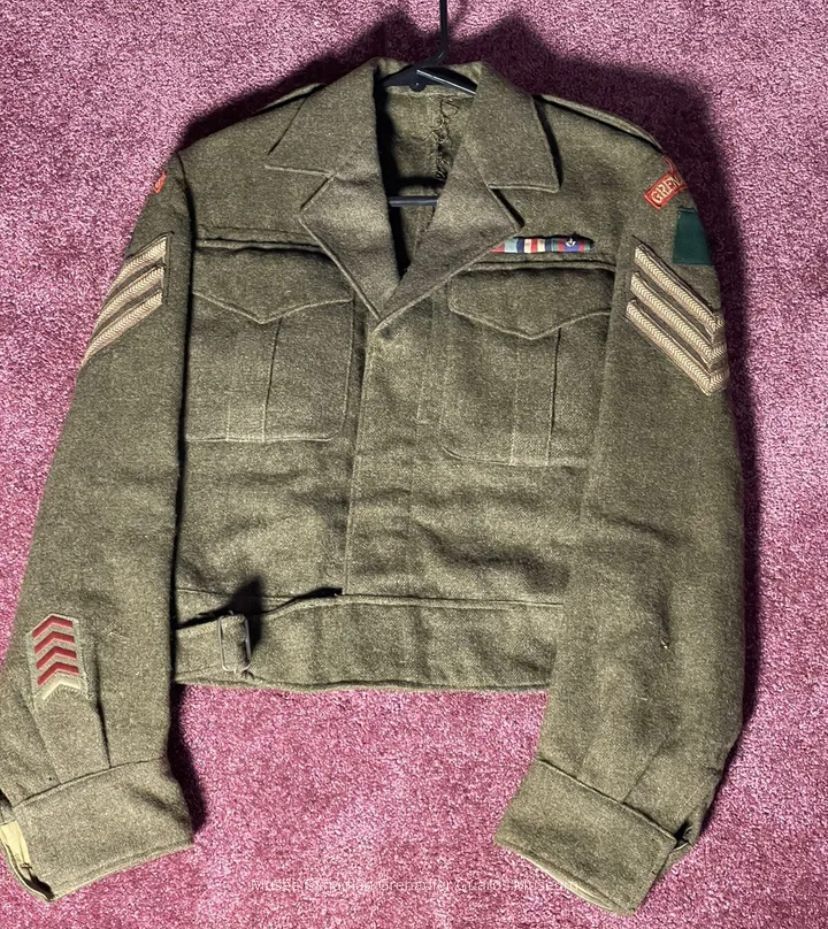
1944 - WW2 - Named 22nd CAR Battle Dress to D62708 Sergeant Thomas Robinson, MID - 4-button open collar - Manufactured by S&G Clothing Co. Ltd. of MontrealDescription
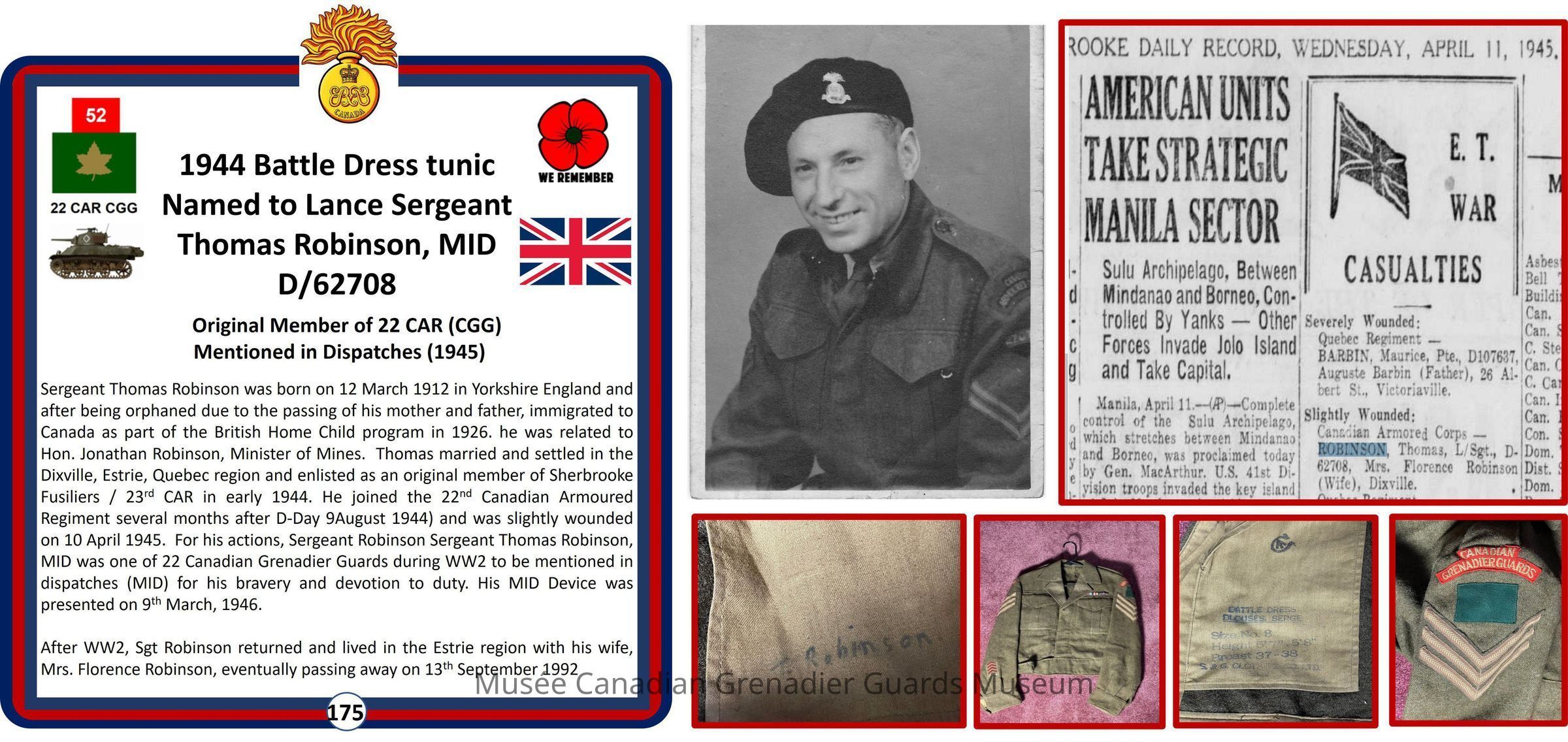
1299 - A rare named example of an open collar 4-button CGG 22nd Canadian Armoured Regiment 4th Canadian Armoured Division 'return from war' 1944 Battle Dress, Blouse Serge, Size 8, Height 5' 8", Breast 37-38, C->Arrow mark, Named to Sgt Thomas Robinson, MID on inside lower left pocket.
ABOUT THE RECIPIENT / SOLDIER:
Lance Sergeant Thomas Robinson (MID)
Sergeant Thomas Robinson was born on 12 March 1912 in Yorkshire England and after being orphaned due to the passing of his mother and father, immigrated to Canada as part of the British Home Child program in 1926. he was related to Hon. Jonathan Robinson, Minister of Mines. Thomas married and settled in the Dixville, Estrie, Quebec region and enlisted as an original member of 1st Battalion Canadian Grenadier Guards in early 1944.
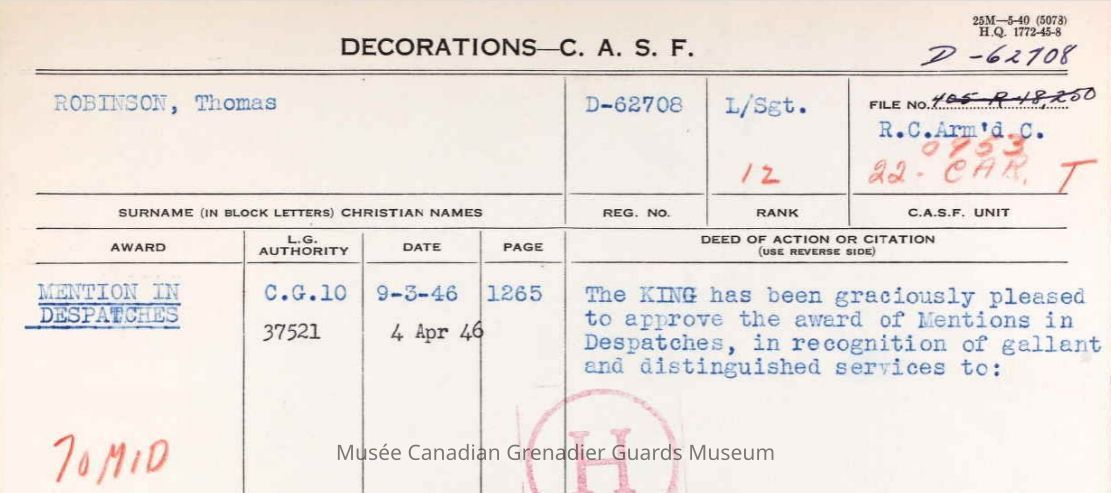
He joined The Sherbrooke Fusiliers at the beginning of the war and in August 1944 joined Canadian Grenadier Guards - 22nd Canadian Armoured Regiment - several months after D-Day and was slightly wounded on 10 April 1945. For his actions, Sergeant Robinson Sergeant Thomas Robinson, MID was awarded his MID on one 10 April 1945, and 1 of 22 Canadian Grenadier Guards during WW2 to be mentioned in dispatches (MID) for his bravery and devotion to duty. His MID Device was presented on 9th March 1946. He is buried in Crooker Cemetery in Dixville Quebec.
After WW2, Sgt Robinson returned and lived in the Estrie region with his wife, Mrs. Florence Robinson, eventually passing away on 13th September 1992
ABOUT THE BATTLE DRESS and S&G Clothing, Co. Ltd of Montreal:
Battle Dress Blouse
By September 1939, Canada had been in the process of approving the new British Battle Dress uniform for wear by Canadians. The blouse was a departure from the uniforms worn by most of the world's armies; cut short at the waist, the garment was designed with practicality in mind. By 1941, Battle Dress had been issued to the entire overseas army, and it was to be the uniform of the army in Canada as well, except when replaced by summer summer dress. Battle Dress, in its final (1949) form, would be a standard garment of issue until the 1970s.
S&G Clothing / Montreal Wartime
During the Second World War, Canadian industries manufactured war materials and other supplies for Canada, the United States, Britain, and other Allied countries. The total value of Canadian war production was almost $10 billion - approximately $100 billion in today's dollars.
In 1940, the Honourable C.D. Howe became the Minister of the newly created Department of Munitions and Supply. This government department controlled and coordinated all aspects of war production.
This department was, in a sense, one of the biggest businesses in the world. It coordinated all purchases made in Canada by British and other Allied governments for things like military transport vehicles, tanks, cargo and military ships, aircraft, guns and small arms, ammunition as well as uniforms, minesweeping equipment, parachutes, firefighting equipment, and hospital supplies. It also created 28 Crown corporations to produce everything from rifles to synthetic rubber. Out of Canada's population of 11.3 million, the total number of workers engaged in essential war industries was 1,049,876, with approximately 2,100,000 more engaged full-time in what was called "essential civilian employment", which included War supplies, Mining, Transportation, agriculture, communications, and food processing. To ensure that wages remained under control and to curb inflation, the government established the National Selective Service Regulations, prohibiting employers from advertising for workers except through National Selective Service offices. As well, employees were prohibited from seeking other employment without a permit.Created By
Lieutenant Michael Hayes-Rivet, retired.Create Date
September 26, 2023Updated By
Lieutenant Michael Hayes-Rivet, retired.Update Date
September 5, 2026