Name/Title
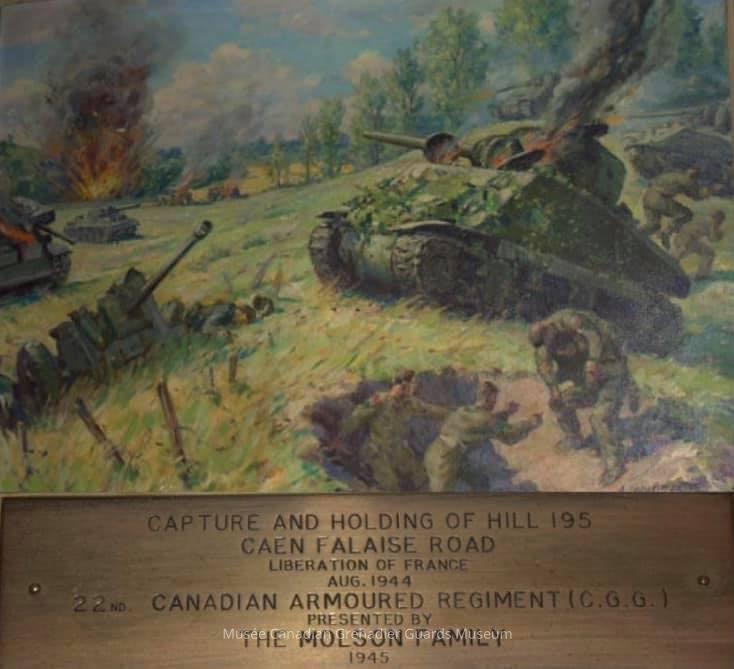
1945 "Capture and Holding of Hill 195" by 22nd Canadian Armoured Regiment, CGG presented by The Moson Family Trust and painted by Adam Sherriff Scott 1945Description
The Capture and Holding of Hill 195 by 22nd Canadian Armoured Regiment, (CGG)
Showing Lt. Donald Ross carrying Cpl. Bob Osborne, and Gdsm Kenneth Brisbois with another unnamed CGG Member (and ‘Giraffe’ The Sherman M1A1 in the foreground)Context
The original Art work was donated to the Regiment by the Molson Family and is displayed by the Museum in the Officers Mess.
The names behind the famous Art work painted by Adam Sherrif Scott, “The Capture and Holding of Hill 195”, of the Canadian Grenadier Guards 22nd Cdn Armoured Regiment’s Battle for Hill 195 on 10 August, 1944.
Lt. Donald Ross, Cpl. Bob Osborne, Gdsm. Kenneth Brisbois (and ‘Giraffe’ The Sherman M1A1)
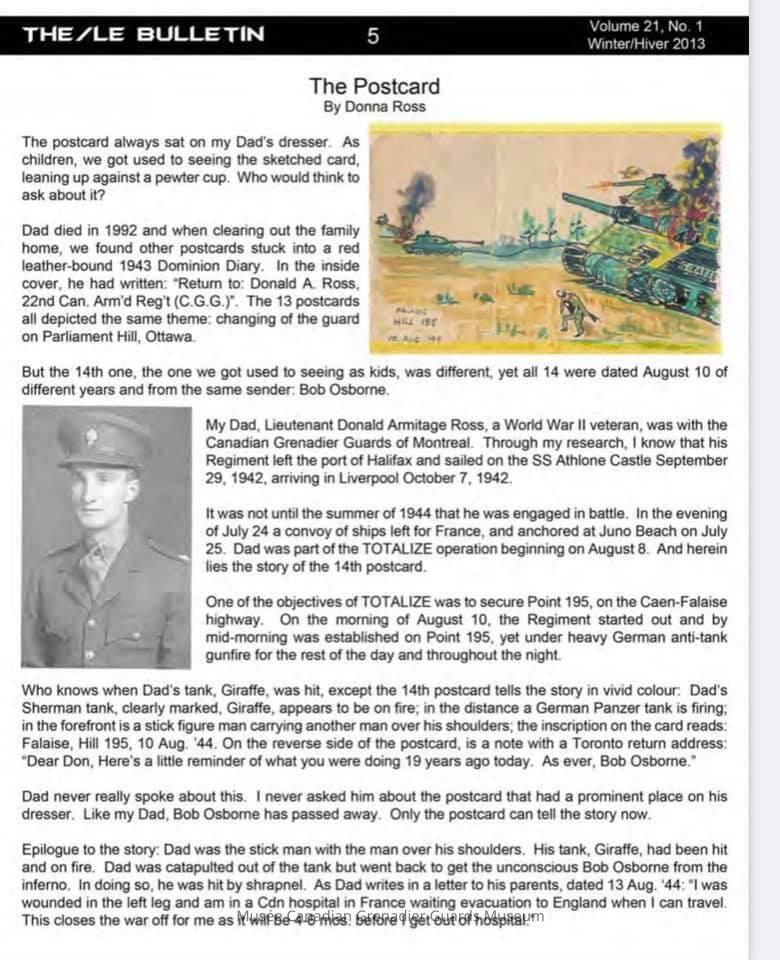
If you have ever been in the Officer’s Mess at Home Station, you will have seen our famous War Artist painting, with distinguishing heroes rescuing a crew member from a brewed tank. Taken from the personal account and hand drawn postcard sketch by Corporal Bob Osborne, He is the soldier (bottom right) being carried on the back of Lt. Donald Ross. In the battle trench, with outstretched arms is Gdsm Ken Brisbois... (as confirmed by their written records and children - Ken Brisbois Jr. & Ms. Donna Ross.)
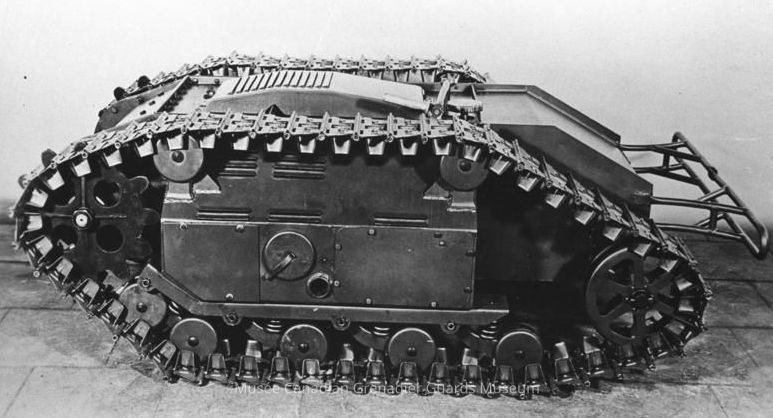
One of the unique features of this battle was the Regiment's first encounter with German "Goliath" guided robot tanks. "The Goliath tracked mine (German: Leichter Ladungsträger Goliath, "Goliath Light Charge Carrier") was a series of two unmanned ground vehicles used by the German Army as disposable demolition vehicles during World War II. These were the electrically powered Sd.Kfz. 302 and the petrol-engine powered Sd.Kfz. 303a and 303b. They were also known as "beetle tanks" by the Allies.
They carried 60 or 100 kg (130 or 220 lb) of high explosives, depending on the model, and were intended to be used for multiple purposes, such as destroying tanks, disrupting dense infantry formations, and the demolition of buildings or bridges. Goliaths were single-use vehicles that were destroyed by the detonation of their warhead."
It is not recorded how many of the Regiment's tanks were damaged by "Goliaths".Created By
Lieutenant Michael Hayes-Rivet, retired.Create Date
December 24, 2021Updated By
R. John Dolbec C/Sgt. (ret.)Update Date
March 7, 2026